








The Elsys ERS CO2 answers the question you cannot tell by looking at a room: how stale is the air? It measures the CO2 concentration and additionally temperature, humidity, light level and motion – and sends it all over LoRaWAN, without cable and without a power socket. CO2 here is more than a comfort figure: it is the best available indicator of how much exhaled air is standing in the room and when it needs ventilating. In classrooms, meeting rooms and open-plan offices it is the figure that ends discussions. Elsys builds in Sweden, the device is LoRa Alliance certified and qualified for the Swisscom network.
- 0 … 10,000 ppmCO2 measuring range
- ±50 ppm ±3 %accuracy
- 5 readingsCO2, temperature, humidity, light, motion
- NFCsetup by smartphone
What the ERS CO2 does
- CO2 as a measure of air quality: outdoors the figure sits at around 400 ppm. From about 1000 ppm the ability to concentrate measurably declines, from 1400 ppm it becomes clearly noticeable. The sensor makes that progression visible – and so makes the question “does this room need airing?” answerable.
- Five quantities in one housing: besides CO2 also temperature, humidity, light level and motion. Only the combination explains what is happening: a CO2 rise in an empty room points to a problem, in a full meeting room it is simply normal operation.
- Setup over NFC: hold the smartphone against the housing, set intervals and keys, done – for a school with thirty rooms that is the difference between one morning and two days of work.
- Thresholds trigger immediate reports: instead of transmitting rigidly every fifteen minutes, the sensor can report at once when a limit is crossed. That saves battery and still delivers the report when it counts.
- Unobtrusive housing: flat, smooth and white – in classrooms and offices it is not perceived as surveillance equipment, which is decisive for acceptance.
- Certified for Swiss operation: LoRa Alliance Certified and Swisscom IoT Qualified.
Where it is needed
- Schools and kindergartens: ventilating by measurement instead of by feel. A simple traffic light in the classroom demonstrably changes behaviour more than any instruction.
- Meeting rooms and open-plan offices: where many people sit for a long time, CO2 rises quickly – the measurement shows whether the ventilation is a match for the occupancy.
- Demand-led ventilation control: plants run by measurement instead of by timetable. That noticeably lowers energy consumption, because ventilation is no longer blanket.
- Evidence for building owners and operators: documented measurement series prove that the ventilation actually performs in service as planned.
- Hospitality, fitness, practices: rooms with changing, sometimes high occupancy, where air quality is part of the quality of stay.
- Networks across properties: one sensor type across many buildings, evaluated centrally – that is what LoRaWAN is built for.
That settles the selection. What follows is the depth for planning and operation.
Measuring CO2 properly – what matters
The mounting position decides how meaningful the figure is. CO2 does distribute well through a room, but not instantly. Right beside the door, in the draught of a ventilation outlet or immediately behind a seated person you get values that do not stand for the room: exhaled air reaches the sensor there unmixed and drives the reading up. The inner wall at about one and a half to two metres height, with some distance from window, door and ventilation, has proven itself.
Self-calibration is a blessing and a pitfall at once. It keeps the sensor accurate for years without anyone turning up with calibration gas – provided the room sees fresh air regularly. If a room is never properly ventilated for weeks, the sensor eventually takes the raised permanent level as its zero point and shows values that are too low. Yet it is exactly in such rooms that the measurement matters most. Anyone wanting to rule that out calibrates by hand or deliberately plans ventilation windows.
And the accuracy in figures: the deviation is made up of a fixed part and a part proportional to the reading. At 1000 ppm it is therefore around 80 ppm – more than enough for ventilation decisions. The noise of a few ppm is visible in raw data; anyone wanting a calm curve for a dashboard smooths over several measurements.
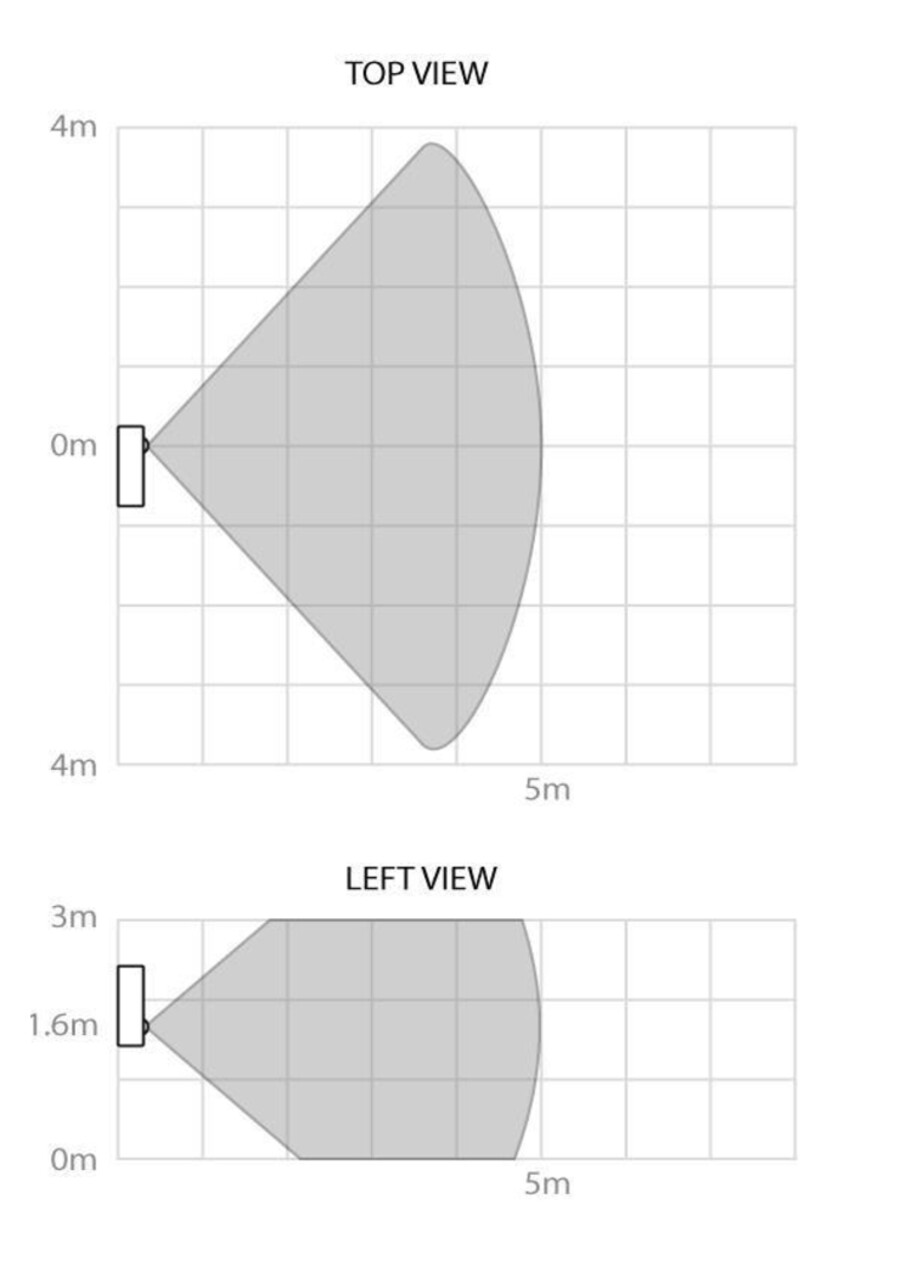
Detection area of the supplied motion detector: around five metres of range at a good four metres of width, angled downwards in the side view. It answers the question “is the room occupied?” – and so supplies the explanation for the CO2 curve along with it.
Planning battery life realistically
A CO2 sensor needs considerably more energy per measurement than a plain climate sensor – the measuring cell has to become active briefly for it. Battery life therefore depends more strongly on the measuring interval than with the ERS2. For ventilation control one measurement every ten to fifteen minutes is usually enough; measuring every minute shortens the service life considerably without gaining much technically – the air in a real room does not change that fast. On top of that comes link quality: with weak reception every transmission takes longer and costs more. A gateway in the same building is therefore also an investment in battery life.
Technical data
The general product data – protection rating, batteries, dimensions, housing, origin, certifications – is in the detail table further down this page.
| Readings | |
|---|---|
| CO2 | 0 … 10,000 ppm, accuracy ±50 ppm ±3 % of the reading |
| CO2 noise | around 14 ppm at 400 ppm, around 25 ppm at 1000 ppm |
| CO2 calibration | automatic via the lowest value of the last 8 days or so; manual calibration possible |
| Temperature | resolution 0.1 °C |
| Humidity | resolution 0.1 % RH |
| Light level | 4 … 2000 lux, resolution 1 lux, accuracy around ±10 lux |
| Motion | passive infrared, around 30 s blocking time after triggering and after each transmission |
| Operation | |
| Sampling and transmit interval | independently adjustable, plus thresholds for immediate reports |
| Configuration | NFC via Android app, alternatively by downlink from the network |
| Radio | |
| Radio technology | LoRaWAN, Semtech stack |
| Channel plans | EU863-870 for Switzerland; further regions supported from the factory |
Help with planning
The datasheet and instructions are under the Documents tab at the top of this page. Are you equipping a school or an office building and unsure about sensor density, mounting positions or the link to the ventilation control? Talk to us – we will help you bring the number of devices down to a sensible level. And if it turns into a project — sizing, pre-configuration or commissioning — we will gladly put together a quote.
Recensioni
Ancora non ci sono recensioni.