




The Elsys ERS2 measures what a room feels like – temperature, humidity, light level and whether anyone is moving in it – and transmits the values to your system over LoRaWAN. No cable, no socket, no holes in the wall: the flat white housing is screwed or stuck on and then runs for up to ten years on two batteries, depending on the transmit interval. It is set up via NFC with a smartphone, not over a cable or a configuration file. Elsys builds in Sweden, the device is LoRa Alliance certified and qualified for the Swisscom network – for rollouts in Swiss properties that is the short route to approval.
- 4 measurementstemperature, humidity, light, motion
- up to 10 yearsbattery life
- 0.1 °C / 0.1 % RHresolution
- NFCsetup by smartphone
What sets the ERS2 apart in a building
- Four measurements in one device: temperature and humidity for indoor climate, light level for lighting and blinds, motion for actual use. One sensor instead of four – with a hundred rooms that decides the economics.
- Setup via NFC instead of cable: hold the smartphone to the housing, set transmit interval, data rate and keys, done. For a floor full of sensors that saves half a day compared with any other method – and every device is guaranteed the same settings.
- Unobtrusive rather than technical: a flat, smooth white housing that does not stand out as measuring equipment in an office, classroom or living space. With sensors in occupied rooms, user acceptance is a real factor.
- Freely configurable: sampling and transmit intervals can be set independently, plus thresholds that trigger an immediate report. You can therefore measure closely and still transmit sparingly – or have an exceedance reported at once.
- Certified for Swiss operation: LoRa Alliance Certified and Swisscom IoT Qualified. Anyone working on the Swisscom network is spared the question of whether the device is approved.
- Replaceable batteries: two standard lithium cells in AA format, exchangeable by the operator – no return shipping, no special tools.
What it is used for
- Indoor climate in offices and schools: documenting temperature and humidity instead of arguing about perceived draughts. The measurement series is the basis of any optimisation.
- Occupancy analysis: which meeting rooms are really used, which stand empty? The motion detector gives the answer without identifying individuals.
- Heating and ventilation optimisation: actual values from the room instead of assumptions from the plant room – it often turns out that individual zones are permanently overheated.
- Blinds and lighting: the light level controls blinds and lights according to actual need rather than a timetable.
- Heritage buildings and archives: temperature and humidity monitoring in rooms where no cable may be laid.
- Facility management across several properties: one network of identical sensors across several buildings, evaluated centrally – the strength of LoRaWAN over WiFi solutions.
- Larger rollouts: because configuration and mounting are quick and the devices are identical, the effort per room stays the same even at a hundred rooms.
That settles the selection. What follows is the depth for planning and operation.
What the individual measurements are worth
Temperature and humidity are captured with a resolution of 0.1 degrees and 0.1 per cent respectively. Important for mounting: the sensor measures where it hangs. Above a radiator, in direct sun or next to the door you do get correct readings, but not those of the room. An interior wall at about one and a half metres, away from air outlets, has proven itself.
The light sensor covers the range that matters indoors – from dusk to bright task lighting, with an accuracy of about ten lux. For controlling light and blinds that is ample. In direct sunlight it runs into its limit; anyone wanting to measure actual irradiance needs a radiation sensor for that.
The motion detector works passively via infrared and has a lockout of around 30 seconds after every trigger and after every transmission – this prevents self-triggering from internal device activity. For you that means: the sensor reliably answers the question “was anyone here?”, but it is not a people counter. Anyone wanting to know how many people enter a room needs a different measuring principle.
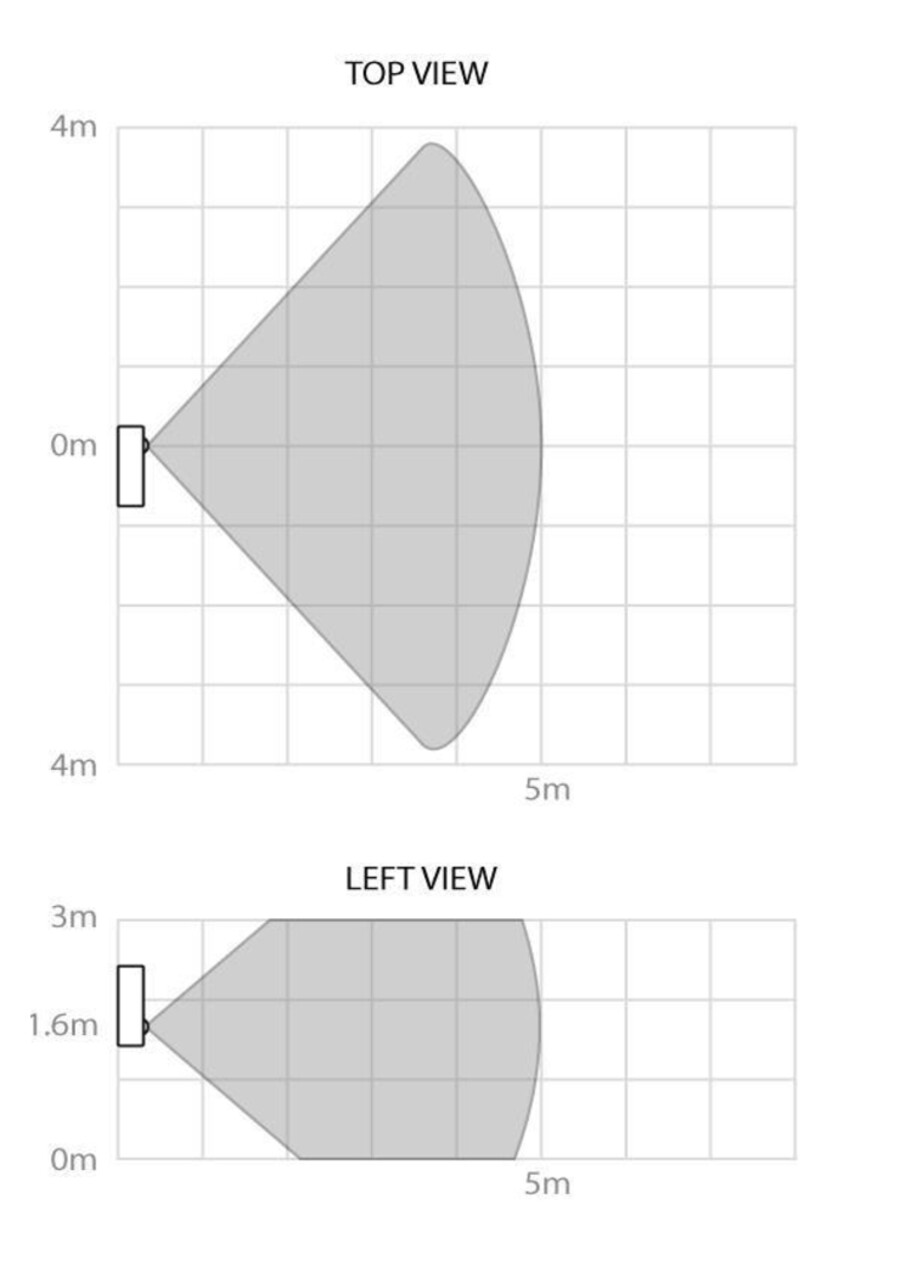
Detection area of the motion sensor: seen from above, a cone of around five metres range and a good four metres wide; in side view angled downwards. For mounting that means: at about one and a half to two metres on the wall, one sensor covers a normal office or classroom; for long rooms or around corners a second one is needed.
Planning battery life properly
The ten years quoted are a best case, not a guarantee. Four factors determine the actual life: how often it measures, how often it transmits, how good the radio link is – with weak reception the network raises the spreading factor and the transmission takes longer – and how warm or cold the location is. A sensor that transmits hourly and has a gateway in the same building realistically reaches the manufacturer’s figure. One that transmits every five minutes at the edge of coverage reaches a fraction of it. Plan therefore with the interval you genuinely need – for indoor climate one measurement per quarter hour is usually enough.
Technical data
The general product data – protection rating, batteries, dimensions, housing, origin, certifications – is in the detail table further down this page.
| Measured values | |
|---|---|
| Temperature | resolution 0.1 °C |
| Humidity | resolution 0.1 % RH |
| Light level | 4 … 2000 lux, resolution 1 lux, accuracy around ±10 lux |
| Motion | passive infrared, around 30 s lockout after trigger and after every transmission |
| Operation | |
| Sampling and transmit interval | independently adjustable, plus thresholds for immediate reports |
| Configuration | NFC via Android app, alternatively by downlink from the network |
| Battery life | up to 10 years, depending on interval, data rate and environment |
| Radio | |
| Radio technology | LoRaWAN, Semtech stack |
| Channel plans | EU863-870 for Switzerland; further regions supported ex works |
Help with planning
The datasheet and instructions are under the Documents tab at the top of this page. Planning an installation across several rooms or properties and unsure about gateway coverage, transmit interval or connecting to your building management system? Talk to us before ordering – especially on the interval a short conversation pays off, because it feeds straight through to battery life. For sizing, pre-configuration and commissioning we will gladly put together a quote.

Reviews
There are no reviews yet.