
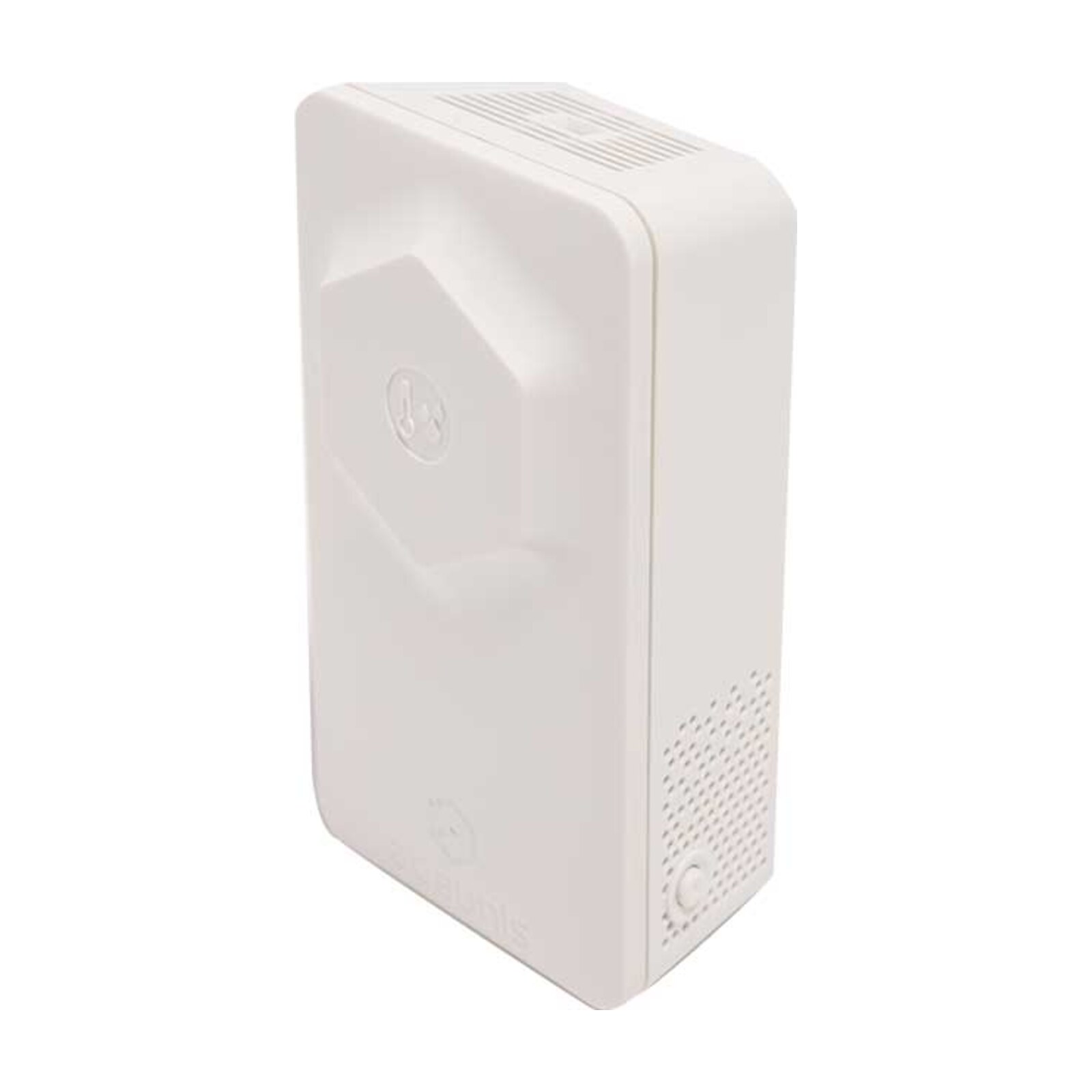
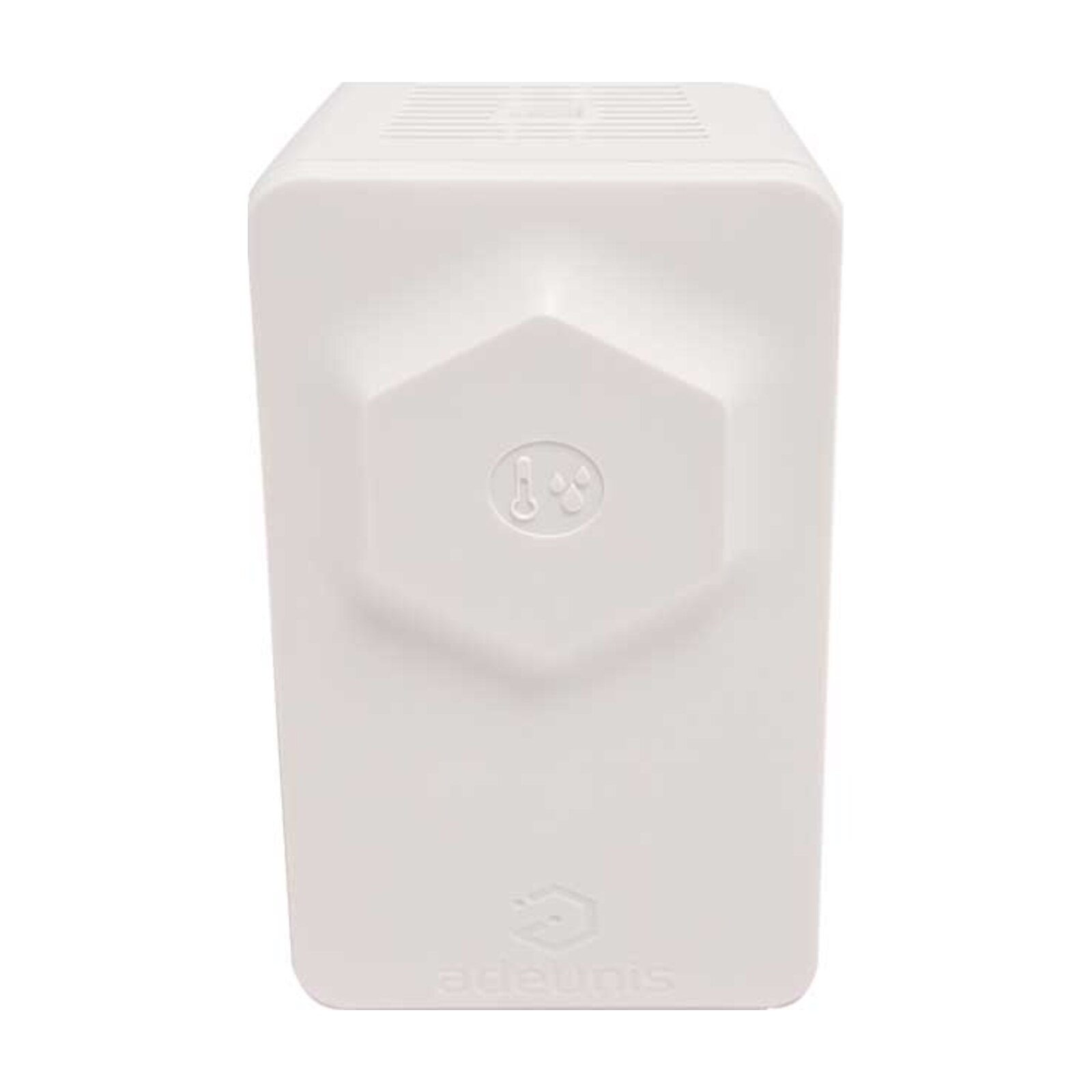
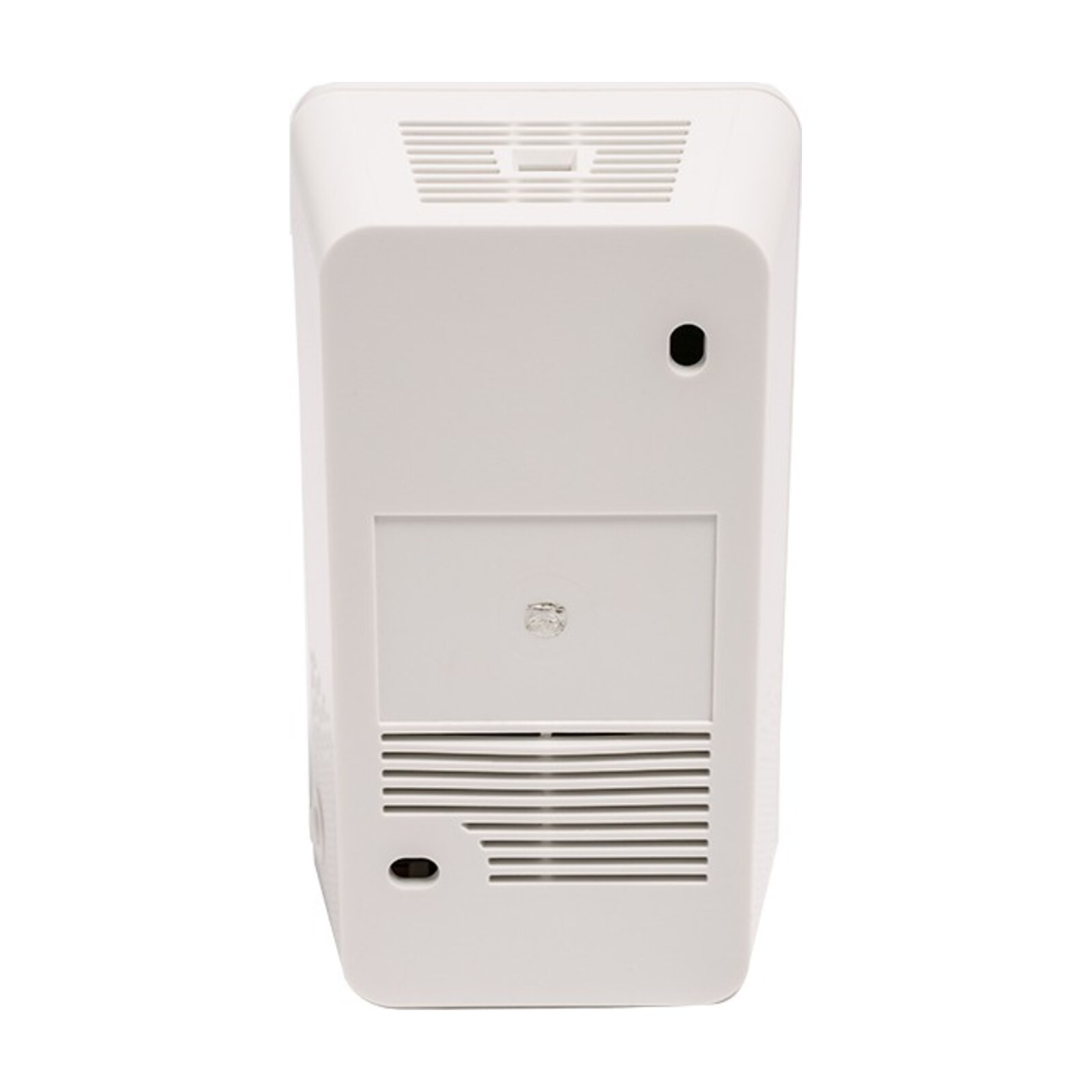


The Adeunis Comfort NB-IoT / LTE-M measures room temperature and humidity and sends its readings over the mobile network, with no gateway, no Wi-Fi and no access to the building’s IT. It needs only a SIM card and coverage. That is the reason to choose it over a LoRaWAN sensor: when devices are spread across many sites where a radio network of your own does not pay off, or when IT will not allow third-party devices onto the premises. You configure it by smartphone via NFC and integrate it through the LwM2M or MQTT standards rather than a vendor portal. How long the battery lasts depends less on the sensor than on the network operator. Further down you will see why.
- NB-IoT · LTE-Mcellular, no gateway needed
- ±0.2 °C · ±2 % RHtypical accuracy
- up to 15 yearsbattery with hourly reports
- 145 valuesbuffer per measured variable
What sets the Comfort NB-IoT / LTE-M apart
- No radio network of your own: The sensor registers directly with a mobile operator. There is no gateway that needs power and a network connection and can fail, and no coordination with the building’s IT.
- Two technologies in one device: The sensor supports NB-IoT and LTE-M. With a multi-operator SIM it picks the best operator and technology itself at start-up. If needed, you can fix both.
- A standard instead of a vendor portal: LwM2M is an open device-management standard. The readings sit in the standard IPSO objects for temperature (3303) and humidity (3304), and any LwM2M platform understands them without a dedicated decoder. If you prefer MQTT, the sensor can run that way too.
- Measuring and sending are separate: The sensor measures at the set rate, stores the values in its internal memory and sends them in batches. A radio connection costs many times more than a measurement, so the battery lasts longest with few transmissions and many readings.
- Nothing gets lost: If the server cannot be reached, the sensor keeps the readings and sends them once the connection is back. Every value carries a UTC timestamp synchronised by the network.
- Alarms with hysteresis: Upper and lower thresholds for temperature and humidity, plus a reset margin. The sensor reports a breach immediately and again once the value is back in range, without chattering around the limit.
- Scheduled radio silence: Transmission can be suspended for a fixed window each day, for example at night in an office where nobody acts on the readings. This saves battery and data volume.
- Remote maintenance over the air: Configuration, commands and firmware updates for both application and cellular modem run through the LwM2M server, per device or for the whole fleet. An update of around 400 KB takes 5 to 15 minutes depending on the network.
- Replaceable battery, mains option: The dual pack is swapped after years and the device stays. Alternatively, an external 5 V supply connects to a terminal block inside the housing. If both are connected, the external supply takes priority.
- Designed and built in France: Compliant with the Radio Equipment Directive (RED), for tenders where origin matters.
Where the Comfort NB-IoT / LTE-M is used
- Distributed property portfolios: Schools, kindergartens, municipal buildings, branch offices. Each site has only a few sensors, and a gateway per building would cost more than the sensors themselves.
- Rental flats and damp damage: Document the indoor climate over months to separate building physics from ventilation habits in mould cases, without access to the tenant’s Wi-Fi.
- Heating optimisation: Compare room temperatures across several buildings with heating operation and find overheated zones. The measurement runs independently of the building services.
- Workplaces and offices: Evidence of indoor conditions, including in rented space where no network of your own may be installed.
- Archives, storage and plant rooms: Threshold alarm when it gets too warm or too humid, even in basements, as long as the mobile network reaches them.
- Temporary measurement campaigns: Mount for a few weeks, collect data, take down. With no infrastructure, the measurement runs on day one.
- Large rollouts: Hundreds of sensors spread across a country, enrolled automatically on the platform via bootstrap and reconfigured centrally via LwM2M. Configurations can be saved in the app and copied to further devices, and a site visit is needed only for the battery change.
You now have everything you need to decide. What follows is the depth for planning and integration.
NB-IoT or LTE-M: why the choice decides battery life
The two technologies are variants of the same mobile standard, but built for opposite goals. NB-IoT uses a narrow 200 kHz channel and therefore penetrates deeper into buildings, with a typical sensitivity of −113 dBm. LTE-M uses 1.4 MHz, is roughly five times faster and manages with −107 dBm. In return, it still connects quickly when the signal is mediocre.
The manufacturer’s battery table shows what follows from this, and the result is surprising. With good reception, both technologies are equivalent. With poor reception, it reverses: NB-IoT has to repeat each message many times before it gets through, and with hourly reports the battery lasts only around three years. Under the same conditions, LTE-M exceeds fifteen. A basement room where NB-IoT barely gets through is therefore not a good compromise but the most expensive location in the project. This assessment is based on the manufacturer’s figures below and is meant as a planning aid.
The second lever is the network operator. The battery figures only apply if the network allows power saving mode (PSM), in which the sensor stays registered between two transmissions but sleeps completely. If the operator does not allow it, the sensor wakes far more often. With roaming SIMs this applies to each partner network separately. The app’s diagnostics show whether PSM is granted: timer T3324 is then not −1.
Battery life by transmission interval and reception
Manufacturer figures for the 8200 mAh dual pack, calculated at 25 °C indoors on a PSM-capable network:
| Transmission | NB-IoT, good network | NB-IoT, poor network | LTE-M, good network | LTE-M, poor network |
|---|---|---|---|---|
| every 10 minutes | 13 years | under 1 year | 9 years | 1.8 years |
| every 30 minutes | over 15 years | 1.7 years | over 15 years | 9.4 years |
| hourly (factory default) | over 15 years | 3.3 years | over 15 years | over 15 years |
| every 6 hours | over 15 years | 13.8 years | over 15 years | over 15 years |
| daily | over 15 years | over 15 years | over 15 years | over 15 years |
For project planning this means: check reception at the mounting location before the sensors go up, not on the street outside. After switch-on the app shows RSRP, RSRQ and signal-to-noise ratio with a traffic-light indicator, and for whole buildings there is the Adeunis Fieldtester NB-IoT / LTE-M. For indoor climate, one transmission per hour with readings every ten minutes in the buffer is almost always enough. You see every movement of the curve and stay in the over-fifteen-years column.
Data usage: With the factory settings (hourly, Observe mode) the manufacturer estimates around 320 KB per month, in Push mode 280 KB. With the buffer it is 430 KB for six times as many readings. Management traffic such as registration, time synchronisation and firmware updates is not included. A 60 MB data plan is, on paper, enough for many years of readings. What matters then is the validity period of the SIM plan, not the volume.
Integration via LwM2M or MQTT
Out of the box the sensor speaks LwM2M 1.1 over UDP, encrypted with DTLS and pre-shared keys (PSK). Each device carries a unique factory identity. For large quantities it enrols via bootstrap: at first start the sensor fetches its keys and server address itself, with no manual entry. Supported data formats are SenML-JSON, SenML-CBOR, CBOR and TLV.
There are two operating modes. In Observe the server subscribes to the readings, and the sensor sends nothing until such an observation exists. This regularly surprises people during the first test. In Push the sensor sends on its own at the set interval, and only in this mode do threshold alarms with hysteresis, radio silence and the buffer work. These functions live in Adeunis’ own object 34450, whose description (XML) the manufacturer offers for download. For most projects Push is the right choice, and Adeunis explicitly recommends it for battery life.
If you do not run an LwM2M platform, switch the sensor to MQTT and send the readings to your own broker. There is a separate guide for this in the “Documents” tab. The server reads diagnostic values such as transmit power, reception quality, cell and operator, as well as the low-battery flag, through the standard objects 3 and 4.
Technical specifications
General product data (dimensions, weight, housing, protection rating, battery, origin, manufacturer part number) is in the details table further down this page.
| Measurement | |
|---|---|
| Sensor technology | CMOSens (temperature and humidity) |
| Temperature range | 0 … +65 °C, resolution 0.01 °C |
| Temperature accuracy | ±0.2 °C typical, ±1 °C maximum |
| Humidity range | 10 … 90 % RH, resolution 0.01 % RH |
| Humidity accuracy | ±2 % RH typical, ±4.5 % RH maximum |
| Operation | |
| Measurement and transmission interval | each adjustable from 1 minute to 7 days, factory default 60 minutes |
| Transmission modes | periodic, with or without buffer; on threshold breach; scheduled radio silence |
| Timestamp | UTC, synchronised via the network |
| Radio | |
| Standard | 3GPP LTE Release 13, NB-IoT and LTE-Cat-M1, PSM |
| NB-IoT bands | B1, B2, B3, B4, B5, B8, B12, B13, B17, B19, B20, B25, B26, B28, B66 |
| LTE-M bands | B1, B2, B3, B4, B5, B8, B12, B13, B14, B18, B19, B20, B25, B26, B28, B66 |
| Transmit power | +23 dBm |
| Sensitivity | NB-IoT −113 dBm typical, LTE-M −107 dBm typical |
| SIM | nano SIM 4FF, class C (1.8 V), no PIN |
| Protocols | LwM2M 1.1 over UDP with DTLS-PSK; MQTT(S) optional |
| Configuration | NFC with the “IoT Configurator NB-IoT / LTE-M” app (Android, iOS), protected by an 8-character key; remotely via LwM2M |
| Firmware | application and modem via FOTA |
| Power supply | |
| Battery | dual pack FANSO ER18505H-2, Li-SOCl₂, 3.6 V, 8200 mAh |
| External supply | 4.2 … 6.0 V via two-pole terminal block inside the housing; recommended adapter Mean Well GS05E-USB (not included) |
| Environment | |
| Recommended operating range | +5 … +50 °C per datasheet; per user guide 0 … +50 °C on battery, 0 … +40 °C on external supply |
| Operating altitude | up to 2000 m |
| Other | |
| Compliance | Radio Equipment Directive 2014/53/EU (RED) |
Mounting and commissioning
SIM first, then switch on. The sensor ships in standby. Only insert the SIM card in this state, because inserting or removing it while the device is running can damage it. To open, press a flat screwdriver at an angle into the opening on top, and the front comes away. The card sits under a metal flap on the board. The app’s quick-start function then starts the sensor with three inputs, or you hold the side button for more than five seconds. If network registration fails, the sensor retries twice every twelve hours by default to protect the battery. During first set-up, be patient or check the app.
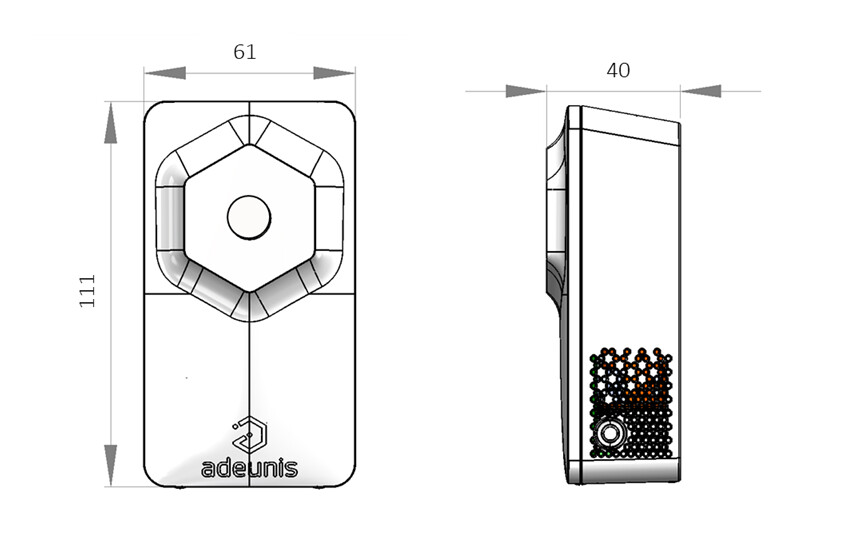
Dimensions in millimetres: 111 high, 61 wide, 40 deep.
Location: On a wall at about 1.5 m, with free air flow and at least one metre from doors and windows. Not in direct sun, not above a radiator, not in the air stream of a ventilation outlet and not lower than 30 cm above the floor. Fix with two 2.2 × 19 mm screws and SX4 plugs. Alternatively the sensor can lie flat on furniture. Keep the top clear: that is where the opening sits that releases the housing for a battery change. Screw the sensor directly under the ceiling or under a shelf and you will not get into it years later.
Running without a SIM: For a test or demonstration the sensor can start in a no-SIM mode. It then measures and shows the readings in the app but sends nothing. This lets you check the measurements before the platform is ready.
Versions
The Comfort is available with different sensors and radio technologies. We are happy to source the other versions for you.
| Model | Difference | Availability |
|---|---|---|
| Comfort NB-IoT / LTE-M (ARF8394AAA) | temperature and humidity over cellular, standard configuration without SIM | This is the version you order here |
| Comfort Serenity NB-IoT / LTE-M (ARF8394ABA) | adds CO2 and volatile organic compounds | on request |
| Comfort LoRaWAN | LoRaWAN 868 MHz, with alarm button and contact input | in the shop |
| Comfort Serenity LoRaWAN | LoRaWAN 868 MHz, with CO2 and VOC | in the shop |
Accessories and alternatives
- SIM card: The SIM Karte IoT Europa with 60 MB fits the device and covers the data needs of a room sensor.
- Check coverage first: The Adeunis Fieldtester NB-IoT / LTE-M measures coverage at every planned mounting location before you order the sensors.
- Same job, other manufacturer: The Elsys ERS Lite NB-IoT / LTE-M also measures temperature and humidity over cellular and runs on three AA cells.
- More indoor climate: The Elsys ERS CO2 NB-IoT / LTE-M also measures CO2, light and motion, if air quality and occupancy matter as well.
- With your own LoRaWAN network: The Adeunis Comfort LoRaWAN in the same housing, with alarm button and contact input.
Help with system design
Datasheet, LwM2M and MQTT user guides, installation guide and the object description for your LwM2M platform are in the “Documents” tab. Not sure whether NB-IoT or LTE-M will work at your sites, or which SIM card suits your project? Tell us where and how many sensors you plan to install, and we will tell you whether the Comfort fits. For coverage measurement, pre-configuration in volume and integration with your platform, we are happy to prepare a quote.


Recensioni
Ancora non ci sono recensioni.