
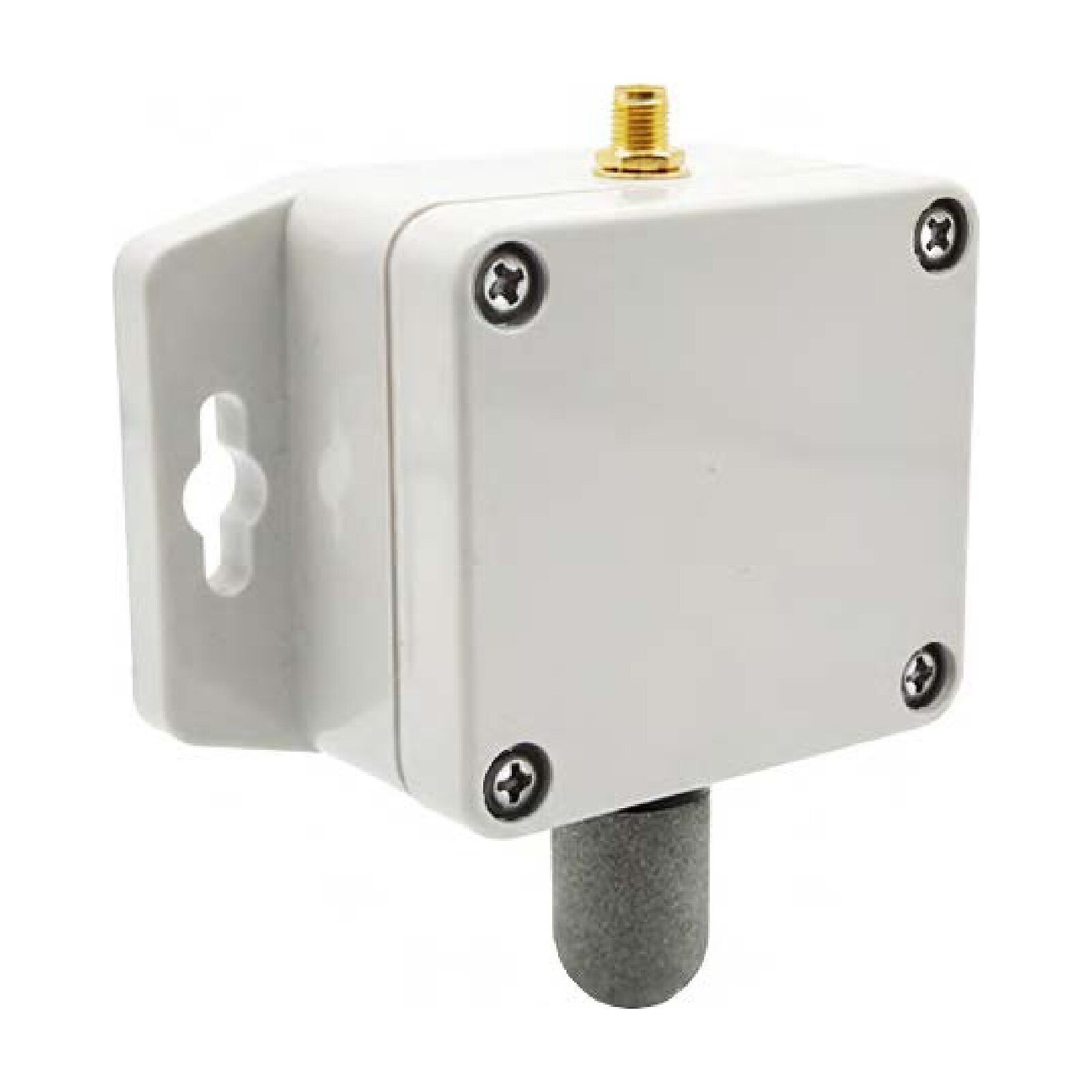

The Elsys ELT-ETH wM-Bus is a battery-powered outdoor sensor for temperature and humidity whose probe sits outside the housing in a filter cup — it therefore measures the air, not the box it is in. It does not transmit over LoRaWAN but over Wireless M-Bus: the same radio link over which water, heat and electricity meters are already being read in many properties. That is exactly its purpose. It brings climate data into an infrastructure that already exists, instead of putting a second one next to it. The telegrams follow the open OMS standard and are therefore understood by any meter-reading system already working in the building.
- external probeSHT4x in a filter cup
- up to 10 yearson a single AA lithium cell
- T1 · C1a · C1bwM-Bus modes per EN 13757
- OMS telegramopen format, no proprietary decoder
- −40 to 60 °Coperating range
What sets the ELT-ETH wM-Bus apart
- The probe sits outside, not in the box: the external SHT4x probe is held in a filter cup beneath the housing. Elsys states explicitly about the internal humidity sensor that it reacts very slowly to changes in outside humidity — inside a closed housing you are, after all, measuring the trapped air. The ETH version exists precisely for this: it is the only one in the series that delivers a usable humidity curve outdoors.
- It speaks the language of meters: the device transmits in Open Metering System format with manufacturer ID “ELY” and device type “Sensor device”. A reading system that already collects water and heat meters picks this telegram up without adaptation. No proprietary decoder, no special handling in the data platform.
- Encrypted end to end: the payload is protected with AES-CBC, and the encryption mode is stated in the telegram header. The collector in between merely passes the data on; only the head-end with the key can read it.
- Three radio modes for two ways of working: T1 transmits continuously and suits walk-by or drive-by reading, C1a and C1b are more compact and suit a fixed collector. Switching is done over NFC, without opening the housing.
- Configuration through the closed housing: the settings live on an NFC chip and are transferred with a phone; changes can be locked so that nobody on site accidentally alters anything. No opening, no gasket handled twice.
- Four measured values, each switchable: temperature, humidity, air pressure and acceleration can be enabled individually. What you do not need consumes neither airtime nor battery — in a device meant to last ten years, that is no small matter.
- The accelerometer is your tamper detector: it reports orientation in X, Y and Z plus a motion counter. If a device is taken off the wall or twisted, that is in the data before anyone has been on site.
- Two multi-purpose inputs on the terminal block: a pulse, a switch contact or an analogue signal can be connected as well. In the telegram the external value carries its own marker — it therefore stays distinguishable from the internal reading and does not land in the same column.
- Battery voltage travels in every telegram: it is a fixed part of the header, not an add-on. You see the decline coming and plan the change, instead of discovering it.
- A fault is reported, not concealed: if a probe fails, the device marks that record as faulty in the telegram and sets the value to zero. A torn-off probe therefore does not quietly report 0 °C but an identifiable error — that difference decides whether an evaluation is correct.
- Development and manufacture in Sweden: device and firmware come from Sweden, the housing from Sweden, Latvia and Lithuania. For procurement requiring proof of origin, that is the figure being asked for.
Where it is used
- Properties with existing radio meter reading: where meters are already collected over wM-Bus, climate measurement joins in without a second radio network.
- Outside temperature as a control variable: one measuring point on the north façade provides the basis for the heating curve — without a cable through the wall.
- Crawl spaces, lofts and voids: places where moisture turns into building damage and nobody looks regularly.
- Stores and cold rooms: the external probe follows the room fast enough to make door openings and faults visible.
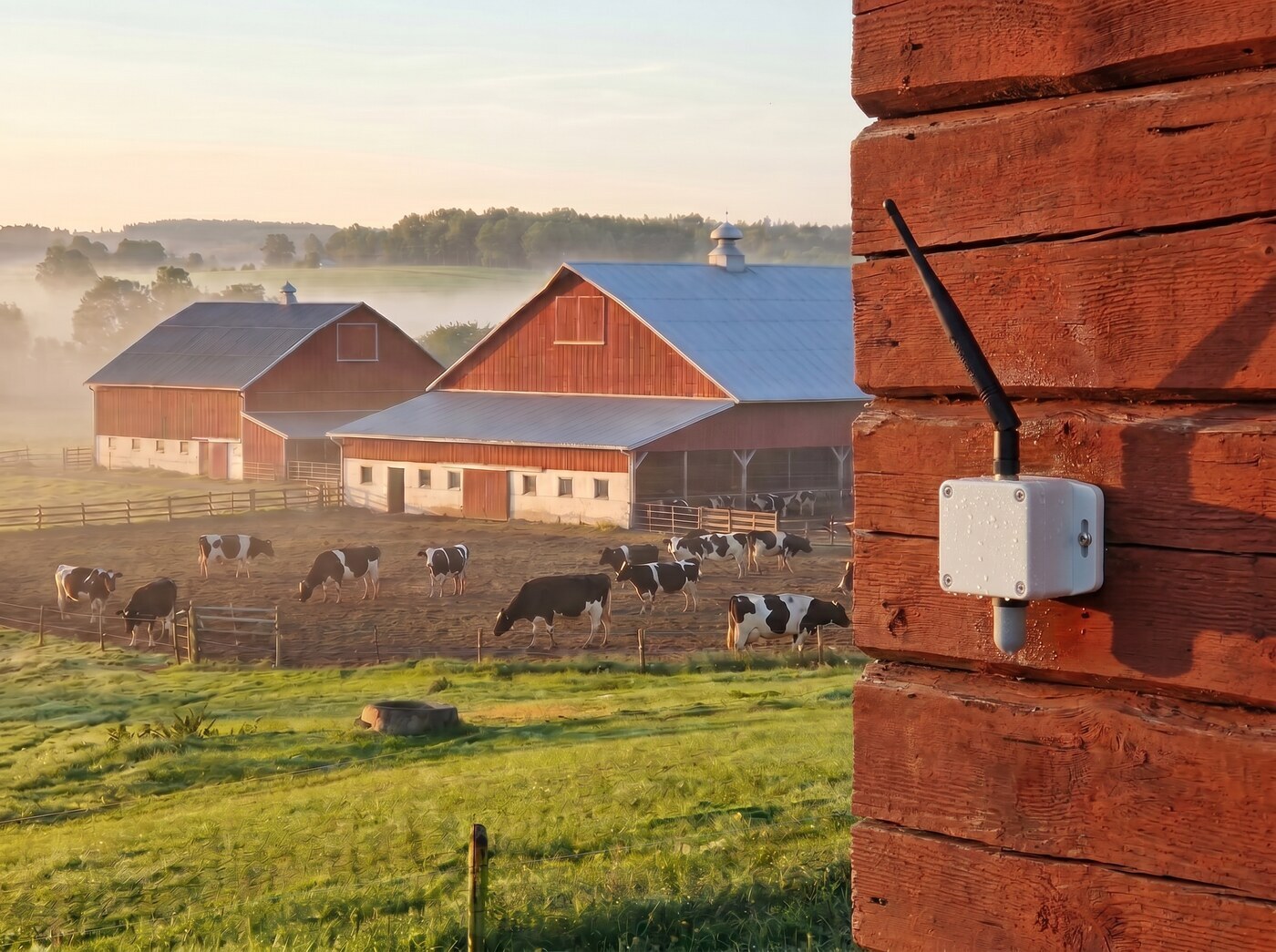
- Agricultural buildings: barn, silo and feed store — robust housing, no infrastructure needed on site.
- Walk-by and drive-by reading: in T1 mode a single pass with the reading device is enough; for scattered sites without a fixed collector, that is the cheapest route to data.
- Larger rollouts: configuration over NFC before installation, mounting with two screws, no network join per device. The effort per measuring point stays predictable even at three-figure quantities.
Two points on the protection rating. With the filter cup fitted, the assembly is IP54 and not IP67 — the cup has to breathe, otherwise it measures nothing. It therefore belongs facing downwards, so that no water stands in it. And: the battery is not included. An AA lithium cell of type ER14505 is required; an ordinary alkaline cell does not supply the necessary voltage.
About the image: the illustrations show the identically built ELT-ETH with the same filter cup and the same housing. Housing dimensions, mounting wings, antenna connector and probe are identical in both versions; the difference lies in the radio module inside and on the type label at the back.
That is the buying decision covered. What follows is the depth you need for planning and integration.
Wireless M-Bus is not a small LoRaWAN
From the outside the two methods look alike — battery-powered transmitter, 868 MHz, narrowband — and yet they behave quite differently in operation. wM-Bus per EN 13757 is one-way radio: the device sends its telegram into the room and never learns whether anyone heard it. There is no joining a network, no acknowledgement, no automatic adaptation of the data rate. That is not a shortcoming but the deliberate design of a meter-reading system: a meter that expects nothing cannot wait for an answer and burn power doing so.
Two things follow for planning. First, what counts is the range to the collector, not to a network — the collector sits in the building, in the stairwell, or in a vehicle driving past. Second, there is no return channel over which lost telegrams could be requested again; gaps are closed through transmission frequency, not through a repeat on demand. Anyone needing continuous series without a site visit plans in the fixed collector. This assessment comes from field practice and is meant as a selection aid, not as a certification statement by the manufacturer.
Filter cup or cable gland — the one trade-off
The series comes in two versions, and the difference is exactly one opening. In the basic version a cable gland with a pressure-compensating membrane sits underneath: it lets air pressure through but holds water back, and the device stays IP67. In this version the filter cup with the external probe replaces that gland — the cup is deliberately permeable so that outside air reaches the probe, and the protection rating therefore drops to IP54.
That is the trade you make: protection rating against a humidity measurement worthy of the name. In practice IP54 is entirely sufficient for a sheltered façade installation or an indoor room, as long as the cup points downwards. What it does not tolerate is jet water, permanent wetness, or an installation in which water collects in the cup. The internal pressure sensor works in both versions.
Battery and running costs
The device is powered by a single AA lithium thionyl chloride cell (ER14505, 3.6 V), which the operator changes themselves — four screws, lid off, swap the cell. The ten years quoted by the manufacturer are the best case and depend on the transmission interval, the number of active measured values and the temperature; a cell that spends the winter at −30 °C gives less than one in a stairwell. The transmitted terminal voltage is therefore not an extra but the planning instrument: from its trend over the first months, the actual service life at the site can be extrapolated instead of being believed.
The manufacturer foresees no further maintenance — apart from the battery change there is nothing to do inside the device. The filter cup deserves a look during a site visit: if it clogs with dust or insects, the humidity measurement becomes sluggish long before it fails.
Integration: what is in the telegram
The device uses the standard Open Metering System telegram. After the header — manufacturer ID, serial number, device type and access counter — the battery voltage in millivolts always follows, then the enabled readings in a fixed order. Temperature arrives in hundredths of a degree, humidity in tenths of a per cent, air pressure in millibars; acceleration is transmitted as a plain-text field with the three axes plus a motion counter. Each block carries its own identifier, so a telegram can be resolved even when not all measured values are active.
One detail that saves time during setup: faulty values get a different data-field identifier and are additionally set to zero. Your evaluation can therefore tell a genuine zero from a failure without falling back on plausibility rules. External sensors on the two inputs carry their own sub-unit and so stay cleanly separated from the internal readings. For commissioning you need the device’s serial number and key in the head-end — both are printed as an Aztec code on the type label at the back of the housing.
Technical specifications
The general product data — protection rating, battery, dimensions, weight, housing, temperature and humidity ranges and origin — can be found in the detail table further down this page.
| Measurement | |
|---|---|
| External probe | SHT4x for temperature and relative humidity, pre-assembled in a filter cup |
| Temperature, resolution | 0.1 °C |
| Temperature, accuracy | typically 0.2 °C |
| Humidity, resolution | 1 % RH |
| Air pressure | 260 to 1260 hPa, accuracy ±1 hPa |
| Acceleration | ±2.0 g, sensitivity 16 mg per digit, data rate 10 Hz |
| Additional inputs | 2 × multi-purpose IN on the internal terminal block, with supply and ground |
| Radio | |
| Method | Wireless M-Bus per EN 13757:2018 |
| Modes | T1, C1a, C1b — switchable over NFC |
| Frequency | 868.95 MHz |
| Transmit power | 14 dBm EIRP maximum |
| Encryption | AES-CBC, end to end |
| Telegram format | Open Metering System (OMS) |
| Antenna | external, via a connector on top of the housing |
| Operation | |
| Configuration | NFC through the closed housing, also over the air; settings can be locked |
| Measuring and transmission interval | freely adjustable |
| Indication | one LED on the board for start-up and transmission |
| Marking | Aztec code on the back with serial number and sensor type |
| Mechanics and conformity | |
| Fixing | two keyhole slots in the mounting wings, or adhesive tape |
| Operating voltage | 3.6 V DC; up to 85 °C permitted with external supply |
| Conformity | CE, RoHS; EMC 2014/30/EU, low voltage 2014/35/EU, radio 2014/53/EU, RoHS 2011/65/EU and 2015/863 |
| Operating altitude | 0 to 2000 m |
| Storage temperature | −40 to 85 °C |
Installation and commissioning
The housing has two mounting wings with keyhole slots; alternatively it can be glued on. The dimensions in millimetres:
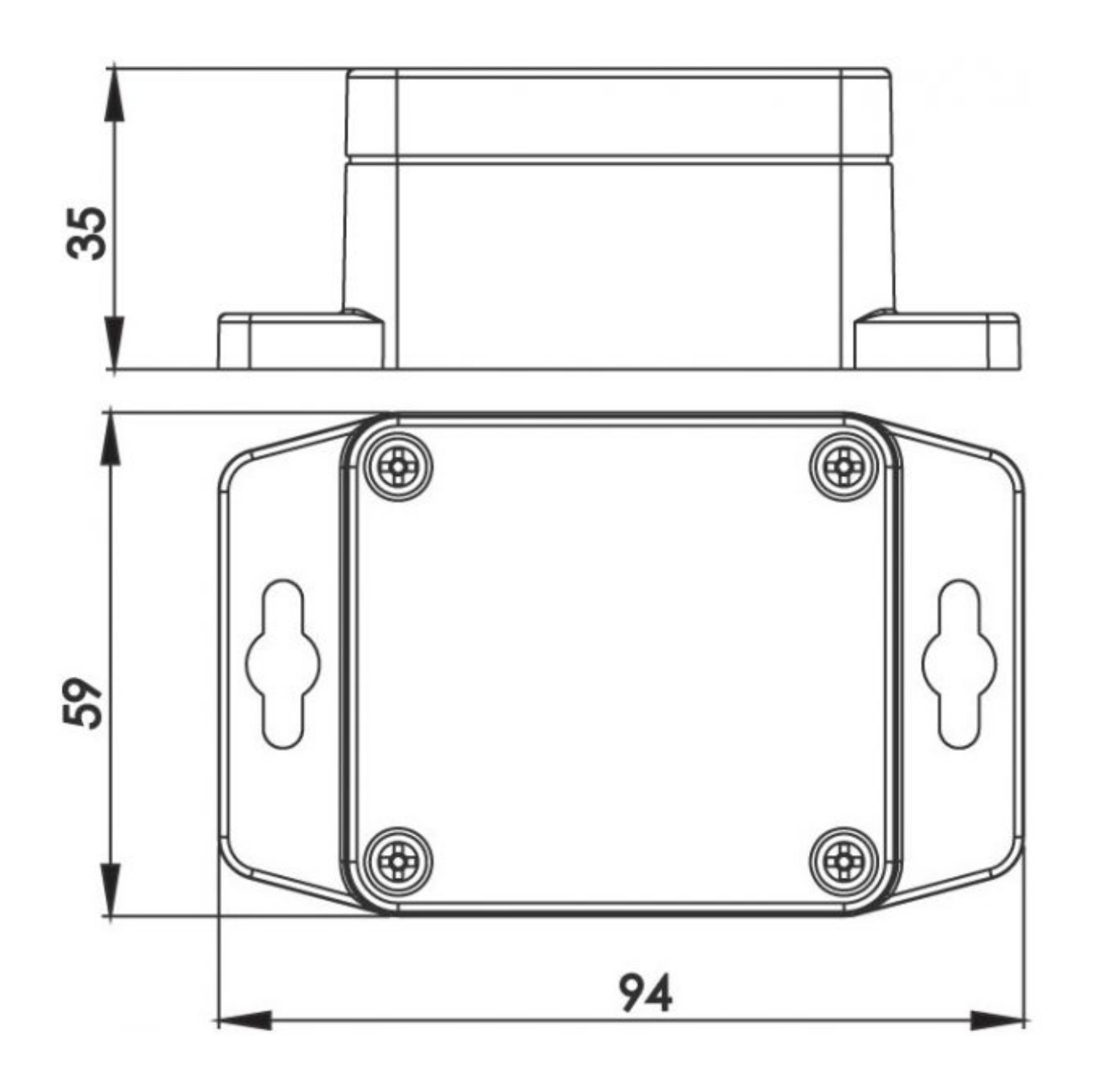
Four points decide whether the readings are any good. First, mount the antenna vertically — it determines range and radiation pattern, and lying flat you give away both. Second, point the filter cup downwards, so that running water does not stand in the cup. Third, no direct sunlight: a heated housing distorts above all the internal sensor, and the external probe sees the radiation too. A spot on the north side or under an overhang is preferable to an exposed one. Fourth, the cell goes in before closing and the lid is fastened with all four screws.
Configuration is done with the manufacturer’s app over NFC — sensibly in the office, before the devices are distributed. After writing, the device restarts and confirms this with the LED; the settings should then be read back once. So that the head-end can resolve the telegrams, serial number and key have to be stored there before the first device goes on the wall.
The versions in the ELT series
The same electronics and the same housing come with different radio methods and with or without an external probe. We are happy to source versions that are not listed.
| Model | Distinguishing feature | What it is made for |
|---|---|---|
| ELT-ETH-W — this page | wM-Bus, external probe in a filter cup, IP54 | climate measurement within existing remote meter reading |
| ELT-W | wM-Bus, cable gland with pressure compensation, IP67 | when the internal probe is enough or your own sensors are connected — on request |
| ELT-ETH-L | LoRaWAN, external probe in a filter cup, IP54 | the same device for a LoRaWAN — public network or your own gateway |
| ELT-2 | LoRaWAN, internal probes, expandable with modules | the universal base version of the series |
| ELT Lite | LoRaWAN, reduced feature set | when only temperature and humidity are needed |
What you additionally need
- The battery is mandatory and not included: an AA lithium thionyl chloride cell is required, for example the EVE ER14505V. An alkaline or NiMH cell is no substitute: it supplies only 1.5 or 1.2 V, while the device expects 3.6 V.
- You do not need a gateway here: unlike our LoRaWAN sensors, no LoRaWAN gateway belongs to this device. The counterpart is your wM-Bus collector or the reading device for the walk-by — both part of the metering infrastructure, not of the sensor.
- The alternative on the other radio path: if LoRaWAN does win out in the project after all, the Elsys ELT-ETH for LoRaWAN is the identical device with a different radio module.
Help with sizing
Unsure whether your existing collector will pick up this telegram, which radio mode suits your reading system, or how many devices make sense at one site? Ask us — we are glad to clear up questions like these before you order. The data sheet and manual are in the “Documents” tab. And if it turns into a project — sizing, preconfiguration in quantity or connection to your head-end — we will gladly prepare an offer for that.
Recensioni
Ancora non ci sono recensioni.