
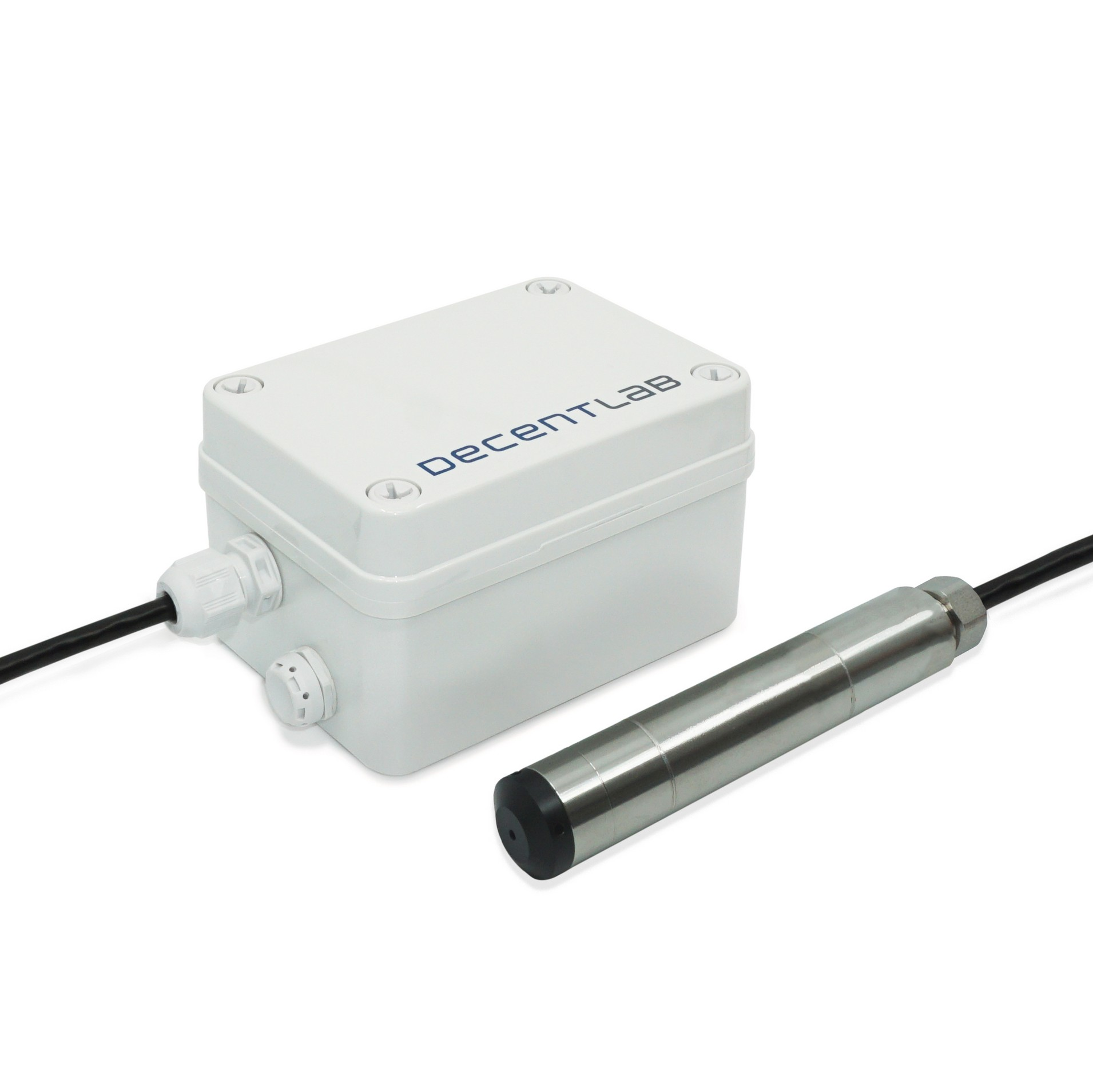


The Decentlab DL-PR36 measures the level in groundwater, wells and tanks — and does so more accurately than is usual for this class of device. The probe hangs on a cable inside the monitoring well and derives the height of the water column above it from the pressure; it also measures temperature. What matters is the error limit: across the whole measuring range the deviation stays below one part per thousand of full scale. Anyone evaluating level trends over years, or defending figures to an authority, needs exactly that quality. Built by Decentlab in Dübendorf, reported over LoRaWAN, powered by two batteries for around ten years.
- ±0.1 %total error band of full scale
- 1.22 mmwater column resolution
- ±0.1 °Ctemperature accuracy
- 10.2 yearsbattery life at ten-minute interval
- 22 mmprobe diameter
What sets the DL-PR36 apart
- Accuracy is the whole argument: linearity better than ±0.02 % and a total error band below ±0.1 % of full scale. On the standard range that means about one centimetre over ten metres of water column. A sensor of the usual class is five times worse — and precisely that difference decides whether a level trend stays readable over years or disappears into the noise.
- Resolution in the millimetre range: 1.22 mm of water column per step. This makes processes visible that a coarser sensor simply never shows — the daily fluctuation in an aquifer, say, or the slow recovery after an abstraction.
- Temperature is not an extra: ±0.1 °C from −40 to +125 °C. It is not merely a second reading; it feeds into the density of the water. Without a usable temperature, a high-precision pressure measurement is worth only half as much.
- Cable down to great depths: where comparable devices stop at ten metres, this one goes well beyond a hundred. That is why this sensor is used in deep groundwater monitoring wells, where the cheaper design is out of the question.
- It reports on its own, for years: two size C batteries carry the device for over ten years at a ten-minute measuring interval. At a field monitoring point the battery change is the most expensive item in operation — here it almost disappears.
- Built for outdoors: the polycarbonate housing is sealed to IP67, impact-resistant and UV-stable. It sits next to the monitoring well and stays there for years.
- Open radio protocol: LoRaWAN class A with AES-128, running on the public network or on your own gateway. No tie to a manufacturer platform.
- Swiss manufacture: developed and built by Decentlab in Dübendorf — short routes for questions about sizing and for custom cable lengths.
Where it is used
- Groundwater level monitoring: the main case. Continuous monitoring in observation wells, with an accuracy that also holds up as evidence.
- Wells and spring catchments: track yield and drawdown without measuring on site regularly.
- Surface water: levels in streams, ponds and retention basins.
- Excavation dewatering: proof that the drawdown stays within what was permitted — here the defensible number counts, not the rule of thumb.
- Reservoirs and tanks: fill level in drinking water reservoirs, cisterns and process vessels.
- Contaminated sites and landfills: long-term monitoring where measurement series have to stay comparable over years.
- Evidence for authorities: wherever a figure must not only be plausible but defensible.
That is the buying decision covered. What follows is the depth you need for sizing and installation.
What ±0.1 % of full scale means in practice
The error figure refers to the full scale of the measuring range, not to the value currently being measured. On the standard range of one bar, ten metres is full scale; one part per thousand of that is one centimetre. This figure applies across the whole range — even when only one metre of water stands above the probe. That is why you do not pick the measuring range generously: a 10 bar sensor would have an error band of ten centimetres at the same monitoring point, although it is of the same quality class. The smallest range that safely covers the expected water column is the most accurate one.
The difference to the cheaper DL-PR26 lies exactly here. Its total error band is ±0.5 % of full scale, so five centimetres over ten metres. For a level display that is perfectly adequate. For a measurement series from which an annual drawdown of a few centimetres is to be read, it is not. This assessment comes from field practice and is meant as a selection aid, not as a guaranteed measurement uncertainty in the metrological sense.
Gauge pressure — why the vent matters
The probe measures relative to atmospheric pressure. For this, a fine vent tube runs inside the cable and connects the interior of the probe with the atmosphere at the housing. That is why the day’s air pressure does not distort the result — and at the same time it is the most sensitive point of the whole installation: if moisture gets into that vent, the measurement drifts without any visible fault.
In practice that means: mount the housing so that no water gets in and no condensation collects — sheltered, and not down inside the shaft. Do not shorten or crush the cable; a cable clamp that is too tight can squeeze the vent tube shut. If you see a zero point slowly running away over months, check this point first and not the sensor.
Battery life by radio conditions
Battery life depends less on the measuring interval than on radio quality. With a gateway in sight the device transmits at a low spreading factor and accordingly briefly; if the monitoring point sits at the edge of coverage, every transmission takes many times longer and costs accordingly more.
| Ten-minute interval, good radio conditions (SF7) | around 10.2 years |
| Ten-minute interval, poor radio conditions (SF12) | around 4.2 years |
| Average power consumption | at most 0.5 mW at a ten-minute interval |
For project planning this means: a gateway closer to the monitoring point is not just a question of connectivity — in case of doubt it doubles the service life of the batteries, and with it the number of service trips over the lifetime of the installation.
Technical data
The general product data — protection rating, housing, dimensions, batteries, origin and certifications — can be found in the detail table further down this page.
| Pressure measurement | |
|---|---|
| Measuring principle | piezoresistive transducer, gauge pressure against atmosphere |
| Measuring range | 0 … 1 bar, corresponding to 0 … 10 m water column; up to 30 bar (300 m) on request |
| Resolution | 0.000122 bar, corresponding to 1.22 mm water column |
| Linearity | at most ±0.02 % of full scale |
| Total error band | at most ±0.1 % of full scale |
| Temperature measurement | |
| Measuring range | −40 … +125 °C |
| Accuracy | at most ±0.1 °C |
| Probe and cable | |
| Probe diameter | 22 mm |
| Cable length | 10 m as standard; longer versions built to order |
| Radio | |
| Radio technology | LoRaWAN class A, AES-128 encryption |
| Frequency band | 868 MHz for Europe |
| Transmit power | 14 dBm (25 mW) |
| Sensitivity | −146 dBm |
| Range | over 10 km with line of sight, around 2 km in built-up areas |
| Power supply and housing | |
| Batteries | 2 × alkaline size C |
| Housing | polycarbonate, weatherproof, impact- and UV-resistant, IP67 |
| Housing dimensions | 135 × 81 × 70 mm, without probe and cable |
Which version fits?
Decentlab offers four related probes. The choice comes down to three questions: how accurate does it have to be, how deep does the probe hang, and is conductivity needed?
| Model | Distinguishing feature | Availability |
|---|---|---|
| DL-PR36 (this page) | 22 mm probe, total error band ±0.1 %, cable well beyond 10 m possible | This is the version you order here |
| DL-PR26 | cheaper, very good resolution, total error band ±0.5 %, cable limited to 10 m | stocked in our shop |
| DL-PR36XS | like the DL-PR36, but with only a 16 mm probe diameter for narrow monitoring wells | on request |
| DL-PR36CTD | like the DL-PR36, plus electrical conductivity — a three-parameter probe | on request |
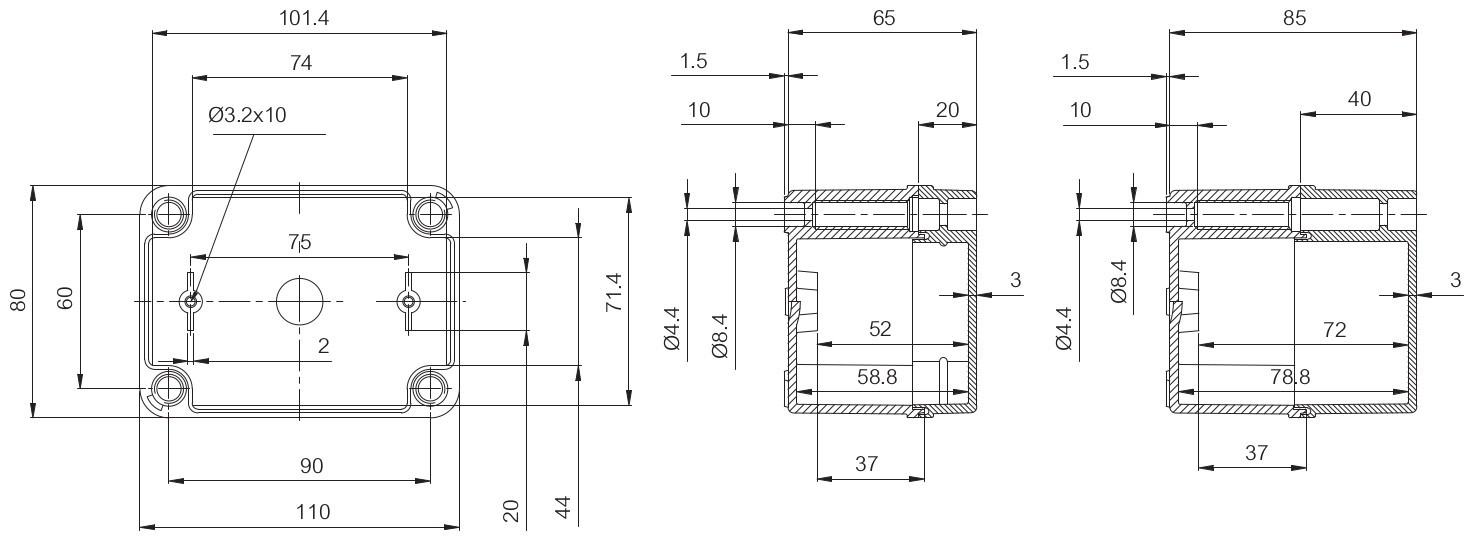
Dimensioned drawing of the housing with drilling pattern. The mounting centres of 90 × 60 mm are the figure you need for the mounting plate at the shaft — the probe itself hangs freely on the cable.
Installation and commissioning
The probe is lowered into the monitoring well on its cable and secured at the top — the cable carries the weight, but must not be under permanent strain. The installation depth is surveyed once and documented; all later values refer to it. If the probe is later moved even by a few centimetres, the measurement series is no longer comparable without a note — and that note, experience shows, is missing two years on.
The housing belongs above the shaft and sheltered, not inside it. Check the radio link before closing the cover: a monitoring point with a metal cover is, in radio terms, a different world from the same point with the shaft open.
Scope of delivery
- 1 × Decentlab DL-PR36 with permanently attached probe and cable in the ordered length
- 2 × size C battery, fitted at the factory
Help with sizing
The data sheet and manuals are in the Documents tab at the top of this page. Unsure about measuring range and cable length? Tell us how deep the monitoring point is and how high the water above it stands at most — these two figures determine the order, and they cannot be changed afterwards. For a special version with a larger range or a longer cable we are happy to obtain a quotation. And if it turns into a project — sizing, radio planning or commissioning — we will gladly prepare an offer for that.
Recensioni
Ancora non ci sono recensioni.