
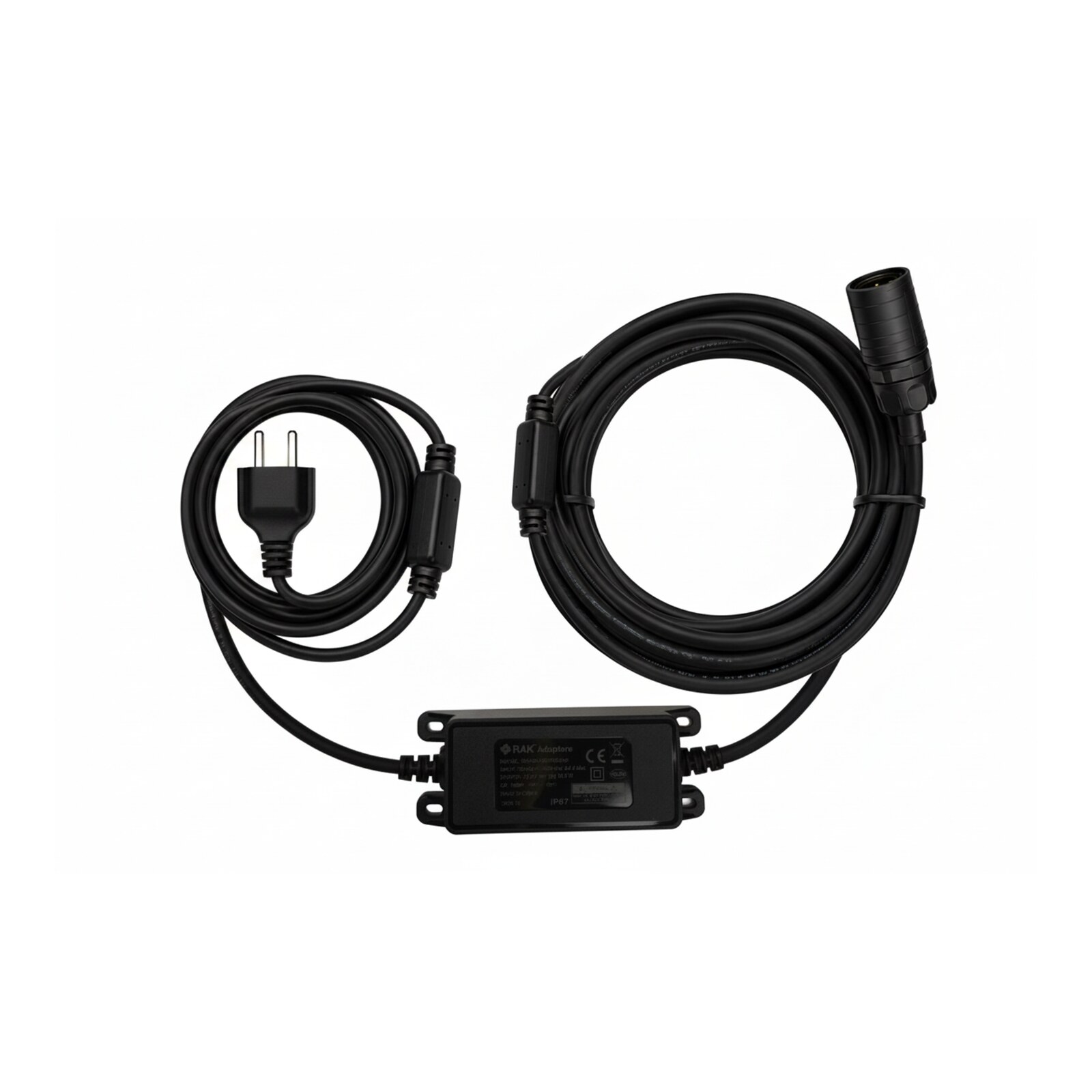


Anyone mounting a gateway on a mast, a façade or a lamp post rarely fails because of the gateway — they fail because of the power. The RAK9150 is the power supply RAKwireless builds for exactly that situation: a sealed housing for permanent outdoor use, moulded mounting flanges for screwing it down, and a DC cable long enough to reach from a sheltered socket to the device. It powers the outdoor gateways RAK7267 WisGate Soho Pro and RAK7240V2 / RAK7240CV2 WisGate Edge Prime, as well as any other device with a 12-volt input and a matching connector. What you order here is the European version with a two-pin type C plug. What sets this unit apart from a hardware-store wall adapter is not the power rating — it is the temperature range in which it still starts up at all.
- 12 V / 1.5 ADC output, 18 W
- IP67ingress protection of the unit
- 5 mDC cable
- −40 … +85 °Coperating temperature
- < 0.1 Wno-load power draw
What the RAK9150 delivers at an outdoor site
- Seven metres of room between socket and device: two metres on the mains side, five on the output side. The unit does not have to sit next to the socket — it can go where it belongs: close to the gateway, on the same mast, within reach for service.
- Frost is designed in, not barely touched: cheap wall adapters are specified from 0 °C and occasionally refuse to start after a cold night. Here the lower limit sits so low that a site at 1800 metres is no longer a special case.
- A gateway should not depend on a power supply that draws more at idle than the gateway itself: the no-load draw lies below the measuring threshold of many clamp meters. At sites partly fed by solar or a small installation, that is not a detail — it is the difference between a calculation and an estimate.
- 86.2 per cent efficiency, efficiency level VI: at full load this means roughly 2.9 W given off as heat (calculated from efficiency and rated power). In a tight enclosure shared with a gateway and an LTE router, that adds up — so plan for it when the volume is limited.
- Overload heals itself, a short circuit does not: under overload the unit switches off and on again in hiccup mode and carries on by itself as soon as the load drops. Under short circuit and overvoltage, by contrast, the output stays off until the mains has been disconnected once. For an unattended site, that is the more important of the two statements.
- It rides out brief mains dips without the gateway rebooting: hold-up time is around 121 ms at 230 V. That covers the typical switchover flicker of a distribution grid — a gateway that would otherwise restart and accept no uplinks for two minutes simply keeps running.
- Class II, so no protective earth: the unit isolates input from output galvanically and works without earthing. On a metal mast, the power feed therefore creates no additional bonding path. If you need earthing, you take it from the mast, not from this power supply.
- Mounting flanges instead of cable strain: the housing has moulded flanges with screw holes — screwed to a wall, or strapped to a mast with cable ties and a tensioning band. The unit then does not hang from its own cables, which is the most common cause of torn-out strain reliefs outdoors.
- 3 kV test voltage between input and output: plus 100 MΩ insulation resistance at 500 V DC. This is the figure an acceptance report asks for, and the one a universal adapter cannot supply.
- Vibration up to 500 Hz: tested from 10 to 500 Hz at 5 g. For lamp posts along through roads, bridge railings and sites next to railway lines, this is the figure that decides how long the solder joints last.
Where this power supply is typically used
- Outdoor gateway on a mast or façade: the standard case — RAK7267 or RAK7240CV2 at the top, the power supply below it, the mains connection in a sheltered socket.
- Unheated service shafts and distribution cabinets: where condensation is the rule and an open power supply has green legs after two winters.
- Agriculture: barn, hayloft, feed silo, fence-controller cabinet — dusty, damp, cleaned with a pressure washer.
- Car parks and underground garages: wash water, salt spray in winter, ceilings without sheltered mounting surfaces.
- Water and wastewater plants: pumping stations, reservoirs, settling tanks, where a gateway runs continuously and nobody passes by every day.
- Construction sites and temporary measurements: installations lasting several months that are built up and taken down again; the unit still survives its third deployment.
- Large rollouts: one type of power supply across all sites means one spare part in the service vehicle, one part number in procurement, one line in the system documentation. Across fifty sites that is worth more than the unit price.
- Retrofitting existing gateways: when a device was bought without a power supply, or the old one failed without the gateway itself coming to harm.
The plug: what ships is the European version RAK9150-C2 with a two-pin type C plug. For orientation: a plug like this fits the socket commonly used in Switzerland — the Swiss standard plug is not needed, and an adapter even less so. This is selection guidance from practical experience, not a manufacturer’s assurance; the installation on site remains decisive. If you need a different plug version for a project abroad, we will source it on request.
What it suits: devices with a 12-volt DC input and a continuous draw of up to 18 W, first and foremost the outdoor gateways RAK7267 and RAK7240V2 / RAK7240CV2, for which RAKwireless lists this power supply.
What it does not suit: devices powered over the network cable — those need a PoE injector, not a power supply. Devices with a 24 or 48 volt input. And devices powered over USB-C: the RAK7268CV2 WisGate Edge Lite 2+, for instance, takes its 12 volts through a USB-C socket rather than this DC connector — mechanically the two do not go together.
No mains connection at the site? Then the answer is not this power supply but the RAK9155 Battery Plus with solar charging and a heater. The other way round: wherever mains is available, the power supply is by far the simpler and maintenance-free option.
Manufacturer’s notes: the unit is intended only for devices with a 12-volt input and must not be loaded beyond its rated power. If the cable, plug, connector or housing is damaged, it must not be used any further. Mains voltage must be disconnected before working on stripped conductors. The two-pin versions are not earthed; on the British model the earth pin is made of plastic and only serves to open the socket shutter. The installation must comply with local regulations.
And one obvious point that still goes wrong: IP67 applies to the power supply, not to the mains plug and not to the socket. The socket belongs in a sheltered position or in an outdoor enclosure — the unit itself may then hang freely in the rain.
That covers the purchase decision. What follows is the depth needed for sizing, mounting and acceptance.
The technology in detail
Class II and what it means for mast mounting. The unit works without a protective earth conductor and relies instead on double or reinforced insulation — evidenced by the test voltage between input and output. In practice this means no further earth connection reaches the mast through the power feed, and no second earthing path is created alongside the one the lightning protection provides. Anyone documenting equipotential bonding at a site records this unit as Class II equipment and not as an earthed device. This classification comes from practical experience and is to be understood as selection guidance, not as a certification statement by the manufacturer.
The rated power is a continuous figure, not a peak figure. Above roughly 120 per cent of rated load the overload protection steps in and works in hiccup mode. Load peaks such as an LTE modem draws at the moment of transmission therefore have to be buffered by the gateway’s own input stage — the power supply does not cover them from reserve. On the gateways for which RAKwireless lists this unit, the two are matched. Anyone powering a different device works with the continuous figure, not with the upper shutdown threshold.
What happens after a fault decides whether someone has to drive out. Three protective functions, two behaviours: overload resets itself, short circuit and overvoltage do not. For a site an hour’s drive away, that distinction is the real information on the data sheet. The consequence for planning: a short circuit on the DC cable — chafed through on an edge, taken on by a rodent — does not cause a brief outage but a silent site until someone visits. The cable therefore belongs in a conduit or on a rail, not loose across a sheet-metal edge.
Energy and waste heat
The general product data are in the detail table further down; what follows is only what matters for a site’s energy budget.
| Energy | |
|---|---|
| Efficiency | 86.2 % |
| Energy efficiency level | Level VI |
| Waste heat at full load | approx. 2.9 W (calculated from rated power and efficiency) |
| Annual consumption, worked example | gateway with a 10 W continuous load: around 102 kWh per year including power supply losses (calculated, not a manufacturer figure) |
Connecting to the gateway
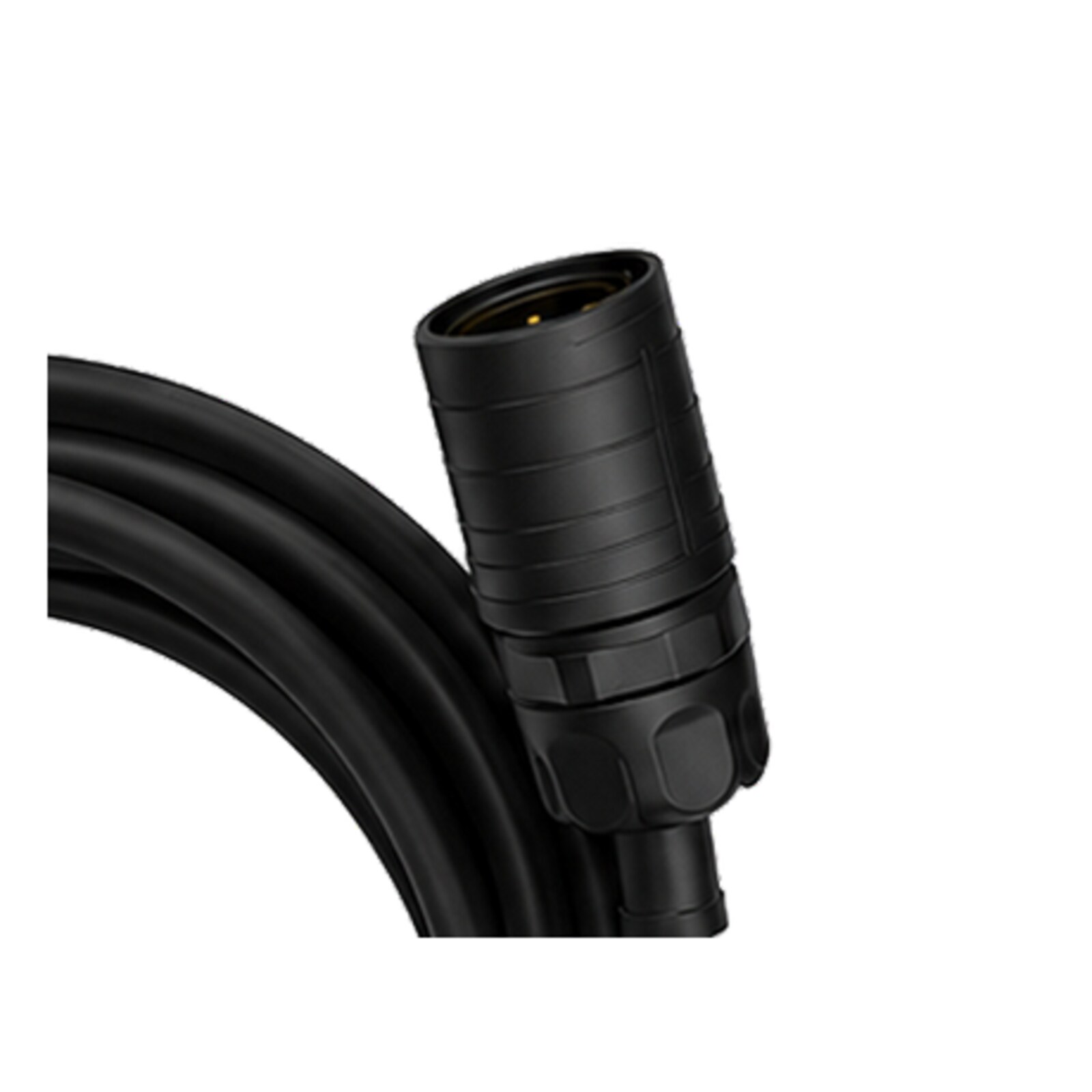
The DC output ends in the connector RAKwireless uses on its outdoor gateways. Two of the four contacts are assigned: pin 1 carries the positive pole, pin 2 the negative pole, pins 3 and 4 are not connected. At the device the cable goes to the 12-volt input; there is no configuration, no setting and no power-up sequence to observe. RAKwireless lists this power supply for the RAK7267 WisGate Soho Pro and for the RAK7240V2 / RAK7240CV2 WisGate Edge Prime.
The second image in the gallery shows what this connector looks like: a round connector with a knurled coupling nut that is tightened by hand and secures the connection against vibration and moisture. To check whether your device matches, compare that shot with the socket on the housing.
If the standard length is not enough, or a site needs a plug type that is not available from stock, the manufacturer offers special versions — tell us the length you need and we will clarify feasibility and minimum order quantity.
Versions and plug types
The manufacturer builds this power supply in four plug versions. What you order here is the European one; we source the others on request, for instance for sites abroad that are to run through the same procurement.
| Versions | ||
|---|---|---|
| Version | Mains plug | Availability |
| RAK9150-C2 | type C, two-pin, unearthed (Europe) | This is the version you order here |
| RAK9150-G3 | type G, three-pin (United Kingdom), plastic earth pin | on request |
| RAK9150-A2 | type A, two-pin (North America, Japan), 100–120 V | on request |
| RAK9150-I2 | type I, two-pin (Australia, New Zealand, China) | on request |
Technical specifications
Ingress protection, temperature and humidity range, dimensions, weight, warranty and origin are in the detail table further down this page. Here are the values that do not appear there.
| Input | |
|---|---|
| Operating range | 85 … 264 VAC (nominal 100 … 240 VAC), 50/60 Hz |
| Input current | 0.4 A at 230 VAC (nameplate: max. 0.8 A) |
| Inrush current | 90 A / 200 µs at 230 VAC |
| Protection class | II (no protective earth conductor) |
| Output quality | |
| Ripple and noise | max. 120 mVp-p |
| Voltage tolerance | ±5 % |
| Line regulation / load regulation | ±3 % / ±5 % |
| Hold-up time | 121 ms at 230 VAC (24.4 ms at 115 VAC) |
| Protective functions | |
| Overload | 120 … 250 % of rated load, hiccup mode, self-resetting |
| Short circuit | output shuts down, reset by disconnecting from the mains |
| Overvoltage | shutdown at 15.6 V, reset by disconnecting from the mains |
| Cables and connector | |
| Mains cable | 2000 ±50 mm, plug to unit |
| DC cable | 5000 ±100 mm, connector to unit |
| DC connector pinout | pin 1 = +, pin 2 = −, pins 3 and 4 unassigned |
| Insulation and testing | |
| Test voltage input to output | 3 kVAC, 1 minute |
| Insulation resistance | 100 MΩ at 500 VDC |
| Mechanical environment | |
| Vibration | 10 … 500 Hz, 5 g |
| Packaging dimensions | 185 × 75 × 70 mm |
| Standards and reliability | |
| Safety | EN/IEC/AS/NZS 62368-1 (versions C2, I2, G3) |
| Emissions | class B to EN 55032 / CISPR 32 |
| Immunity | ESD, radiated fields, burst, surge, conducted disturbance, magnetic field, voltage dips — criterion A in each case |
| MTBF | at least 489,600 h to MIL-HDBK-217F at 25 °C (statistical value, not a service-life guarantee) |
Mounting and commissioning
The housing has moulded flanges with screw holes. On a wall it is screwed down; on a mast it is laid against the surface by its flanges with cable ties or a tensioning band; for special cases, custom brackets can be fixed to those same flanges. What matters is that the load rests on the flanges and not on the cables — a strain relief working on an edge for two winters is the most common damage to outdoor power supplies.
For cable routing, the rule of thumb is that the five metres of DC cable should not be pulled taut but laid with a loop below the device: water then runs off instead of standing at the connector. The mains cable belongs in a sheltered socket or an outdoor enclosure. At sites with rodent pressure — barn, hayloft, cable duct — the DC cable belongs in a conduit; a chafed-through cable trips the short-circuit shutdown, and that one does not reset by itself.
Matching devices from our range
- RAK7267 WisGate Soho Pro, without power supply: the version with a battery cable deliberately ships without a wall adapter — this gateway and this power supply together make up the mains-powered variant.
- WisGate Edge Prime RAK7240CV2: our bestseller for outdoor use, as the LTE version with DC power — listed by the manufacturer for this power supply. We also carry the 16-channel variant.
- RAK9155 Battery Plus: solar storage with a heater for sites without a mains connection — the alternative, not the addition.
- RAK Gateway Mini UPS with 12 V output: placed between power supply and gateway, it bridges mains failures that last longer than the power supply’s hold-up time.
Support with sizing
We are happy to clarify in advance whether your device runs on this power supply — give us the model and its input data and we will tell you whether plug and power rating match. The manufacturer’s data sheet is in the “Documents” tab at the top of this page. If it is about several sites, special cable lengths, other plug versions for sites abroad, or pre-configuring the matching gateways: tell us how many sites you want to equip and we will gladly put together a quotation.
Recensioni
Ancora non ci sono recensioni.