
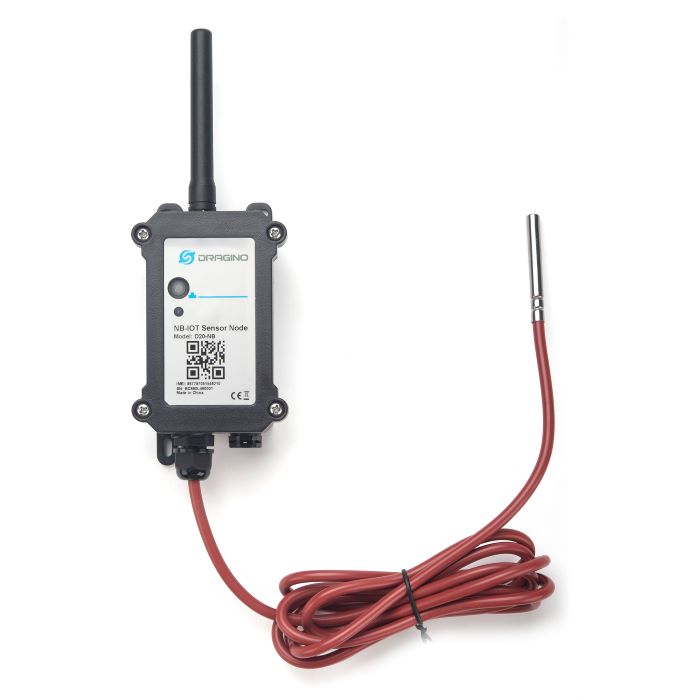
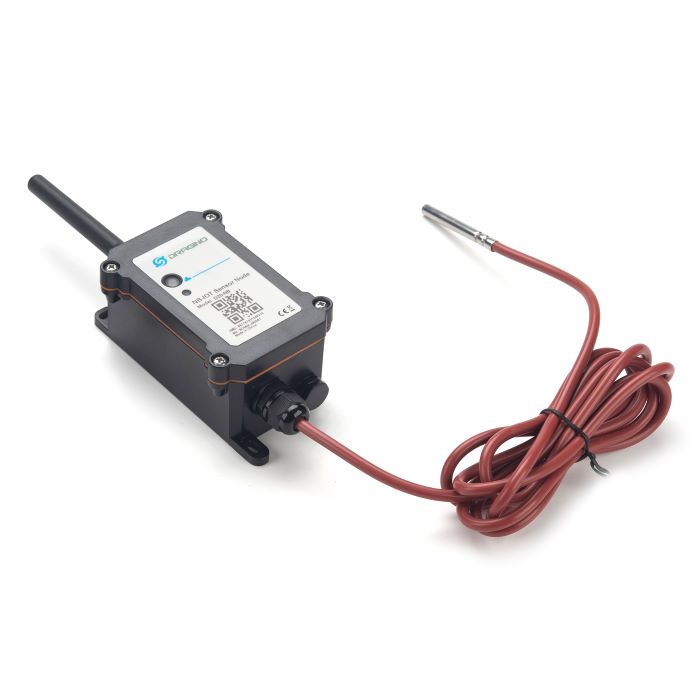
The Dragino D20-NB is the simplest useful outdoor temperature sensor: a rugged DS18B20 in a stainless steel sleeve on two metres of cable, and the rest is radio and battery. Its range runs from −55 to +125 °C and so reaches well beyond what humidity sensors can do — deep freeze at one end, heating flow at the other. At ±0.5 °C it is not a laboratory instrument but a piece of operating equipment; in return it costs a fraction and the 8500 mAh cell carries it for years. The IP66 enclosure stays outside, the probe goes where the measurement is. This version transmits without a gateway over NB-IoT straight onto the cellular network — in return it needs a SIM card and a server that accepts the data.
- −55 … 125 °Cprobe range
- ±0.5 °Ctypical, max. ±2.0 °C
- 2 mprobe cable
- IP66enclosure, probe IP65
- 8500 mAhLi-SOCl₂ cell
What defines the D20-NB
- A measuring range that covers most applications: −55 to +125 °C is not a marketing figure but the DS18B20’s range. The same device therefore measures in a deep-freeze store and on a heating return — and that is why this sensor is so often the right choice although it can do nothing but temperature.
- The probe is stainless steel, not plastic: the sensing element sits in a stainless sleeve rated IP65. It slides into a thermowell, straps to a pipe or pushes into bulk material — and it survives the cleaning that open sensors fail.
- Two metres of cable separate measurement from radio: the device hangs where it has coverage and stays reachable; the probe goes into the cold room, down the shaft, onto the pipe. On a compact sensor both are in the same place — here they are not.
- A digital bus, not analogue technology: the DS18B20 delivers a digital value. There is no characteristic curve to store, no line loss to compensate and no calibration at commissioning — unlike PT100s or thermocouples.
- An alarm flag in every message: a dedicated bit shows whether the value has left a set threshold. Thresholds are set by downlink, and so is the minimum time between two alarm messages — a sensor sitting on a limit therefore does not flood the network.
- Recording when the network drops: if coverage fails, the device writes timestamped readings to its own memory and sends them on once the network is back. For an evidential series that is the difference between a gap and continuity.
- Device status travels along: cell voltage, device model, IMEI and serial number sit in the same message as the readings. For a fleet that means the inventory can be kept from the running data stream without querying the device — and the cell voltage doubles as the early warning before a battery change.
- A large cell, soberly reckoned: 8500 mAh of Li-SOCl₂ is three times that of a common room sensor. The manufacturer quotes up to five years — a realistic figure for a device with a single digital sensor and one transmission per interval.
- Configuration without a network server: reporting interval and thresholds are set on the device or sent back through your own server. There is no LoRaWAN network server managing downlinks here — that responsibility sits with your platform.
- No gateway, no network server: the device transmits straight onto the cellular network and sends its data to your endpoint. No device profile, no join, no key management — but a SIM that wants managing.
- The same electronics, four probe variants: anyone needing a buriable probe takes the D20S; two measuring points on one device, the D22; three, the D23. Decoder and integration stay the same.
Where the D20-NB is used
- Chilled and frozen stores: device outside, probe inside, cable through the door seal. The radio path does not run through the metal door — the reason cold-store monitoring otherwise has holes. And −55 °C covers deep freeze as well.
- Heating, heat pumps, solar thermal: flow and return temperature with a pipe clamp probe, without touching the hydraulics.
- Hot water and legionella checks: the range up to 125 °C covers every cylinder and circulation temperature; the stainless probe fits common thermowells.
- Compost, silage, bulk material: the probe sits in the heap, the device on a post. Self-heating caught early is the difference between turning the pile and a fire.
- Greenhouse, livestock housing, polytunnel: temperature in the crop rather than under the roof.
- Machine and bearing monitoring: the probe at the bearing, the device outside the danger zone.
- Water tanks and cisterns: the probe hangs in the tank, the device on the lid — the probe’s IP65 is built for that, though continuous operation under water is not specified.
- Large rollouts: one article, one decoder, one spare — and through the D20-LS, D20-NB and D20-CB variants the same measuring technology with a different form of power or radio.
That covers the purchase decision. What follows is the depth needed for mounting, integration and operation.
What ±0.5 °C means in practice
The DS18B20 has been the standard sensor for exactly this class of task for decades, and its tolerance is well documented: in the middle of the range it typically holds half a degree, at the edges of the range considerably less well. Dragino states this correctly as ±0.5 °C typical and up to ±2.0 °C maximum — a detail many suppliers leave out.
Consequence for planning: what decides is whether the application needs an absolute value or a change. A cold chain with a limit at −18 °C does not tolerate half a degree of uncertainty well — there the threshold belongs set conservatively, or the sensor checked against a reference instrument. Compost monitoring, where fifteen degrees of rise is the point, tolerates it easily.
Assessment from field practice, not a manufacturer statement: the larger error usually sits not in the sensor but in the installation. A pipe clamp probe without heat transfer compound and without insulation reads several degrees low depending on room temperature; a probe hanging against the wall of a cold room rather than in the air measures the wall. Anyone who installs it properly gets more out of this sensor than out of a more accurate sensor badly placed.
Payload and integration
Without LoRaWAN the whole apparatus of ports, device profiles and decoders falls away: there is no FPort, no network server and no payload function for anyone to maintain. The device opens a connection to the cellular network and delivers the same values — cell voltage, measured quantities, alarm flag, device identity — straight to your endpoint.
Consequence for the integration: what was the decoder in the network server under LoRaWAN is here the receiver on your side. That is less infrastructure but the same work — the raw format has to be interpreted once. The exact field order is in the manufacturer’s cellular manual, linked under “Documents”; it differs from the LoRaWAN version and belongs held against a real message once at commissioning.
One point regularly overlooked on cellular devices: the device identity comes from the IMEI and serial number, not from a DevEUI. Anyone running a fleet of LoRaWAN and cellular devices together needs a key field that can take both.
No gateway — what that costs and what it saves
NB-IoT uses the cellular network that is there anyway. So there is no gateway infrastructure to build, no coverage to plan and no network server to run. In return every device needs a SIM card and a server that accepts the data — the costs do not disappear, they move from the initial investment into running expenses.
The arithmetic that comes first: a single sensor somewhere remote is a clear case for cellular — a gateway for one device never pays. Thirty sensors on one site are an equally clear case for LoRaWAN. The boundary lies, depending on tariffs, somewhere between five and ten devices per site, and it shifts with the question of whether anyone is there to look after a gateway.
Assessment from field practice, not a manufacturer statement: what is regularly underestimated is not the radio technology but the SIM. Many standard data cards are not enabled for NB-IoT at all, and that only shows when the device fails to get onto the network at the site. On top comes administration: a hundred LoRaWAN devices hang on one network server, a hundred NB-IoT devices on a hundred SIM contracts with terms and invoices. That is not a technical but an organisational argument — and on larger fleets it decides more often than range does.
Connecting to your own server
The device speaks MQTT, MQTT over TLS, TCP and UDP. MQTT with TLS is the right choice for most applications: widespread, economical and encrypted. UDP is more economical still and therefore kinder to the battery, but offers no delivery guarantee — usable where individual lost messages are tolerable.
Server, port, credentials and topic are set on the device. There is no network server decoding the payload; the device sends straight to your endpoint. Decoder maintenance falls away, and responsibility for reachability and certificates rests with you.
Data at a glance
| Sensing element | 1 × Dallas DS18B20 in a stainless steel sleeve, IP65, 2 m cable |
| Temperature | −55 … +125 °C · ±0.5 °C typical, up to ±2.0 °C maximum · resolution 0.1 °C |
| Operating temperature | −40 … 85 °C (device) |
| Radio | NB-IoT via Quectel BC660K-GL · B1/B2/B3/B4/B5/B8/B12/B13/B17/B18/B19/B20/B25/B28/B66/B70/B85 in H-FDD |
| Protocols | MQTT · MQTT over TLS · TCP · UDP |
| SIM | GE version: without SIM · nano-SIM slot · 1T version: 1NCE SIM, 500 MB over 10 years |
| Payload | raw format straight to your own endpoint · no FPort, no network-server decoder · field order in the manufacturer’s cellular manual |
| Configuration | on the device or through your own server’s return channel · Bluetooth 5.1 on site · firmware update over the air |
| Power | 8500 mAh Li-SOCl₂, not rechargeable · quiescent current 5 µA at 3.3 V · manufacturer: up to 5 years |
| Enclosure | IP66 · 200 × 120 × 55 mm · 372 g |
| Versions | D20-LB LoRaWAN battery · D20-LS LoRaWAN solar · D20-NB NB-IoT · D20-NS NB-IoT solar · D20-CB LTE-M and NB-IoT · D20-CS LTE-M and NB-IoT solar |
What the manufacturer does not state: Dragino does not name the probe cable’s material for the D20 — on the buriable D20S it is explicitly TPE, on the D20 it is left open. A dimensioned drawing of the probe is also missing; the diameter and length of the stainless sleeve appear neither on the product page nor in the manual. Anyone wanting to fit an existing thermowell should ask for the dimensions before ordering — we will add them at the first goods receipt.
Recensioni
Ancora non ci sono recensioni.