
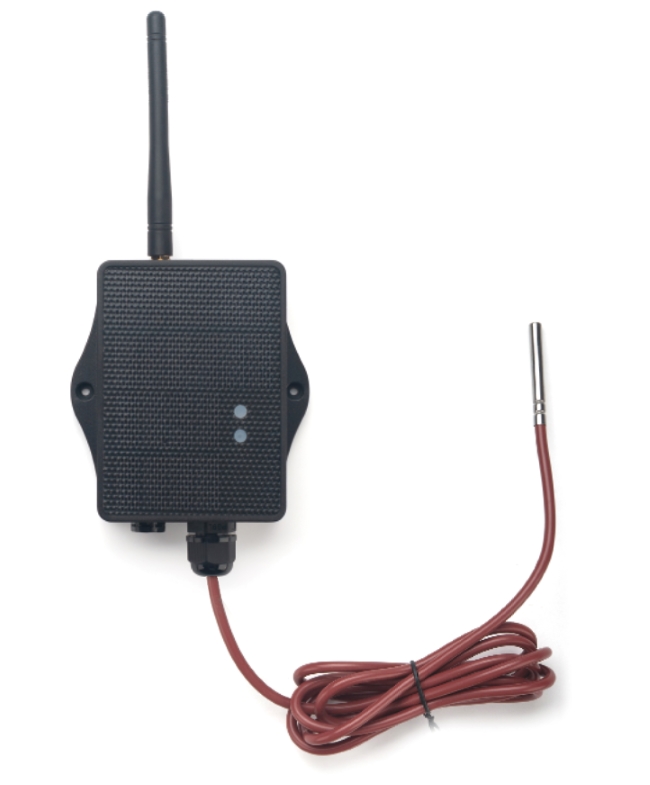
The Dragino D20-LS is the simplest useful outdoor temperature sensor: a rugged DS18B20 in a stainless steel sleeve on two metres of cable, and the rest is radio and battery. Its range runs from −55 to +125 °C and so reaches well beyond what humidity sensors can do — deep freeze at one end, heating flow at the other. The IP66 enclosure stays outside, the probe goes where the measurement is. This is the solar-powered version: a panel charges a rechargeable 3000 mAh Li-ion cell, and the battery change disappears as long as enough light arrives.
- −55 … 125 °Cprobe range
- ±0.5 °Ctypical, max. ±2.0 °C
- 2 mprobe cable
- IP66enclosure, probe IP65
- 3000 mAhLi-ion, solar charged
What defines the D20-LS
- A measuring range that covers most applications: −55 to +125 °C is not a marketing figure but the DS18B20’s range. The same device therefore measures in a deep-freeze store and on a heating return — and that is why this sensor is so often the right choice although it can do nothing but temperature.
- The probe is stainless steel, not plastic: the sensing element sits in a stainless sleeve rated IP65. It slides into a thermowell, straps to a pipe or pushes into bulk material — and it survives the cleaning that open sensors fail.
- Two metres of cable separate measurement from radio: the device hangs where it has coverage and stays reachable; the probe goes into the cold room, down the shaft, onto the pipe. On a compact sensor both are in the same place — here they are not.
- A digital bus, not analogue technology: the DS18B20 delivers a digital value. There is no characteristic curve to store, no line loss to compensate and no calibration at commissioning — unlike PT100s or thermocouples.
- An alarm flag in every message: a dedicated bit shows whether the value has left a set threshold. Thresholds are set by downlink, and so is the minimum time between two alarm messages — a sensor sitting on a limit therefore does not flood the network.
- Recording when the network drops: if coverage fails, the device writes timestamped readings to its own memory and sends them on once the network is back. For an evidential series that is the difference between a gap and continuity.
- Device status on its own port: model, firmware version, frequency band and battery arrive on FPort 5, separate from the readings on FPort 2. For a fleet that means the inventory can be queried without searching the measurement database.
- No battery change planned in: the solar panel charges a rechargeable 3000 mAh Li-ion cell. With sufficient light the replacement cycle disappears — at hard-to-reach measuring points the larger item over the service life. The cell is a buffer, not the main store: it carries the device overnight and through spells of bad weather.
- Configuration over the air: reporting interval and thresholds are set by downlink. The device can also be configured on site over Bluetooth 5.1 and its firmware updated wirelessly — a device on a cold room stays where it is.
- Not tied to a platform: LoRaWAN 1.0.3, Class A, OTAA. Runs on TTN, ChirpStack and the Swisscom LPN with the same device profile and the same decoder.
- The same electronics, four probe variants: anyone needing a buriable probe takes the D20S; two measuring points on one device, the D22; three, the D23. Decoder and integration stay the same.
Where the D20-LS is used
- Chilled and frozen stores: device outside, probe inside, cable through the door seal. The radio path does not run through the metal door — the reason cold-store monitoring otherwise has holes. And −55 °C covers deep freeze as well.
- Heating, heat pumps, solar thermal: flow and return temperature with a pipe clamp probe, without touching the hydraulics.
- Hot water and legionella checks: the range up to 125 °C covers every cylinder and circulation temperature; the stainless probe fits common thermowells.
- Compost, silage, bulk material: the probe sits in the heap, the device on a post. Self-heating caught early is the difference between turning the pile and a fire.
- Greenhouse, livestock housing, polytunnel: temperature in the crop rather than under the roof.
- Machine and bearing monitoring: the probe at the bearing, the device outside the danger zone.
- Water tanks and cisterns: the probe hangs in the tank, the device on the lid — the probe’s IP65 is built for that, though continuous operation under water is not specified.
- Large rollouts: one article, one decoder, one spare — and through the D20-LS, D20-NB and D20-CB variants the same measuring technology with a different form of power or radio.
That covers the purchase decision. What follows is the depth needed for mounting, integration and operation.
What ±0.5 °C means in practice
The DS18B20 has been the standard sensor for exactly this class of task for decades, and its tolerance is well documented: in the middle of the range it typically holds half a degree, at the edges of the range considerably less well. Dragino states this correctly as ±0.5 °C typical and up to ±2.0 °C maximum — a detail many suppliers leave out.
Consequence for planning: what decides is whether the application needs an absolute value or a change. A cold chain with a limit at −18 °C does not tolerate half a degree of uncertainty well — there the threshold belongs set conservatively, or the sensor checked against a reference instrument. Compost monitoring, where fifteen degrees of rise is the point, tolerates it easily.
Assessment from field practice, not a manufacturer statement: the larger error usually sits not in the sensor but in the installation. A pipe clamp probe without heat transfer compound and without insulation reads several degrees low depending on room temperature; a probe hanging against the wall of a cold room rather than in the air measures the wall. Anyone who installs it properly gets more out of this sensor than out of a more accurate sensor badly placed.
Payload and integration
The readings arrive on FPort 2 in eleven bytes of fixed order: two bytes of battery voltage in millivolts, two bytes of temperature from the connected probe as a signed value with a factor of ten, two unused bytes, one byte with the alarm flag, the operating mode and the state of input PA8, then two times two bytes for the probes this model does not have — they read 0x7FFF. D20, D22 and D23 share exactly this field layout; the decoder is the same for all three.
Device status — model (0x19), firmware, frequency band, sub-band, battery — runs separately on FPort 5, and the replayed stored values on FPort 3. The latter each carry a four-byte Unix timestamp.
For the integration that means three things. First: the decoder has to evaluate the port, otherwise status messages land in the time series as implausible readings. Second: 0x7FFF is not a reading but “no probe” — anyone not catching it gets 3276.7 °C into the database. Third, and unlike the humidity sensors from the same brand: the live message on FPort 2 carries no timestamp. The measurement time here is the time of receipt; only the replayed stored values bring their own time, and only there does the evaluation have to use it.
Solar operation — what carries the balance and what tips it
A LoRaWAN uplink costs little energy: the radio is awake for fractions of a second and then sleeps on at a few microamps. That makes the solar balance here considerably more relaxed than on a cellular device — the daily demand is low enough that even an overcast winter day usually still covers it. The rechargeable 3000 mAh Li-ion cell is not meant as the main store but as a buffer overnight and through spells of bad weather.
Consequence for planning: what decides is not the cell capacity but where the panel sits. Facing south and unshaded all day, the balance carries; in the shade of a hedge, behind a roof edge or down a shaft it does not — and that shows in December, not in June.
Assessment from field practice, not a manufacturer statement: for the solar version Dragino gives neither a battery life nor a minimum irradiation. With two independent variables — location and reporting interval — that is consistent, but it does not help with planning. What is usable is the cell voltage carried in every message: anyone recording it through the first winter knows afterwards whether the site carries, instead of guessing.
Data at a glance
| Sensing element | 1 × Dallas DS18B20 in a stainless steel sleeve, IP65, 2 m cable |
| Temperature | −55 … +125 °C · ±0.5 °C typical, up to ±2.0 °C maximum · resolution 0.1 °C |
| Operating temperature | −40 … 85 °C (device) |
| Radio | LoRaWAN 1.0.3, Class A, OTAA · EU868 · up to +22 dBm · sensitivity down to −139 dBm |
| Payload | FPort 2 readings (11 bytes) · FPort 3 stored values with timestamp · FPort 5 device status |
| Configuration | LoRaWAN downlink · Bluetooth 5.1 on site · firmware update over the air |
| Power | solar panel with rechargeable 3000 mAh Li-ion cell · no battery-life figure from the manufacturer |
| Enclosure | IP66 · 200 × 120 × 55 mm · 372 g |
| Versions | D20-LB LoRaWAN battery · D20-LS LoRaWAN solar · D20-NB NB-IoT · D20-NS NB-IoT solar · D20-CB LTE-M and NB-IoT · D20-CS LTE-M and NB-IoT solar |
What the manufacturer does not state: Dragino does not name the probe cable’s material for the D20 — on the buriable D20S it is explicitly TPE, on the D20 it is left open. A dimensioned drawing of the probe is also missing; the diameter and length of the stainless sleeve appear neither on the product page nor in the manual. Anyone wanting to fit an existing thermowell should ask for the dimensions before ordering — we will add them at the first goods receipt.
Recensioni
Ancora non ci sono recensioni.