
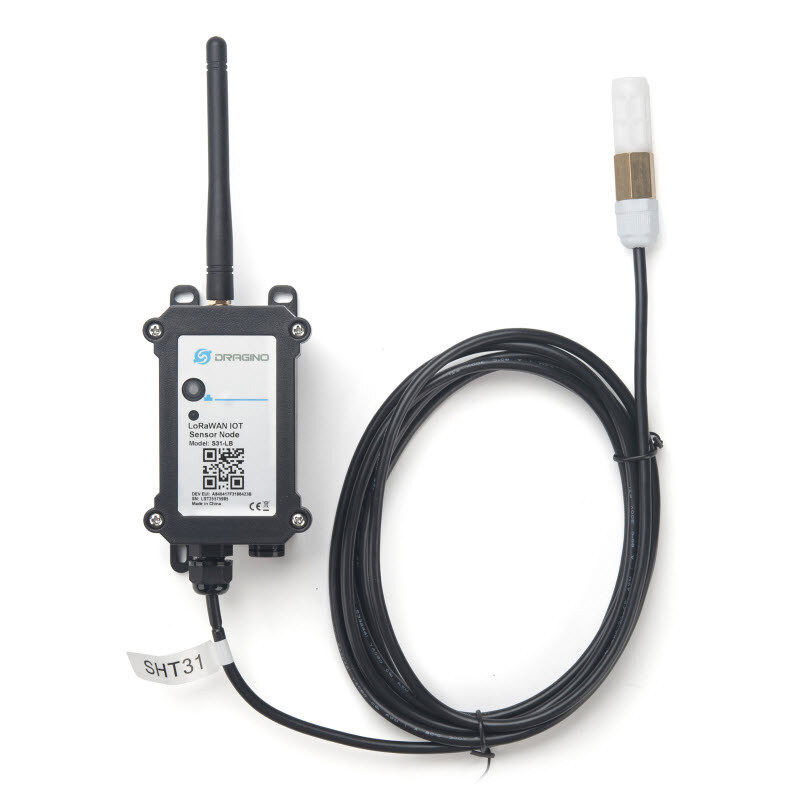
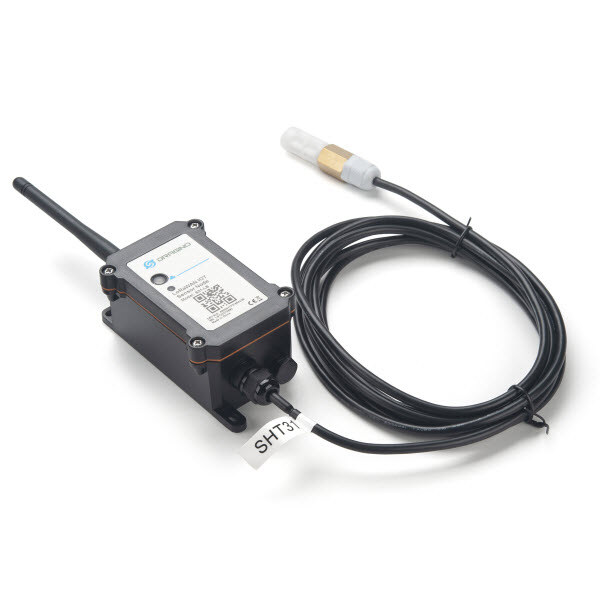
The Dragino S31-LB measures temperature and humidity where the measuring point is not where the radio device can hang. The Sensirion transducer does not sit in the enclosure but in its own waterproof sleeve on a three-metre cable — so the device stays on the accessible wall while measurement happens where it matters: in the cold store, in the chamber, under the ceiling, in the substrate of a planting. At ±0.2 °C and ±2 %RH it is considerably tighter than the usual room sensors, and the 8500 mAh cell carries it for years. The IP66 enclosure is built for outdoors, not merely tolerated there.
- ±0.2 °Caccuracy, 0 … 90 °C
- ±2 %RHhumidity, full range
- 3 mprobe cable
- IP66enclosure
- 8500 mAhLi-SOCl₂ cell
What defines the S31-LB
- Measurement is separated from radio: probe and transmitter are three metres apart. The measuring point can therefore be chosen by physics and the transmitter position by radio coverage — two requirements that regularly contradict each other on a compact device.
- A Sensirion SHT31, not an in-house part: the transducer fitted has a public datasheet and behaviour documented over years. ±0.2 °C and ±2 %RH are not marketing but the component’s specification — and they sit a class above what simple room sensors deliver.
- The probe is protected against condensation: the transducer sits in a waterproof sleeve that passes humidity but not water. This is precisely where open probes fail in cold stores and greenhouses: after the first condensation cycle they read permanently wrong.
- The timestamp comes from the device: every message carries a Unix time from the sensor, not the network server’s receive time. If delivery is delayed the series therefore stays chronologically correct — the precondition for it to serve as evidence.
- Alarm flag in every message: a dedicated bit shows whether the value has left a configured threshold. The back end does not have to test thresholds itself, and an alarm is not lost if processing falls behind.
- Device status on its own port: model, firmware version, frequency band and battery arrive on FPort 5, separate from the readings on FPort 2. For a fleet that means inventory can be queried without searching the measurement database.
- A large cell, soberly calculated: 8500 mAh of Li-SOCl₂ is three times that of a typical room sensor. The manufacturer states up to five years — for a device that powers an external probe before every measurement, that is a more honest figure than the ten-year promises of smaller devices.
- Configuration over the air: reporting interval and thresholds are set by downlink. A device on a hall ceiling stays where it is.
- Not tied to a platform: LoRaWAN 1.0.3, Class A, OTAA. Runs on TTN, ChirpStack and Swisscom LPN with the same device profile and the same decoder.
- Two power forms, one part number: where no battery change is wanted, the same device exists as the S31-LS with a solar panel and a rechargeable cell. Measuring and radio sections are identical, the integration stays the same.
Where the S31-LB is used
- Cold stores, cold warehouses, ripening rooms: device outside, probe inside, cable through the door seal. The radio path does not run through the metal door — the reason cold-store monitoring otherwise has gaps.
- Warehouses with humidity limits: paper, timber, electronics, animal feed. ±2 %RH is accurate enough to prove a limit rather than merely assert it.
- Greenhouses and indoor growing: the probe hangs in the crop, the device on the post. Condensation-protected, so still able to measure after misting.
- Plant rooms and halls: measurement under the ceiling or in the riser, transmitter at hand height. Maintenance without a ladder.
- Drying and process monitoring: temperature and humidity at the point that governs the process, not at the point that happens to be accessible.
- Outdoor climate on buildings: IP66 on the enclosure and a protected probe allow façade mounting; the operating range runs from −40 to 85 °C.
- Evidence towards third parties: thanks to the device’s own timestamp the series stays unbroken and chronological even if delivery falls behind.
- Large rollouts: one part number for indoor and outdoor measuring points, one decoder, one spare — and through the S31-LS variant the solar version as well, with no new integration.
That covers the purchase decision. What follows is the depth needed for radio planning, integration and operation.
Why three metres of cable are more than an accessory
On a compact device the transducer is where the antenna is. That sounds harmless but in practice decides whether a measurement is usable or not. Three examples, all with the same core: in a cold store the transmitter has to go outside because the metal door kills the radio path — the measurement has to stay inside. In a hall you need to measure where the warm air stands, so under the ceiling, while maintenance has to happen at hand height. In a greenhouse the probe belongs in the crop, but the transmitter belongs where it is not in the way of every operation.
Consequence for planning: the three metres are not a convenience but the degree of freedom that decouples the two requirements. They are also the limit — anyone needing more will not get further with this device, and an extension is no small matter on a digital SHT31 bus, because signal integrity depends on cable length.
Assessment from field practice, not a manufacturer statement: the probe sleeve is why this device stays usable for years in damp surroundings, and at the same time the reason for a sluggishness one needs to know about. A protected probe follows a humidity step more slowly than an open one — immaterial for room climate and storage, but not for controlling a fast drying process. Anyone wanting to capture steps on a scale of minutes should check that on the actual setup rather than infer it from the datasheet.
Payload and integration
Readings arrive on FPort 2 in fixed order: two bytes of battery voltage in millivolts, four bytes of Unix timestamp, one byte holding the alarm flag, the mode and the state of input PA8, then two bytes of temperature as a signed value with a factor of ten and two bytes of humidity with a factor of ten. Device status — model, firmware, frequency band, sub-band, battery — travels separately on FPort 5.
For the integration this means two things. First, the decoder must evaluate the port, otherwise status messages end up as implausible readings in the time series — an error that only shows when somebody analyses the data. Second, the transmitted timestamp should be used as the measurement time rather than the receive time. With LoRaWAN, minutes can pass between measurement and delivery; for a series serving as evidence that is the difference between right and nearly right.
Data at a glance
| Transducer | Sensirion SHT31 in a waterproof, condensation-protected sleeve, 3 m cable |
| Temperature | sensor −40 … +80 °C · ±0.2 °C across 0 … 90 °C · resolution 0.1 °C |
| Humidity | 0 … 99.9 %RH · ±2 %RH across the full range · resolution 0.01 %RH |
| Operating temperature | −40 … 85 °C |
| Radio | LoRaWAN 1.0.3, Class A, OTAA · EU868 |
| Payload | FPort 2 readings · FPort 5 device status |
| Power | 8500 mAh Li-SOCl₂, not rechargeable · manufacturer: up to 5 years |
| Enclosure | IP66 · 200 × 120 × 55 mm · 370 g |
| Versions | S31-LB battery · S31-LS solar with 3000 mAh Li-ion · S31B with the transducer inside the enclosure |
On the range figures: the manufacturer gives −40 to +80 °C for the sensor and an operating range of −40 to 85 °C for the device. The accuracy figure of ±0.2 °C refers to 0 to 90 °C and therefore extends beyond the sensor range — that is the SHT31 component’s specification, not the finished device’s. Outside 0 to 80 °C the tolerance is wider; by how much, Dragino does not say. For cold-store temperatures below 0 °C one should therefore not count on two tenths of a degree, but compare the setup once against a reference instrument.
Recensioni
Ancora non ci sono recensioni.