
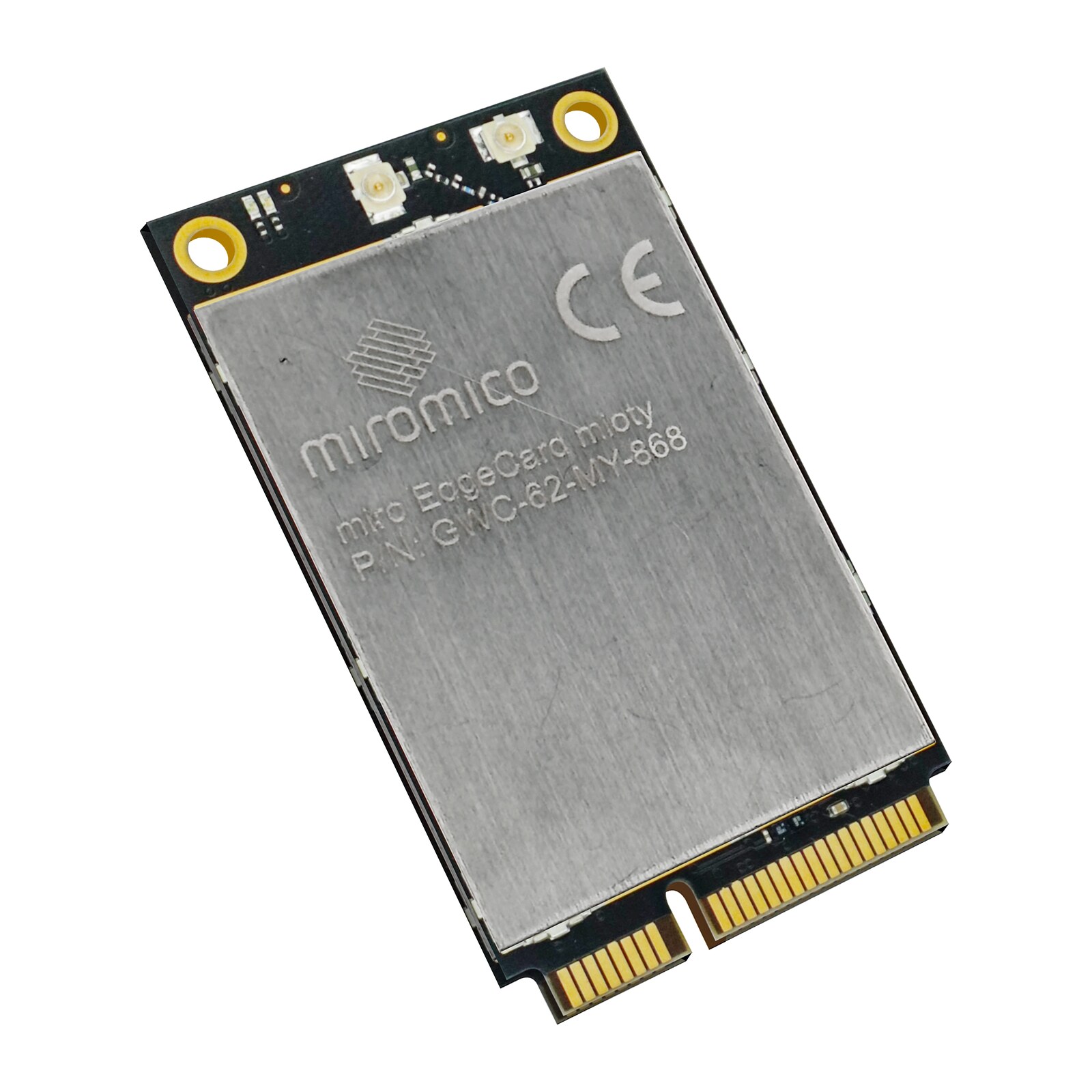
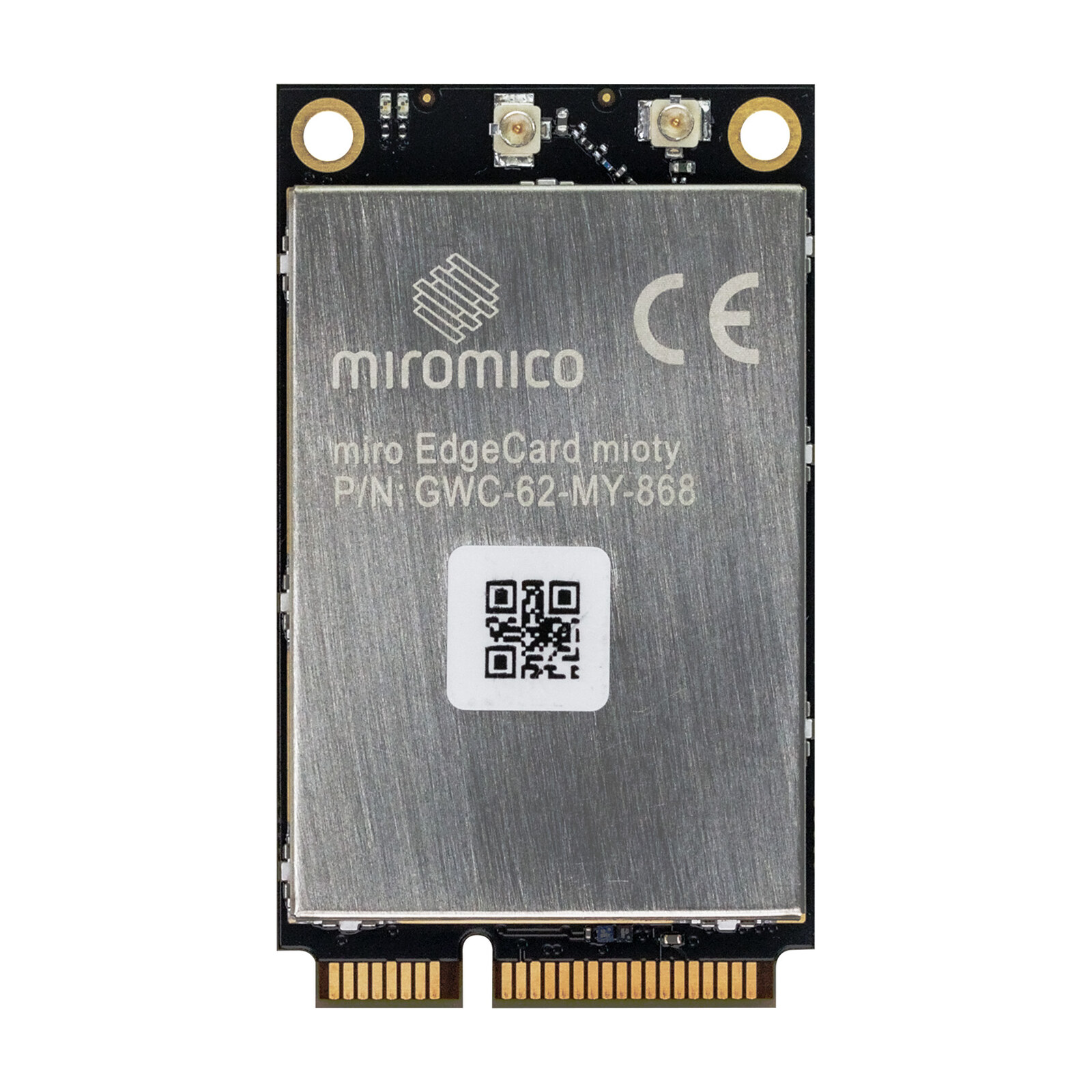
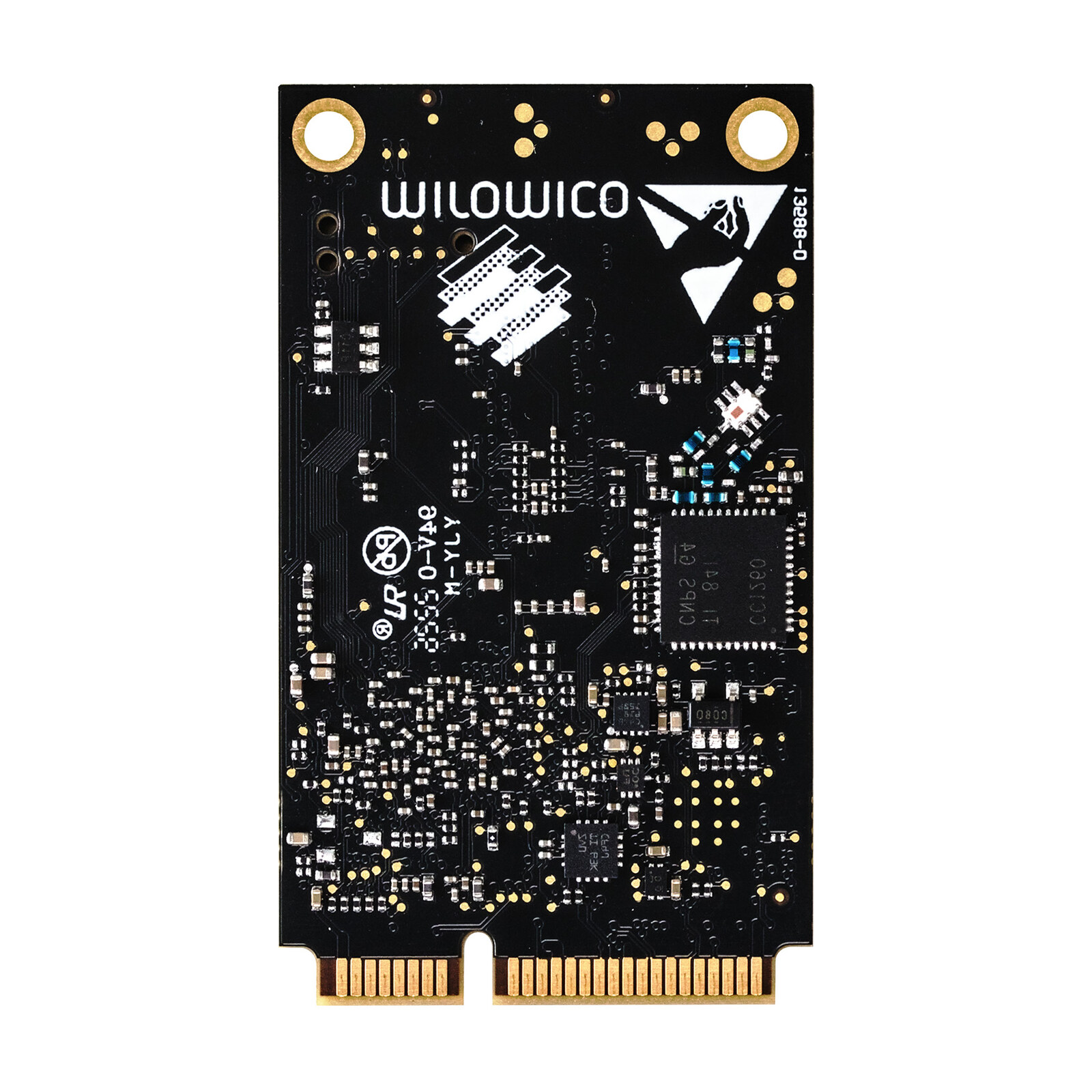


The miro EdgeCard mioty turns any device with a Mini PCIe slot into a full mioty base station. The radio section, the processor and the base station software all sit on the card itself: it receives the telegrams, reassembles them and passes finished data to a mioty Service Center through the standardised BSSCI interface. The host computer only ever sees a USB network device and needs no computing power for the radio. For a device developer that means: anyone who wants to add mioty to their own gateway, a cabinet controller or an industrial device plugs in a card instead of writing a radio stack. Behind the card stands Miromico in Zurich — the same development that produced the LoRaWAN card and the finished miro Edge gateways.
- 24 dBmTransmit power
- −136 dBmSensitivity
- 3.5 millionTelegrams per day
- 1.65 WPower draw
- Mini PCIeForm factor
What sets the EdgeCard mioty apart from an ordinary radio card
- The telegrams are decoded on the card, not on the host: the mioty base station software runs on the card’s Sitara processor, a quad-core Cortex-A53. The host computer receives finished BSSCI data and does not have to provide any computing power for radio decoding — a small ARM computer or a frugal industrial PC is enough.
- The radio section is a software defined radio: receiver and transmitter are not cast in silicon but implemented in software. What the card can do can therefore be extended by firmware — it already carries switches for additional transmission schemes that are switched off today.
- It appears as a network device, not as an exotic radio card: the Mini PCIe slot carries USB 2.0 following the Communication Device Class. Every host system that speaks USB CDC sees a network interface — no proprietary kernel driver, no tinkering with the operating system.
- Antenna diversity without opening the enclosure: the card selects between its two antenna branches in software, with nobody having to unscrew the device. In environments full of reflections — control cabinet, plant room, sheet metal facade — the better branch can be determined during operation.
- Power amplifier and low-noise preamplifier are built in: the radio frequency front end sits on the card. You neither have to design an external power amplifier nor optimise the receive path for noise yourself — the trickiest part of gateway development disappears.
- mioty splits every message into many short sub-packets: the parts are sent scattered across time and frequency, and the base station reassembles the message as soon as enough of them have arrived. An interferer that cuts in briefly therefore never hits the whole message.
- The capacity is designed for dense installations: the telegram figure in the key data above is not an unconditional laboratory value but a manufacturer specification given for a packet error rate of at most 1 per cent. That is the number you can base a remote meter reading project on.
- The interface to the Service Center is standardised and encrypted: BSSCI is the cross-vendor interface between base station and Service Center; the card supports it with TLS and, optionally, with mutual authentication via mTLS.
- The base station licence is installed at the factory: there is no later activation and no licence key that gets lost when a card is replaced. The card works as a base station as soon as it is plugged in.
- Full-length Mini PCIe form factor with shielding can: the card keeps to the dimensions of the standard and carries a soldered shielding can over the radio section. That keeps spurious emissions in check when the card sits next to a computer board.
- Power comes from the slot: no second supply lead, no auxiliary power supply in the enclosure. What the host provides at its Mini PCIe slot is enough for the card.
What the card is used for
- Building your own mioty gateway: you decide on enclosure, host and power supply, and buy in the certifiable radio section. That shortens gateway development from a radio project to an integration task.
- Adding mioty to an existing device: many industrial computers, edge gateways and cabinet controllers have a free Mini PCIe slot that was originally meant for a cellular modem. The card fits right in there.
- Remote meter reading and smart metering: water, heat and electricity meters transmit rarely, but for years and from basements. It is precisely for this mixture of high device counts and poor radio conditions that the telegram splitting scheme was designed.
- Property and facility management: one base station per building, hundreds of sensors below it — and a radio scheme that copes better with reinforced concrete and lift shafts than most narrowband systems.
- Industry 4.0 and machine monitoring: in halls with drives, welding plants and radios the interference spectrum is broad. Because a message consists of many short parts, it survives where a single long packet would be lost.
- Logistics and supply chain: load carriers and containers in motion produce a frequency offset. The scheme is designed to absorb such deviations rather than fail on them.
- Large rollouts: whoever equips many sites ultimately pays not the card price but the running cost. A card that fits into a uniform host device and obtains its firmware over the network interface keeps that cost low.
- Laboratory, acceptance testing and pre-series: for test benches and endurance runs the card plugs into an ordinary computer. For tests without real end devices it brings a switchable emulator mode with virtual end points.
This is mioty — not LoRaWAN. The two schemes share the 868 MHz band and nothing else. A LoRaWAN sensor does not join this base station, and a mioty end device finds no LoRaWAN gateway. If you are looking for a gateway card for LoRaWAN, the miro EdgeCard 02 is the identically built sister card.
This is a card, not a finished gateway. It still needs a host device with a Mini PCIe slot and USB, an 868 MHz antenna, an enclosure and a network connection — all of that comes from you. Anyone who wants a mioty base station to unpack and plug in is better served by the miro Edge Indoor mioty or the version with LTE.
Without a Service Center there is no data. The card delivers BSSCI — the counterpart that turns it into usable data is not part of the delivery. Miromico offers the version GWC-62-MY-868-NM for that, which contains the Service Center and Application Center software; we procure it on request.
Conformity of the finished device is yours. The card carries the CE marking, but the device you build it into does not get it automatically. Antenna routing, antenna placement and proof of the exposure limits are, according to the manufacturer, the system integrator’s business; Miromico explicitly names a minimum distance of 20 cm between antenna and body and rules out operation together with another antenna or transmitter at the same location. On top of that comes the requirement that the enclosure prevent unauthorised physical access to the card.
That is the purchase decision covered. What follows is the depth needed for sizing, integration and acceptance.
The technology in detail
Why mioty transmits differently from everything else in the shop that works on 868 MHz. LoRa buys range with time: a packet is spread and occupies the channel for a long while — the greater the distance, the longer. Anyone who interferes during that time destroys the whole message. mioty takes the opposite route. The message is split into many short sub-packets that are sent scattered across time and frequency; the base station collects them and reconstructs the message even when some of the packets are missing. The scheme is called telegram splitting and is standardised as ETSI TS 103 357 — so it is not one vendor’s house format. This comparison comes from application practice and is meant as a selection aid, not as a certification statement by the manufacturer.
What software defined radio means here in practice. The receiver is not a fixed circuit but a computing engine that evaluates the digitised antenna signal. Two things follow from that. First, the same card can be operated as a plain sub-GHz front end delivering raw I/Q data — for measurement tasks and for transmission schemes of your own. Second, functions are already present that are not switched on today: a variable MAC identifier, two additional transmission layers for particularly frugal and for faster end devices, direct access to the PHY MAC level as well as diagnostic and measurement interfaces. They are released through configuration switches. Anyone firmly planning on one of these functions should clarify with us beforehand what is released in which firmware.
Where the card’s limit lies. It is a base station, not an end device and not a network server. The payload flows overwhelmingly from the end devices towards it — mioty is a decidedly uplink-heavy scheme, and anyone who regularly wants to push large amounts of data down to the devices has picked the wrong band and the wrong scheme. On top of that, the transmit time limit in the 868 MHz SRD band applies equally to everyone: the card’s transmit power extends the range, not the permitted transmit duration. That too is an assessment from practice and not a manufacturer specification.
What the card costs in operation
| Quantity | Value and what follows from it |
|---|---|
| Energy demand in continuous operation | From the power draw in the key data above, roughly 14.5 kWh per year follows — less than the host computer draws at idle. In the energy bill of a base station the card is not the item worth thinking about. |
| Cooling | No active cooling foreseen. At this dissipation, convection in the host enclosure is enough as long as the card does not sit directly above a power supply or a processor heat sink. |
| Maintenance | No wear parts, no battery, no calibration. The recurring effort is limited to firmware maintenance. |
| Firmware maintenance | Miromico publishes firmware packages together with a checksum file and a software bill of materials. For operators who have to document their supply chain, the bill of materials is the decisive part — it answers the question of which third-party components are inside the card. |
Integration into your system
In the Mini PCIe slot the card only occupies the USB lines; the PCI Express signals remain unused. After power-up a USB CDC network interface appears on the host. Through it the card is configured, and through it the BSSCI connection to the Service Center also runs. The host is therefore not a passive carrier but has to forward the traffic between card and network — that is the one task regularly forgotten during integration, which later shows up as “the base station will not come up”.
The connector additionally provides an Inter-IC bus with a fixed participant address, two status outputs for light emitting diodes on the enclosure and two separate reset lines — one for the card, one for the input and output component. The status outputs are the simplest way of showing a service technician on site, without a screen, whether the base station is running. Anyone already using the host’s Inter-IC bus for their own components should check the address for duplication beforehand; it is given below in the specifications table.
The full description of the interface, the configuration switches and the firmware update is kept by Miromico in its technical documentation. The entry points to it and the data sheet are in the “Documents” tab above this description.
Versions of this card
We stock the European version with base station software. The version with additional Service Center and Application Center software is procured on request.
| Order number | Difference | Availability |
|---|---|---|
| GWC-62-MY-868 | base station software, EU868 band | This is the version you order here |
| GWC-62-MY-868-NM | Service Center and Application Center software additionally on the card | on request |
Technical specifications
The general product data — dimensions, weight, temperature and humidity ranges, antenna connector, interface, origin and manufacturer number — are in the details table further down this page. What follows is what does not belong there.
| Radio | |
|---|---|
| Radio scheme | mioty according to ETSI TS 103 357, telegram splitting |
| Implementation | software defined radio on the main processor, optionally as a sub-GHz I/Q front end |
| Antenna diversity | two branches, selected in software |
| Radio frequency front end | low-noise preamplifier and power amplifier on the card |
| Processing | |
| Processor | Texas Instruments Sitara AM62x, four Cortex-A53 cores |
| Base station software | mioty BS Core Library, licensed at the factory |
| Memory | DDR4 working memory and flash on the card, plus an EEPROM |
| Interface to the host | |
| Data path | USB 2.0, Communication Device Class, visible on the host as a network interface |
| Application interface | BSSCI to the mioty Service Center, TLS and mTLS supported |
| Inter-IC bus | participant at address 0x20 — check for duplication before use |
| Status outputs | two outputs for light emitting diodes on the host enclosure |
| Reset lines | separate for card and for the input and output component |
| Pins used | supply 3V3, ground, USB D+ and D− as well as the signals named above; all other pins are not connected |
| Optional functions | |
| switched off at the factory | variable MAC identifier, transmission layer for particularly frugal end devices, transmission layer with a higher data rate, direct access to the PHY MAC level, emulator mode with virtual end points, diagnostic and measurement interfaces |
| Release | through configuration switches in the firmware |
| Mechanics | |
| Form factor | Mini PCI Express at full length, shielding can over the radio section |
| Circuit board thickness | 1 mm |
| Mounting | two holes Ø 2.6 mm, 24.2 mm between centres |
Installation and commissioning
The card keeps to the dimensions of the Mini PCIe standard but carries a shielding can and therefore measures 3.9 mm overall. That is the value an installation fails on: slots designed for a flat memory card or an unshielded cellular modem do not have that height free everywhere. Before designing an enclosure it is therefore worth a look at the dimension drawing — the two holes and their spacing are dimensioned there just like the overall height.
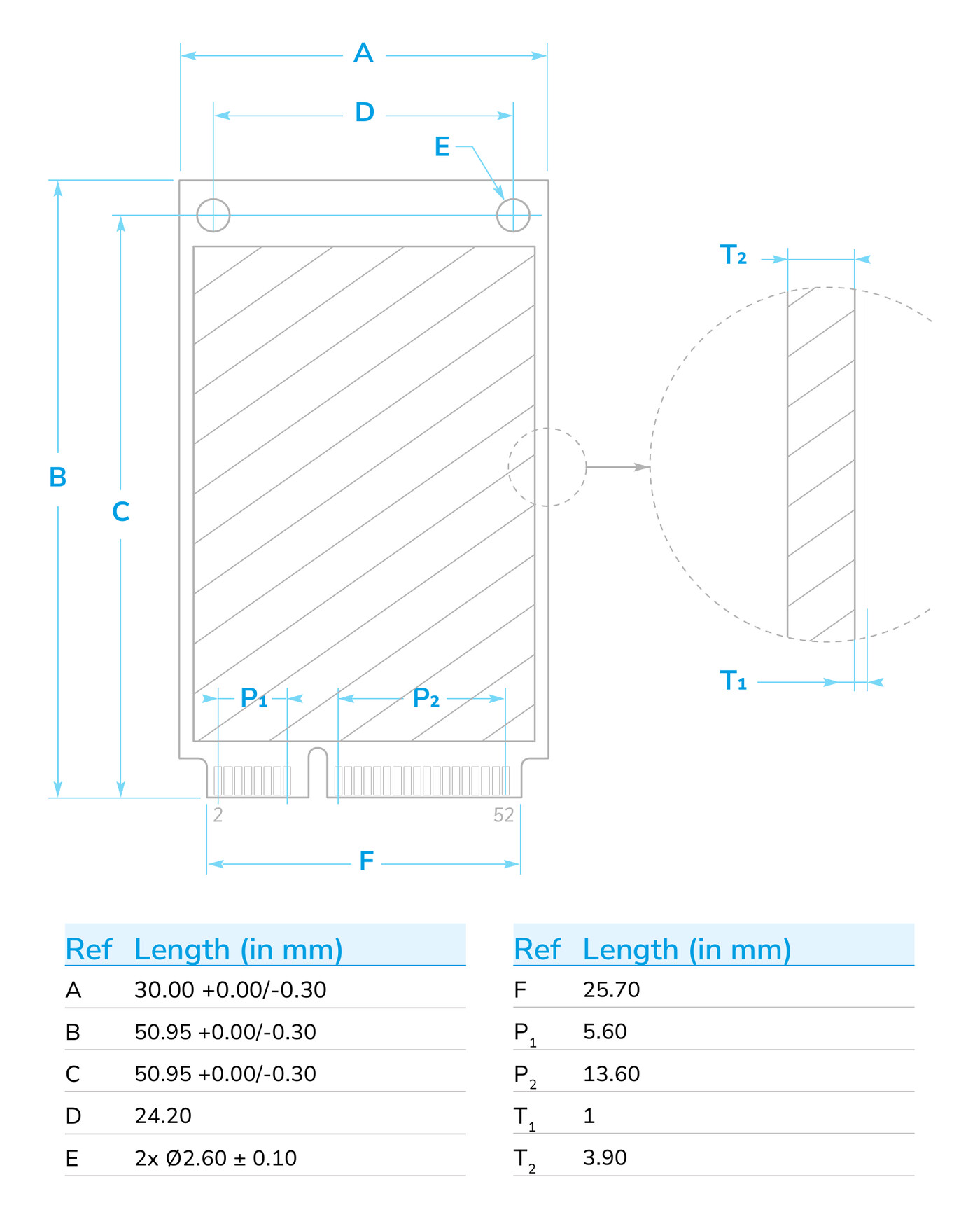
The dimension drawing from the data sheet with its accompanying table: A is the width, B and C the length, D the spacing between the centres of the two mounting holes E, T1 the thickness of the circuit board and T2 the overall height. All values in millimetres.
About the antenna. Both connectors are miniature connectors of the U.FL type. They are not made to be plugged often, and they do not belong on an enclosure wall. The usual and correct approach is a short transition cable from U.FL to a socket in the enclosure wall, to which the actual antenna is then fitted. Such a cable comes with the antenna we name below as an accessory. Do not forget strain relief: the U.FL socket on the card is the weakest point of the whole chain.
About acceptance testing. Plan the time for testing the finished device, not only for development. The card itself is tested; the device it sits in does not become tested by that. Anyone who fixes the antenna routing early and does not change it afterwards is spared the second measurement campaign.
Matching accessories and alternatives from our range
- Antenna with a matching transition cable: the 868 MHz antenna, 5 dBi, with a 21 cm extension from U.FL to RP-SMA brings exactly what the card needs: the transition from the miniature connector to a socket in the enclosure wall. The band matches, mioty and LoRaWAN share it.
- The matching mioty end device for testing: a base station cannot be commissioned without an end device. The miro Insight mioty sensor with CO2 measurement is currently the only mioty end device in our range and therefore the shortest path to the first received message.
- If it is to be a finished device: the miro Edge Indoor mioty is the base station in an enclosure, with Ethernet and power over the network cable. The version with LTE is the one to take where no network socket is available.
- The same form factor for LoRaWAN: the miro EdgeCard 02 plugs into the same slot and turns the host into a LoRaWAN gateway instead of a mioty base station. Anyone who needs both installs both cards — provided there are two slots.
Support with sizing
Get in touch before ordering if you are unsure whether your host device fits — whether the slot offers the required height, whether it carries the USB lines and whether your operating system recognises the network interface without an additional driver. These questions are part of purchase advice and cost nothing. The data sheet and the technical documentation are in the “Documents” tab. For radio planning, for sizing a base station density across several properties, for preconfiguration in quantity or for support through a device approval we will gladly prepare you a quotation.

Reviews
There are no reviews yet.