
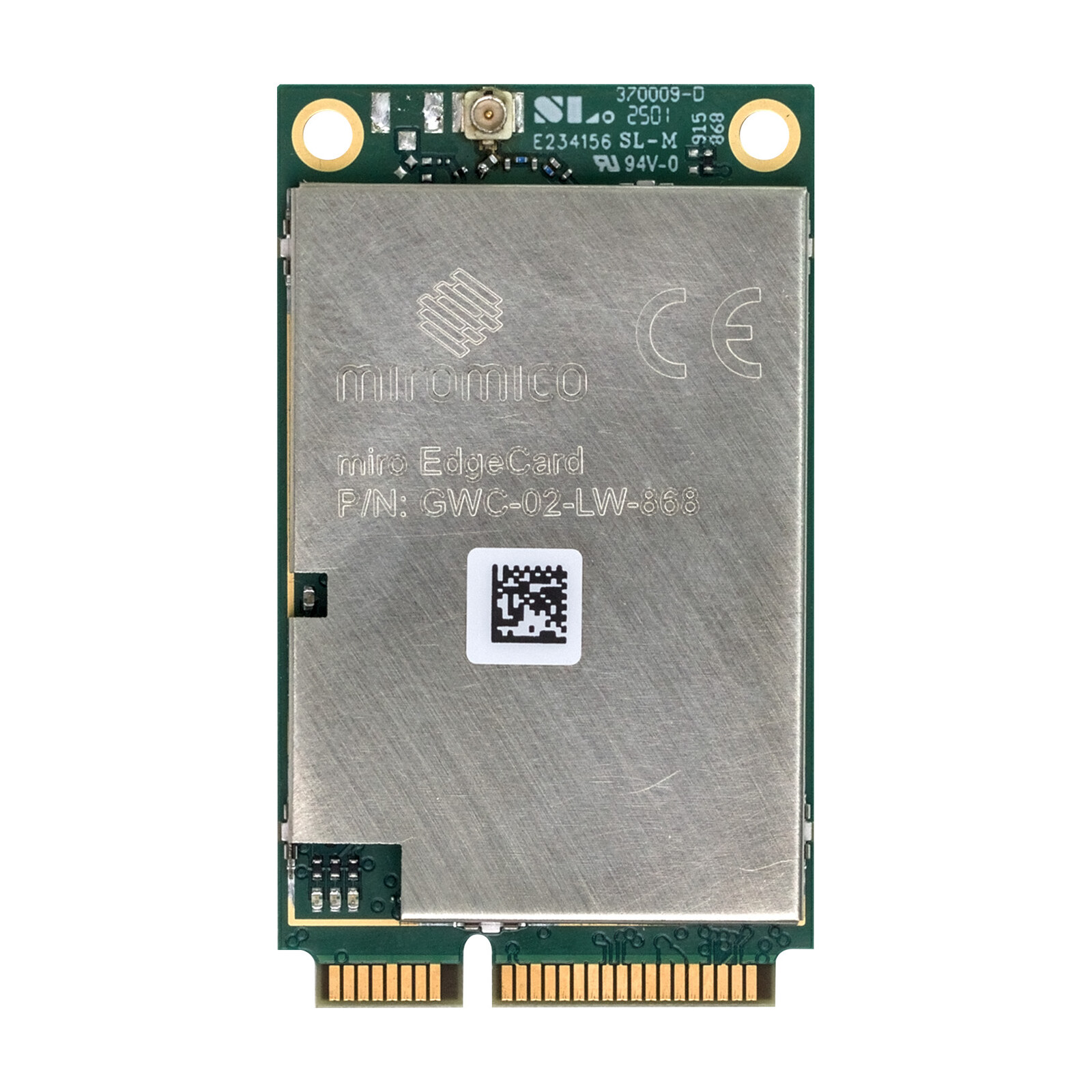
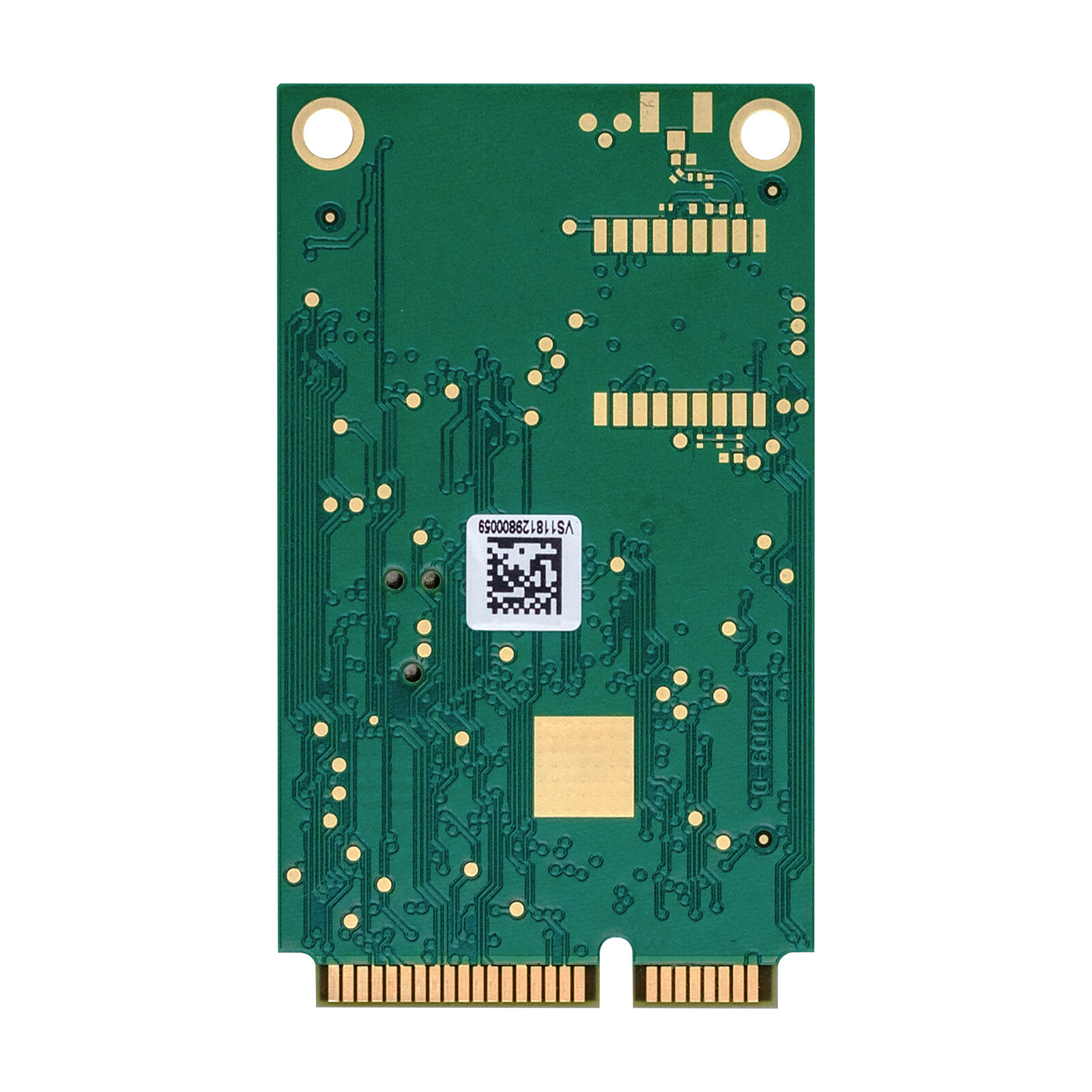


The miro EdgeCard 02 turns a device with a Mini PCIe slot into a LoRaWAN gateway. On the card sit Semtech’s concentrator chip, two receive branches and a transmit path of its own with a power amplifier; towards the outside it appears over USB as a serial interface onto which Semtech’s open driver layer fits directly. For device developers this is the short route to a gateway of their own: you decide on enclosure, computer and network connection, and buy the tricky radio section as a tested assembly. Behind the card stands Miromico in Zurich — the same development that produced the mioty card and the finished miro Edge gateways.
- 27 dBmTransmit power
- −139.5 dBmSensitivity at SF12
- Listen before talkdedicated transmit path
- SX1302Concentrator chip
- Mini PCIeForm factor
What sets the EdgeCard 02 apart from an ordinary concentrator card
- The transmit path is independent and can listen first: alongside the concentrator and the two receive branches sits a further transceiver that is responsible for transmitting alone. It handles listen before talk and spectrum scanning — so the gateway checks whether the channel is free before it transmits.
- From that follows the most important sentence on this page: with listen before talk, operation beyond the usual one per cent transmit time limit that otherwise applies in the European 868 MHz band becomes possible. For a gateway that has to acknowledge many end devices and deliver downlinks, that is the difference between “works” and “does not work”.
- The transmit mask is cleaner than with a shared transmit branch: because the transmit path is not branched off the receive section as an afterthought, emissions in the adjacent channels stay lower. That pays off when several gateways stand close together.
- The concentrator demodulates in parallel, not one after another: a gateway therefore does not have to guess when which end device transmits — it listens on all channels at once. How many that is can be found in the details table at the bottom of this page.
- The driver layer is open and maintained: the card works with the open-source hardware abstraction layer for the SX1302. You are not dependent on a vendor’s binary package, and the common packet forwarders and network server connections build on it.
- It appears over USB, not over SPI: many concentrator cards expect an SPI link and therefore a circuit board you design yourself. This one speaks USB — every host system with a Mini PCIe slot and a USB connection gets by without hardware development of its own.
- The firmware can be exchanged while installed: dedicated pins trigger the loading process, and the new image arrives over USB. For an update you therefore have to neither remove the card nor attach a programming adapter.
- Status indicators without logic of your own: two outputs for light emitting diodes and a signal reporting a valid configuration are led outwards. A device thus shows its state on the front panel without the host having to do anything.
- A serial line to the card’s microcontroller is exposed: for diagnosis and development this is the route you cannot avoid during fault finding when the USB side stays silent.
- Full-length Mini PCIe form factor with shielding can: the card keeps to the dimensions of the standard and carries a soldered shielding can over the radio section, which keeps spurious emissions in check.
- Power comes from the slot: no second supply lead, no auxiliary power supply in the enclosure — although the slot really does have to deliver the peak current while transmitting.
What the card is used for
- Building your own LoRaWAN gateway: you decide on enclosure, host, power supply and backhaul, and buy in the certifiable radio section. A radio project becomes an integration task.
- Adding LoRaWAN to an industrial computer: the free Mini PCIe slot that was originally meant for a cellular modem takes the card. That is the fastest way to give an existing plant controller a radio network.
- Gateways in your own enclosure for special environments: the protection rating, mounting method and connectors of an off-the-shelf gateway do not always fit — in the control cabinet, in a hazardous area, at the machine. With a card you build the enclosure around the radio section instead of the other way round.
- Dense networks with a high downlink share: wherever the gateway has to acknowledge or command a lot — actuators, valves, thermostat heads — a gateway without listen before talk hits the transmit time limit. Here the dedicated transmit path is the reason to buy.
- Private networks on your own premises: works site, campus, farm. The card combined with a small computer and a network server of your own gives a network that needs no outside infrastructure.
- Series products with a radio link: anyone building their own device in quantity would rather buy in a tested radio section than develop it and have it individually approved.
- Large rollouts: a uniform card in a uniform host device keeps the running cost low — one spare part, one firmware level, one procedure for replacement.
- Development and test bench: for range measurements, acceptance tests and laboratory setups the card plugs into an ordinary computer, without anyone having to open a gateway.
This is a card, not a finished gateway. It still needs a host device with a Mini PCIe slot and USB, an 868 MHz antenna, an enclosure, a network connection and a LoRaWAN network server — all of that comes from you. Anyone looking for a gateway to unpack and plug in should take the RAK7268CV2 WisGate Edge Lite 2+ for indoors and the WisGate Edge Prime RAK7240CV2 for outdoors. From Miromico themselves there are the miro Edge with internal antenna and the version with LTE.
We stock the European version. This card works in the 868 MHz band. The version for 915 MHz and the version for 2.4 GHz are procured on request — they are not the same product and they are not switchable.
Do not confuse it with the older EdgeCard 08. The predecessor card with the SX1308 has been declared end of life by Miromico. Anyone maintaining an existing design cannot simply swap the two: it is a different concentrator chip with a different driver layer.
Conformity of the finished device is yours. The card carries the CE marking, but the device you build it into does not get it automatically. Antenna routing, antenna placement and proof of the exposure limits are, according to the manufacturer, the system integrator’s business; on top of that comes the requirement that the enclosure prevent unauthorised physical access to the card.
That is the purchase decision covered. What follows is the depth needed for sizing, integration and acceptance.
The technology in detail
Why three radio components instead of one. The concentrator handles the digital signal processing, two transceivers form the two receive branches, and a further transceiver serves the transmit path exclusively. This division of labour is the reason for two properties that stand next to each other in a data sheet and yet belong together: the clean transmit mask and the ability to listen before transmitting. A transmit branch that shares its component with the receiver cannot, in principle, do both equally well.
What listen before talk changes in practice. The European regulation for the 868 MHz band permits a transmit time of one per cent in most sub-bands. A gateway serving hundreds of end devices gets into trouble with that as soon as the application calls for confirmed transmissions or control commands. The regulation provides channel-checked transmission as an alternative: whoever measures before transmitting and only transmits on a free channel is not subject to the rigid time limit in the same form. The card brings the technology for that — whether and how you may make use of it depends on the sub-band, on the transmit power and on the edition of the applicable standard. This assessment comes from practice and replaces neither an examination by a notified body nor legal advice.
Where the card’s limit lies. It is a concentrator, not a network server. What becomes of the received packets is decided by the software behind it: a packet forwarder on the host, then a network server in your network or in the cloud. Without that part the card only delivers raw packets. It is also not an end device — it cannot run as a sensor in someone else’s network. And it does not replace a site survey: the sensitivity in the key data above applies in the laboratory, not behind a fire wall.
What the card costs in operation
| Quantity | Value and what follows from it |
|---|---|
| Current draw | Less than 1 A from the slot’s 3.3 volt rail, so under roughly 3.3 W. What matters is not the average but the peak while transmitting: the host’s slot has to be able to deliver it without the voltage collapsing. |
| Energy demand in continuous operation | In continuous operation the annual demand lies in the range of a few tens of kilowatt hours — a minor item next to the host computer. |
| Cooling | No active cooling foreseen. While transmitting, the area around the power amplifier warms up noticeably; an air gap above the shielding can is therefore better than an enclosure part resting directly on it. |
| Maintenance | No wear parts, no battery, no calibration. The recurring effort is limited to firmware maintenance and to maintaining the driver layer on the host. |
Integration into your system
In the Mini PCIe slot the card only occupies the USB lines; the PCI Express signals remain unused. On the host a serial USB interface appears, onto which the open-source hardware abstraction layer for the SX1302 builds. Then follows the usual chain: packet forwarder on the host, network server, application. Anyone who does not want to reinvent the wheel uses the same building blocks that sit in every bought gateway — the difference is in the enclosure, not in the software.
The connector additionally carries the signals a device builder needs: an input that triggers the loading process for new firmware, a line to switch off the radio section, a reset line, two outputs for light emitting diodes, a signal for a valid configuration and a serial line to the card’s microcontroller. On top of that comes a voltage output of 1.2 V. The full pin assignment is in the data sheet; the practically important signals are listed below in the specifications table.
Firmware images, the sources of the driver layer and the technical documentation are published by Miromico. The entry points to them and the data sheet are in the “Documents” tab above this description. Note the manufacturer’s product change notice on the USB identifier: anyone recognising the card by its identifier should check, before a series device, which identifier the current firmware reports.
Versions of this card
We stock the European version. The remaining versions we gladly procure on request.
| Order number | Difference | Availability |
|---|---|---|
| GWC-02-LW-868 | EU868 band, SX1302 | This is the version you order here |
| GWC-02-LW-915 | US915 band, otherwise identical | on request |
| GWC-80-LW-2G4 | 2.4 GHz band, ranging, different radio components | on request |
| GWC-08-LW-868 | predecessor card with SX1308 | declared end of life by the manufacturer |
Technical specifications
The general product data — dimensions, weight, temperature and humidity ranges, antenna connector, interface, origin and manufacturer number — are in the details table further down this page. What follows is what does not belong there.
| Radio | |
|---|---|
| Components | concentrator SX1302, two receive components SX1250, dedicated transmit component SX1261 |
| Special capabilities | listen before talk and spectrum scanning via the dedicated transmit path |
| Spreading factors and bandwidths | SF7 to SF12 at 125, 250 and 500 kHz |
| Further modulations | 0.6 to 300 kbit/s with frequency shift keying; in addition GFSK, MSK, GMSK, ASK and OOK for protocols of your own |
| Radio frequency front end | power amplifier on the card, shielding can over the radio section |
| Interface to the host | |
| Data path | USB 2.0 over the contacts of the Mini PCIe slot, visible on the host as a serial interface |
| Software | open-source hardware abstraction layer for the SX1302 |
| Firmware update | while installed, over USB, triggered through dedicated pins |
| Status signals | two outputs for light emitting diodes, one output for a valid configuration |
| Further signals | reset line, switch-off line for the radio section, serial line to the microcontroller, voltage output 1.2 V |
| Pins used | supply 3V3, ground, USB D+ and D− as well as the signals named above; all other pins are not connected |
| Power supply | |
| Current draw | less than 1 A from the slot’s 3.3 volt rail |
| Mechanics | |
| Form factor | Mini PCI Express at full length |
| Circuit board thickness | 1 mm |
| Mounting | two holes Ø 2.6 mm, 24.2 mm between centres |
Installation and commissioning
The card keeps to the dimensions of the Mini PCIe standard but carries a shielding can and therefore measures 3.9 mm overall. That is the value an installation fails on: slots designed for a flat memory card or an unshielded modem do not have that height free everywhere. Before designing an enclosure it is therefore worth a look at the dimension drawing — the two holes and their spacing are dimensioned there just like the overall height.
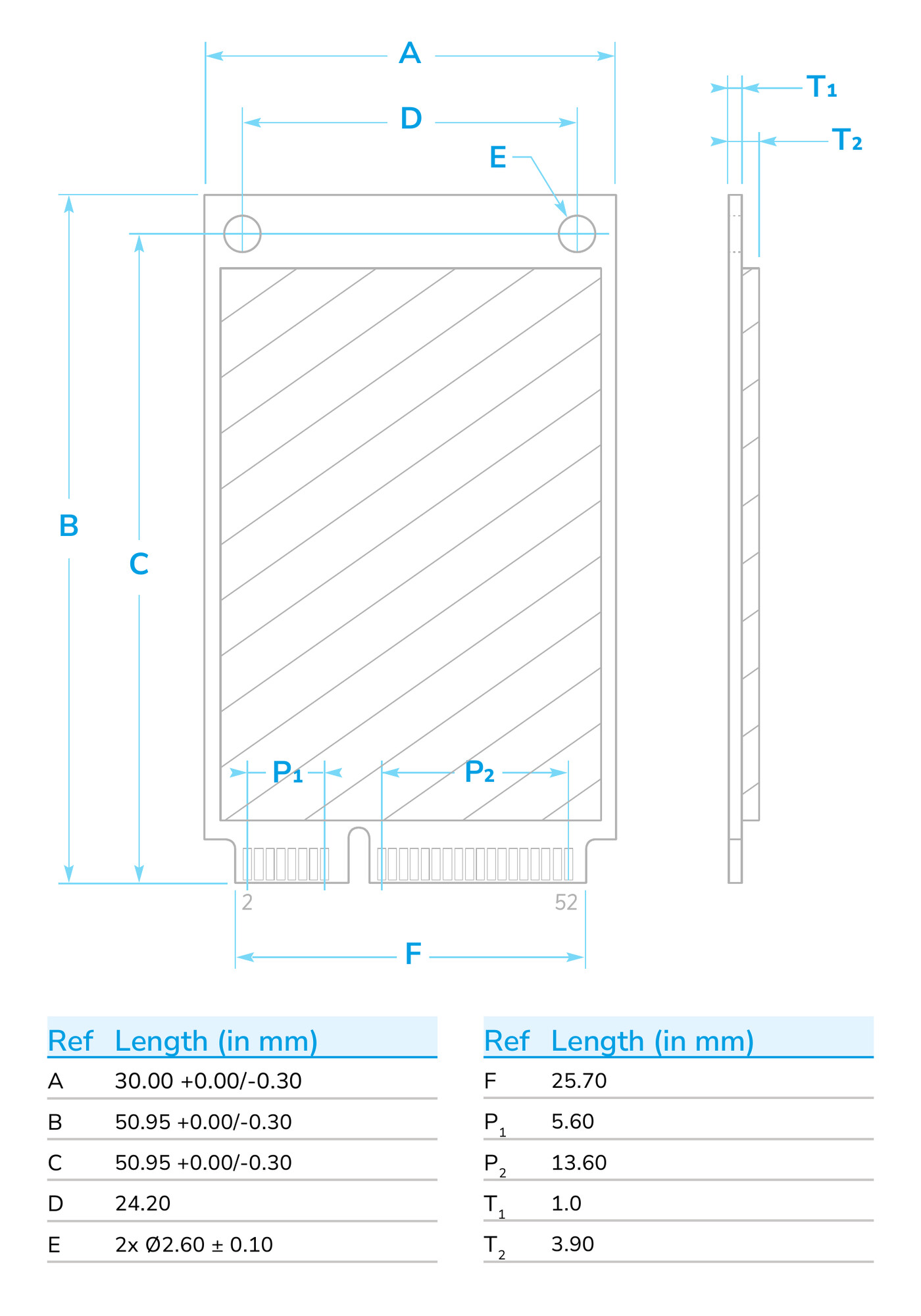
The dimension drawing from the data sheet with its accompanying table: A is the width, B and C the length, D the spacing between the centres of the two mounting holes E, T1 the thickness of the circuit board and T2 the overall height. All values in millimetres.
About the antenna. The connector is a miniature connector of the U.FL type. It is not made to be plugged often, and it does not belong on an enclosure wall. The usual and correct approach is a short transition cable from U.FL to a socket in the enclosure wall, to which the actual antenna is then fitted. Such a cable comes with the antenna we name below as an accessory. Do not forget strain relief: the U.FL socket on the card is the weakest point of the whole chain.
About the power supply. When in doubt, measure what your host’s slot actually delivers while transmitting. A voltage dip at the moment of transmission does not show up as an error message but as a gateway that sporadically restarts or loses packets — a fault pattern you search for a long time without that suspicion.
About acceptance testing. Plan the time for testing the finished device, not only for development. The card itself is tested; the device it sits in does not become tested by that. Anyone who fixes the antenna routing early and does not change it afterwards is spared the second measurement campaign.
Matching accessories and alternatives from our range
- Antenna with a matching transition cable: the 868 MHz antenna, 5 dBi, with a 21 cm extension from U.FL to RP-SMA brings exactly what the card needs: the transition from the miniature connector to a socket in the enclosure wall.
- The same form factor for mioty: the miro EdgeCard mioty plugs into the same slot and turns the host into a mioty base station instead of a LoRaWAN gateway. Anyone who wants to serve both radio networks installs both cards — provided there are two slots.
- If it is to be a finished gateway, indoors: the RAK7268CV2 WisGate Edge Lite 2+ with LTE is our best-selling indoor gateway and arrives ready to connect with enclosure, antenna and power supply.
- If it is to be a finished gateway, outdoors: the WisGate Edge Prime RAK7240CV2 is built for mast and facade and brings the protection rating with it.
- From Miromico, in an enclosure: the miro Edge with internal antenna and the version with LTE are the finished gateways from the same manufacturer.
Support with sizing
Get in touch before ordering if you are unsure whether your host device fits — whether the slot offers the required height, whether it carries the USB lines and whether it delivers the peak current while transmitting. These questions are part of purchase advice and cost nothing. The data sheet, the driver layer and the technical documentation are in the “Documents” tab. For radio planning, for sizing the gateway density across a site, for preconfiguration in quantity or for support through a device approval we will gladly prepare you a quotation.


Reviews
There are no reviews yet.