
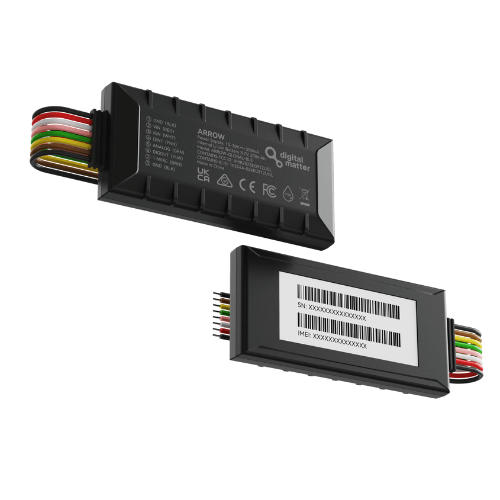
The Arrow Global BLE is a hardwired vehicle tracker — and at the same time a Bluetooth gateway on wheels. It locates through four satellite systems, reports over 4G with 2G fallback and reads BLE sensors in the vicinity along the way: temperature probes in the load space, tags on tools, levels in containers. On top come the functions that separate a telematics device from a plain locating device — crash detection with second-by-second data, driver identification, remote immobilisation. It connects to the vehicle supply and needs no battery changes.
- ~1.5 mlocating accuracy
- 4G Cat 1biswith 2G fallback, worldwide
- BLE 4.2gateway for wireless sensors
- 10 … 30 Vvehicle supply, hardwired
What sets the Arrow Global BLE apart
- It locates and reads at the same time: the Bluetooth function turns the tracker into a mobile gateway. A temperature probe in a refrigerated body or a tag on a tool therefore needs no mobile connection of its own — the tracker collects and sends in bundles. That lowers the cost per monitored object considerably.
- Four satellite systems instead of one: GPS, GLONASS, Galileo and BeiDou together, plus a low-noise preamplifier with a SAW filter. In urban canyons and car park entrances, the number of visible satellites decides whether there is a position at all.
- The Swiss bands are there: LTE Cat 1bis with B20 and B28 — the bands that matter here. If 4G drops, 2G remains as a fallback.
- Black box in a crash: crash and rollover detection with up to two hours of second-by-second data. If the question later arises of what exactly happened, there is an answer instead of a guess.
- It knows who is driving: driver identification by RFID or iButton, with driving behaviour analysis. In a fleet with changing drivers, that is the precondition for attributing data to anyone at all.
- Inputs and an output: ignition, one digital input, one analogue input up to 30 V and a switched ground output rated 2 A. That allows bodies, pumps or auxiliary loads to be monitored and switched as well.
- It notices interference: GPS jammer detection, tamper alarm and a recovery mode. A tracker that can simply be drowned out is worthless against theft.
- Built for the vehicle supply: 10 to 30 V with load dump protection and a self-healing fuse — designed for the voltage spikes that actually occur in a vehicle. An internal backup battery still reports when someone disconnects the supply.
- Backhaul as you choose: TCP, HTTPS webhook, MQTT and a documented interface. The data does not have to land in a particular platform.
Where it is used
- Fleet management: cars, vans and service vehicles — position, driving times, driving behaviour.
- Construction and agricultural machinery: equipment with an on-board supply, where operating hours and auxiliary loads also matter.
- Cold chain: the tracker reads BLE temperature probes in the body and delivers position and temperature in one data stream.
- Rental: proof of use, return control and — through remote immobilisation — leverage when something is not returned.
- Tool and material tracking: BLE tags on equipment travelling in the vehicle. What gets forgotten at unloading becomes visible.
- Theft protection: geofences, jammer detection and recovery mode work together.
- Larger fleets: because one device covers both locating and sensors, the number of subscriptions per vehicle drops.
That settles the selection. What follows is the depth for installation and integration.
What the Bluetooth gateway means in practice
A BLE sensor has no connection of its own to the outside; it broadcasts into its surroundings and waits to be heard. That is exactly what this tracker takes care of: it receives the broadcasts of tags and probes in the vehicle, collects them and passes them on together with the position. For the calculation that means one mobile subscription per vehicle instead of one per sensor. With a refrigerated body holding three probes and a dozen tagged tools, that is the difference between bearable and uneconomic.
The limit lies in range and cadence. Bluetooth carries reliably within the vehicle but not across the car park; a tag left behind at a customer is no longer seen. And the sensors report at their own interval, not on demand — the data is as fresh as the slowest transmitter in the set. For temperature monitoring that is uncritical, for a real-time display it is not.
Technical data
The general product data — manufacturer part number, dimensions and origin — is in the detail table further down this page.
| Locating and radio | |
|---|---|
| Satellite systems | GPS, GLONASS, Galileo, BeiDou; low-noise preamplifier with SAW filter |
| Accuracy | around 1.5 m |
| Mobile | 4G LTE Cat 1bis, all important bands including B20 and B28; 2G as fallback |
| Bluetooth | 4.2, as a gateway for BLE tags and sensors |
| Interference detection | GPS jammer detection |
| Inputs and outputs | |
| Inputs | ignition, 1 × digital, 1 × analogue 0 … 30 V |
| Output | 1 × switched ground output, 2 A |
| Driver identification | RFID or iButton via 1-Wire |
| Operation | |
| Power supply | 10 … 30 V vehicle supply, load dump protection, self-healing fuse |
| Backup battery | 200 mAh internal, for alarm messages when the supply is cut |
| Quiescent current | under 1 mA |
| Event detection | crash and rollover, up to 2 hours of second-by-second recording |
| Further functions | geofencing, driving behaviour analysis, tamper alarm, recovery mode, remote immobilisation |
| Backhaul | TCP, HTTPS webhook, MQTT, documented interface |
Installation
The device is hardwired: permanent positive, ground and ignition. The installation position decides the locating quality — under a metal trim or deep in the dashboard, the antenna sees little of the sky. A position with as clear a view upwards as possible and some distance from control units and the ignition system has proven itself. A tracker that only delivers imprecise positions after installation usually has no reception problem but a placement problem.
For vehicles under warranty it is worth checking beforehand whether intervention in the vehicle electrics is permitted. And remote immobilisation, if used, belongs on a circuit whose interruption does not put the vehicle into a dangerous state.
Fitting alternative
- Without an on-board supply: for trailers, containers and parked machinery the Digital Matter Oyster3 4G is the device — battery-powered, with movement-based reporting and years of runtime.
Help with sizing
Unsure whether the hardwired or the battery-powered type suits your fleet, or which BLE sensors can be integrated? Tell us what is to be monitored — this question is gladly settled in conversation, because it decides the subscription costs of the coming years. And if it turns into a project — sizing, pre-configuration in quantity or connection to your systems — we will gladly put together a quote.
Reviews
There are no reviews yet.