
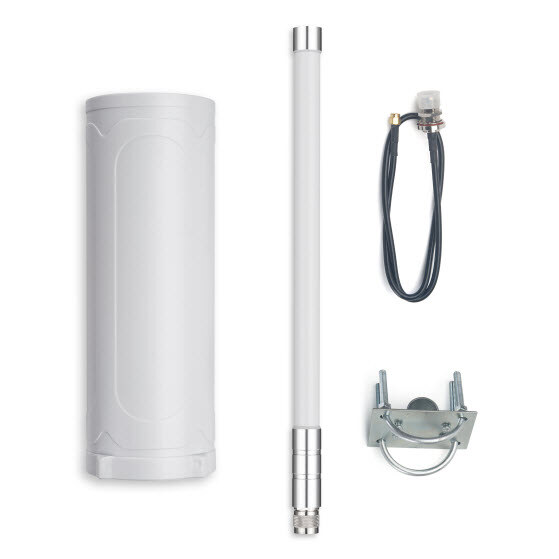
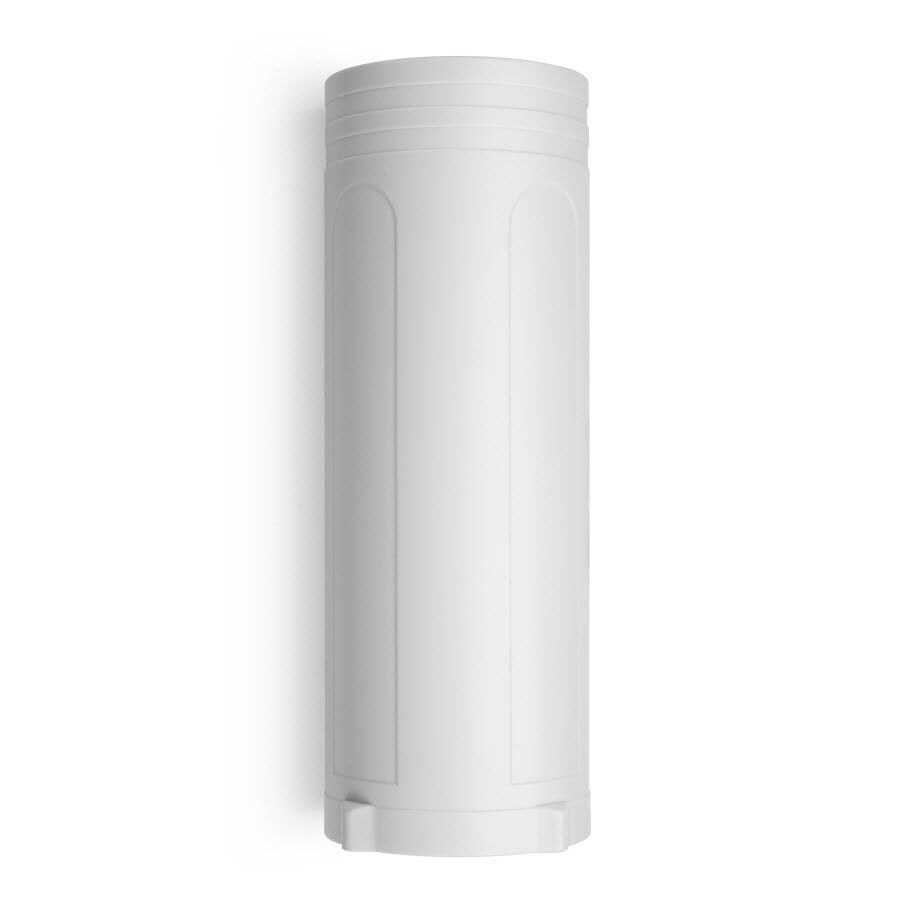
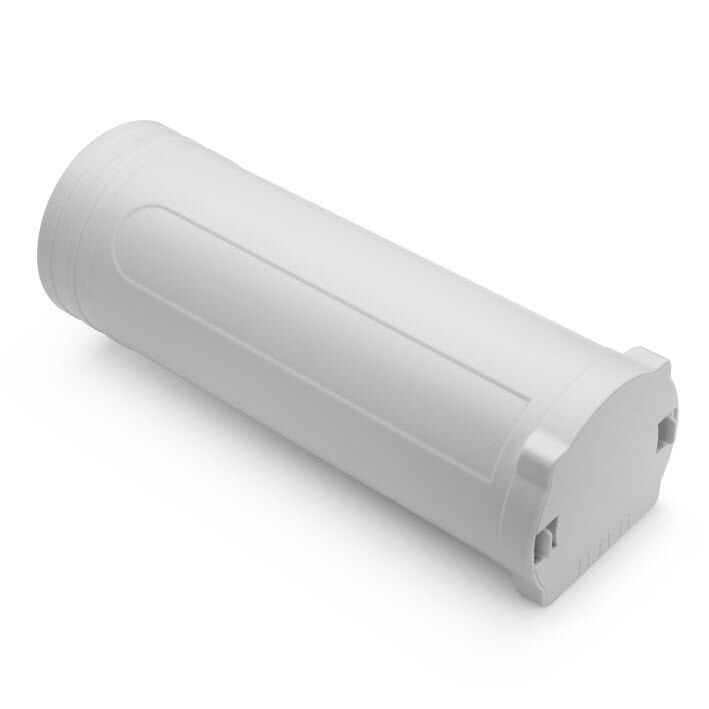
The Dragino DLOS8N is the outdoor gateway with which a LoRaWAN network of your own begins. It picks up the radio telegrams of the sensors within range and passes them on over Ethernet, WiFi or optionally cellular to a network server — a gateway does no more than that, and that is precisely the point most often misunderstood on a first build. It is made for outdoors: IP65 enclosure, fibreglass antenna included, operation from −20 to 85 °C and power either from the supplied adapter or over 802.3af PoE. Inside works the newer SX1302 concentrator, which draws noticeably less current than the older SX1301.
- SX1302concentrator
- IP65outdoor enclosure
- 802.3afPoE, 37 … 57 V
- −20 … 85 °Coperating range
- GPSbuilt in, time and position
What defines the DLOS8N
- Three paths to the network, one of them a fallback: Ethernet with PoE, WiFi to 802.11 b/g/n and, as an ordering variant, an LTE module that Dragino explicitly calls cellular failover. A gateway on a roof without a second path stays reachable exactly as long as the one line does.
- SX1302 instead of SX1301: Semtech’s newer concentrator does the same job at markedly lower power draw and runs cooler — in a closed outdoor enclosure in the sun that is not a detail but the difference between steady and intermittent.
- One supply, two ways: 12 to 24 V DC from the included adapter, or PoE to 802.3af at 37 to 57 V. On a roof PoE is almost always the better choice, because only one cable has to go up.
- Frugal in operation: 300 to 500 mA at 12 V, so roughly four to six watts. That is an order of magnitude a solar installation or a UPS can carry for hours.
- GPS for time and position: the built-in module provides an accurate time base — the precondition for Class B operation — and the gateway’s position, which makes inventory easier once several gateways are distributed.
- The fibreglass antenna is included: no follow-up order, no adapter, no guessing about gain. Together with the power supply and mounting hardware the device is ready to run.
- Open Linux, not a closed system: the gateway runs an open-source embedded Linux with a web interface. Anyone who wants to can reach the configuration files and the packet forwarder.
- Several modes towards the network server: Semtech UDP packet forwarder, LoRaWAN Station connection and MQTTS. That lets the device attach to practically any network server.
- Usable even without a network server: for simple setups the gateway can talk directly to ABP end devices, with no server in between. For test benches and closed installations that saves half the infrastructure.
- Two frequency models: the 868 version covers EU868, RU864, IN865 and KZ865. That is the one we carry; the 915 version is not relevant for Europe.
Where the DLOS8N is used
- First gateway for a network of your own: a roof, a mast, a yard — and the sensors in range no longer need a SIM card.
- Farms: one gateway at the highest point covers several kilometres in open country and therefore soil sensors, levels and gates across all parcels.
- Industrial sites and logistics areas: outdoor mounting saves coordinating with the building’s IT; all it needs is power and a network path.
- Municipal applications: levels, fill states, parking areas and street lighting all hang on the same gateway.
- Sites with an uncertain fixed line: the LTE variant takes line failure out of the calculation.
- Construction sites and interim networks: IP65 and mast mounting allow a build with no building envelope.
- Filling coverage gaps: a second gateway on the shaded side of a site — LoRaWAN end devices automatically report to whichever hears them best.
- Test and laboratory setups: the mode without a network server makes measurement series possible before the server landscape is in place.
That covers the purchase decision. What follows is the depth needed for planning, installation and operation.
What “49 demodulators” really means
The manufacturer’s figures say the device emulates 49 LoRa demodulators and one (G)FSK demodulator, with ten programmable parallel demodulation paths. That sounds like 49 channels and is not. What it means is: the concentrator listens on eight radio channels simultaneously and can process several spreading factors in parallel on each of them. Eight channels times six or seven spreading factors give the quoted number of demodulators.
Consequence for planning: for capacity it is the number of channels that matters, not the number of demodulators. Eight channels are the European standard and are enough for a few hundred sensors per gateway — in practice the limiting factor is almost always the legal duty-cycle limit on the end devices, not the gateway’s receiving capacity.
Assessment from field practice, not a manufacturer statement: anyone comparing gateway datasheets on the number of demodulators is comparing marketing. Three things are comparable: the number of radio channels, the receiver’s sensitivity and the quality of the antenna path. On the last point the installation decides more than the device — ten metres of thin antenna cable costs more signal level than lies between two gateway models.
Location and antenna
LoRaWAN lives on line of sight. Every metre of height widens the horizon, and every obstacle in the first Fresnel zone costs level. For the DLOS8N that means: mast or roof edge rather than windowsill, antenna vertical, and as short a cable as possible between antenna and device. The supplied fibreglass antenna is intended for direct mounting on the enclosure; anyone wanting to move it away has to allow for cable loss.
On powering it on a roof: PoE is almost always the better solution there, because only one cable goes up and the supply stays dry. Note the voltage figure of 37 to 57 V — that is the range of a compliant 802.3af injector. Passive PoE injectors at 24 V, as commonly found with WiFi accessories, do not belong on this device.
Data at a glance
| Concentrator | Semtech SX1302 with two SX1250 · 49 LoRa and 1 (G)FSK demodulator · 10 parallel demodulation paths |
| Frequencies | 868 model: EU868, RU864, IN865, KZ865 · custom bands possible |
| Backhaul | Ethernet 10/100 RJ45 · WiFi 802.11 b/g/n · optional EC25 LTE module as fallback |
| Power | 12 … 24 V DC, 2 A · or PoE to 802.3af, 37 … 57 V · consumption 300 … 500 mA at 12 V |
| Position and time | GPS module built in |
| Software | open-source embedded Linux · Semtech UDP packet forwarder · LoRaWAN Station · MQTTS · ABP operation without a network server |
| Enclosure | IP65 · operating temperature −20 … 85 °C · external fibreglass antenna |
| Shipping unit | 415 × 130 × 95 mm · 1255 g |
| Versions | DLOS8N without cellular · DLOS8N-EC25 with LTE module |
What the manufacturer does not state: the device dimensions without packaging, the antenna gain and the receiver sensitivity do not appear on the product page. For radio planning the last two in particular would be useful — to be asked of the manufacturer or taken from the SX1302 datasheet, which Semtech publishes.
Reviews
There are no reviews yet.