
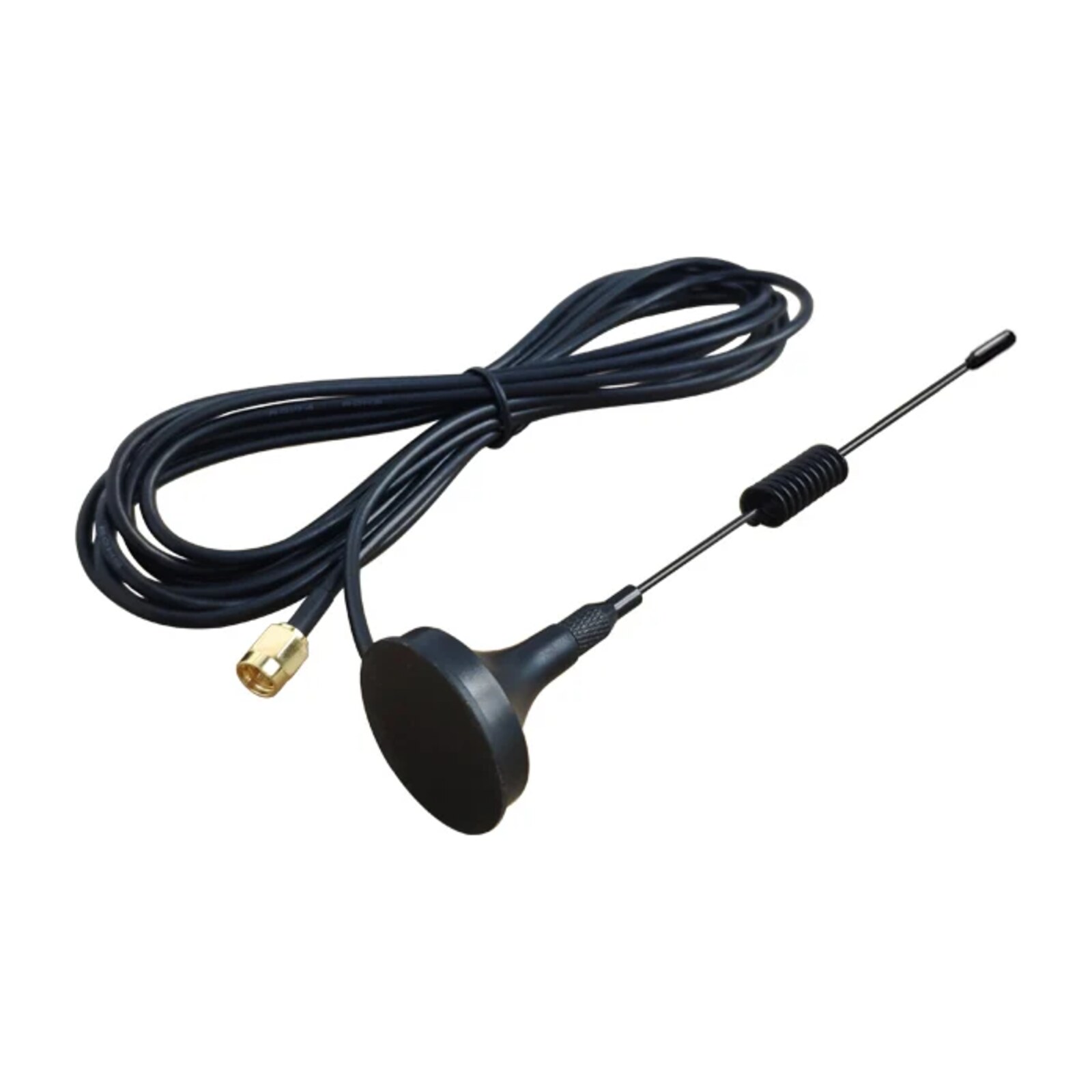
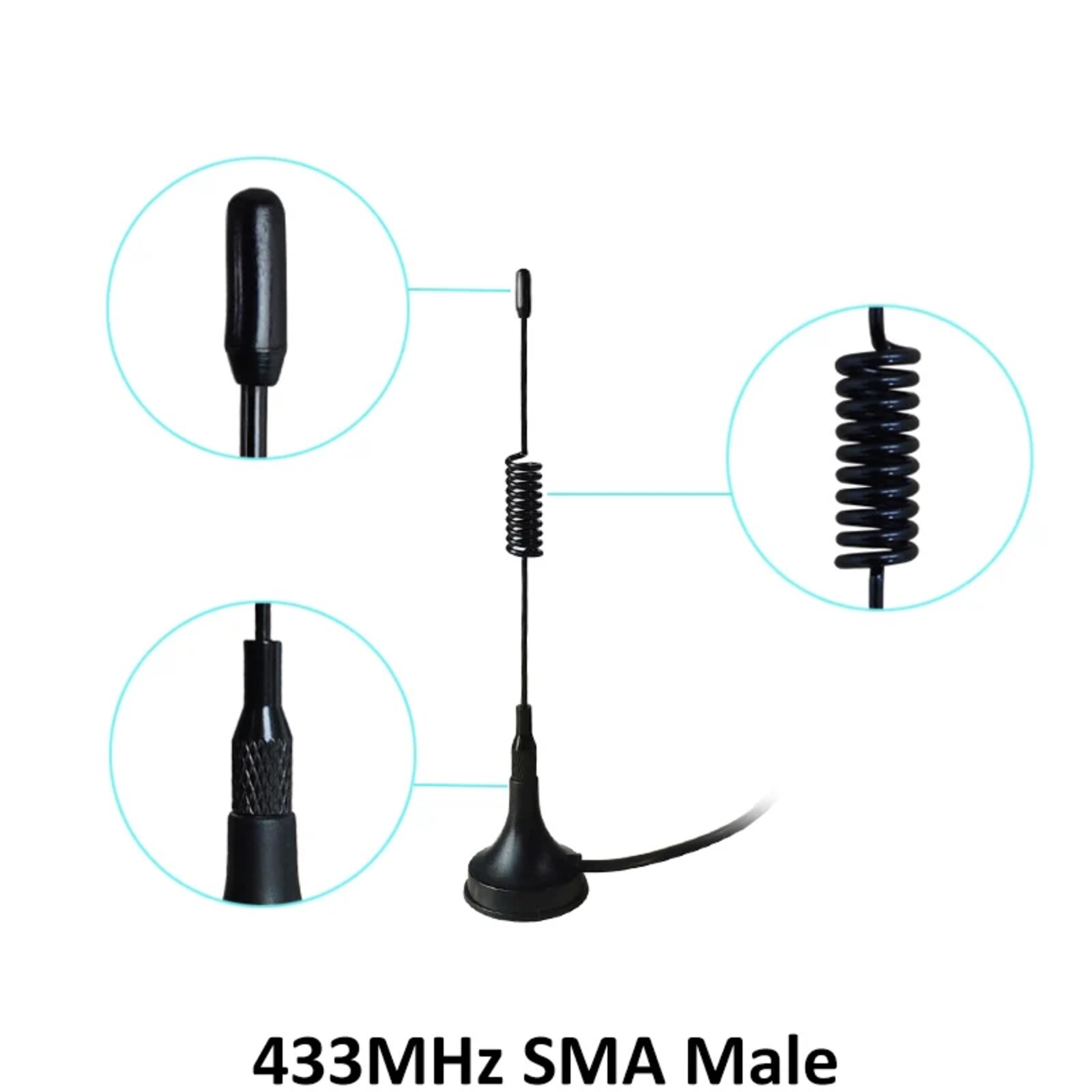
This antenna works on 433 MHz — not on the 868 MHz that LoRaWAN uses in Europe. That is the one sentence which decides between success and disappointment: screwed onto the wrong band, little of the range remains. On the right one it is a grown-up little antenna — a magnetic base that holds on any sheet of metal, a cable long enough to reach from inside a cabinet to the window, and a connector that mates with the usual module socket without an adapter. It is made for LoRa modules of the SX1278 family, for Meshtastic nodes on the EU_433 preset, for receivers of radio sensors and for the SDR stick on the workbench. We ordered this batch by mistake on 433 instead of 868 MHz and are selling it off while stock lasts.
- 433 MHzoperating frequency
- 3 mpermanently attached cable
- SMA plugconnection to the device
- 15.1 cmoverall height including base
- magnetic basemounting without tools
What this antenna delivers on 433 MHz
- The magnetic base is not just a holder, it is part of the antenna: a shortened radiator needs a conductive counter surface. Put the antenna on a cabinet, an enclosure lid or a sheet of metal and that surface becomes the counterpoise, flattening the radiation towards the horizon. Standing free on a desk, the same antenna performs worse — here the mounting surface is not an accessory but a component.
- The cable takes the antenna to where reception is: radio modules usually sit where power and network arrive — in a metal enclosure, in the basement, behind a concrete wall. With the attached cable the antenna moves out of the enclosure to the window, onto the cabinet lid or to the mast, while the device stays where it belongs.
- The loading coil turns a short rod into a quarter wave: on 433 MHz a quarter wave measures 17.3 cm. The radiator is shorter and makes up the missing electrical length with the visible coil in its upper third. That is why the antenna is resonant on the band despite its handy size — and at the same time why its usable bandwidth is narrower than that of a full quarter-wave radiator.
- The connector fits directly, without an adapter: an SMA plug with a centre pin belongs on the SMA socket carried by LoRa modules, Meshtastic devices and SDR receivers. Adapters, pigtails and the transition losses that come with them are not needed.
- More robust than a U.FL pigtail: the tiny U.FL connectors on development boards are rated by their makers for only a single-digit number of mating cycles and tear off readily. An SMA thread survives everyday laboratory use and can still be tightened with cold fingers in the field.
- Place it instead of mounting it: no drilling, no bracket, no clamp. For temporary setups, drive tests and experiments that is the real advantage — the antenna is moved in seconds and leaves no hole behind.
- 433 MHz is licence-free in Europe: the range 433.05 to 434.79 MHz is an SRD band; transmit power and duty cycle are limited, but no licence is required. That is the basis on which radio sensors, remote controls and the Meshtastic EU_433 preset operate there at all.
- The gain figure deserves context rather than belief: the manufacturer states 5 dBi. For a shortened radiator above a base of three centimetres that is very optimistic; realistically such a design sits closer to 1 to 2 dBi. This assessment comes from application practice and is meant as a selection aid, not as a measured value. Anyone who needs a documented gain figure should choose a fibreglass antenna with a data sheet.
Where it is used
- Meshtastic on EU_433: the second European preset alongside EU_868. Anyone deliberately meshing on 433 MHz gets the matching antenna for the node here.
- LoRa point to point: modules with SX1278 and related chips — RA-02, RFM98 and the usual breakout boards — work on 433 MHz, entirely without a LoRaWAN network and without a network server.
- Receiving radio sensors: weather stations, radio thermometers, tyre pressure sensors, door contacts and radio sockets transmit in the same band. With an SDR stick and the antenna at the window this becomes a receiving station.
- Workbench and laboratory: a known, always identical antenna as a reference point when two setups are to be compared. Thanks to the magnetic base it stands reproducibly in the same place.
- Prototyping: the antenna that sits on the module until the right one arrives — and that you can leave in the drawer afterwards without regret.
- Control cabinet and metal enclosure: the device stays inside, the antenna sits outside on the lid. The magnetic base and the cable are made for exactly this situation.
- Range measurement in the field: placed on a vehicle roof, the magnetic base provides a large counter surface and a reproducible height — more usable than any handheld antenna when a route is being surveyed.
The most important point first — this is not a LoRaWAN antenna: in Europe LoRaWAN runs on 868 MHz. This antenna is tuned to 433 MHz and is out of place on an 868 MHz device; it barely radiates there and, in the worst case, the mismatch stresses the transmitter output stage. For LoRaWAN, for our gateways and for every sensor on the Swiss network you need an 868 MHz antenna.
It suits: devices that genuinely transmit or receive on 433 MHz and that have an SMA socket — LoRa modules of the SX1278 family, Meshtastic nodes on the EU_433 preset, 433 MHz receivers and SDR sticks.
It does not suit: anything on 868 MHz. The equivalent antenna for the right band is the 868 MHz antenna with 5 dBi; if it has to connect to a U.FL socket, take the version with a 21 cm extension, and for a device where the antenna needs to fold over, the Grandwisdom 3 dBi with a hinge.
SMA or RP-SMA — the mix-up that happens most often: this antenna has an SMA plug with a centre pin. Many WiFi devices, by contrast, carry RP-SMA, where pin and socket are swapped: the threaded ring looks the same, but the counterpart has no receptacle for the pin. The two can be screwed together without any contact being made. If in doubt, ask us before ordering — a look into the thread is enough for us.
One-off batch: this item comes from a mistaken order and will not be reordered. Once the stock is gone, the item is gone.
That is the buying decision covered. What follows is the depth needed for planning and mounting.
The technology in detail
Why 433 MHz differs from 868 MHz — and why both have their place. The longer wave travels around obstacles better and penetrates deeper into buildings; that speaks for 433 MHz. Against it stands regulation: the 433 MHz SRD band permits considerably less transmit power than the 868 MHz band, and the band is densely occupied by remote controls, radio sockets and weather stations. On balance, 868 MHz therefore wins for LoRaWAN, while 433 MHz remains interesting where penetration matters and the transmit power is small anyway. This weighing up is an assessment from application practice; what counts are the applicable radio regulations and what your device supports.
Three metres of thin coax cost signal — that belongs in the calculation. The manufacturer does not specify the cable; its diameter and construction correspond to the usual thin coax of the RG174 type. For this kind of cable, roughly half a decibel of loss per metre is to be expected on 433 MHz, so about one and a half decibels over the full length. That is no reason to do without the cable — a position at the window instead of inside a metal cabinet returns a multiple of it. It is, however, the reason not to extend the cable further: beyond about five metres of this type the line eats more than the better position brings in.
No data sheet, and what follows from that. For this antenna the manufacturer publishes neither a data sheet nor a measurement report; the figures in the table come from the supplier’s product documentation. Standing wave ratio, bandwidth and permissible transmit power are documented nowhere. Anyone designing an installation that rests on proven values is better served by an antenna with a data sheet. For a test setup, for receiving and for mesh operation this is no obstacle — there what counts is that it is resonant on the right band and solidly built.
Technical data
The general product data — gain, connection, brand, origin, dimensions — are in the details table further down. Here only what does not appear there.
| Radio frequency | |
|---|---|
| Impedance | 50 Ω |
| Polarisation | vertical with the radiator upright |
| Radiation pattern | omnidirectional in the horizontal plane |
| Standing wave ratio, bandwidth, permissible transmit power | not stated by the manufacturer |
| Mechanics | |
| Magnetic base | Ø 30 mm |
| Cable | 3 m, permanently attached, thin coax of the RG174 type |
| Cable termination | straight SMA plug, gold-plated centre conductor |
| Documents | |
| Data sheet | not published by the manufacturer |
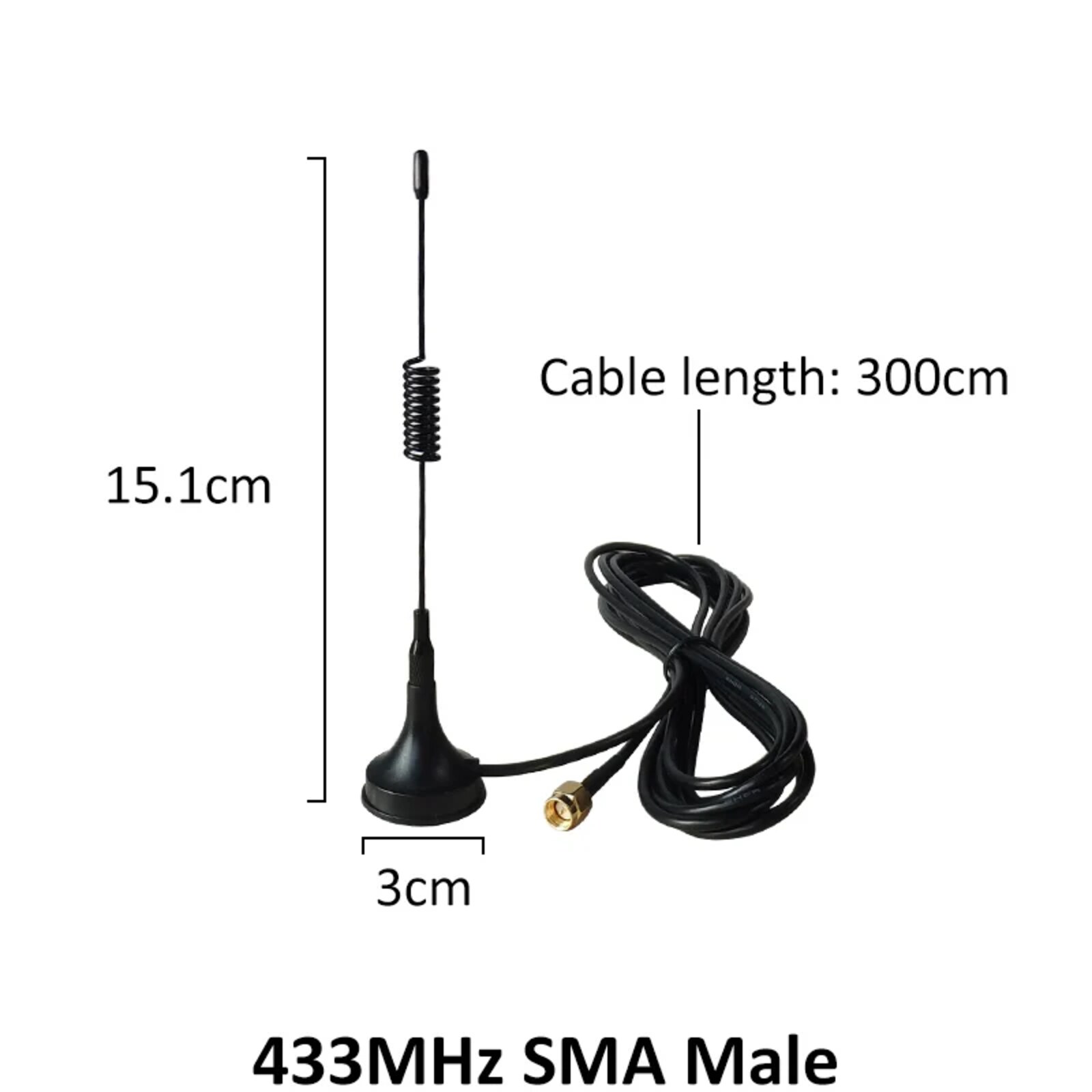
The dimensions come from the manufacturer’s dimensioned illustration. The 15.1 cm is the overall height from the underside of the base to the tip; the radiator alone is correspondingly shorter. The 3 cm is the diameter of the magnetic base.
Mounting and commissioning
First the surface, then the antenna. Look for the largest continuous metal surface you can find for the base — cabinet lid, enclosure top, vehicle roof. The larger it is, the better the shortened radiator works, and the flatter the radiation goes towards the horizon instead of into the sky. On wood, plastic or a desk the antenna does work, but loses noticeably. In such a case a piece of sheet metal as an underlay is not a joke but the cheapest improvement available.
Stand it upright and keep your distance. The radiator belongs upright; lying down, its polarisation no longer matches the other station, which easily costs several decibels. From metal walls, sheet edges and cable looms it should keep a distance about equal to its own height — placed directly against a cabinet wall it detunes. Tighten the connector finger-tight only: SMA threads are small, and an over-tightened thread is the most common cause of death for these connectors.
Do not coil the cable. Lay the excess length in loose loops, not as a tight bundle. And when taking the base off, slide it sideways instead of pulling on the cable — the strain relief at the base is where these antennas usually fail.
Matching accessories and alternatives
- The device to go with the antenna: the LilyGo TTGO T-Beam V1.1 in the 433 MHz version is the board in our range that works on this band — with ESP32, GPS and an SMA socket that this antenna screws onto directly.
- If it has to be 868 MHz after all: the 868 MHz antenna with 5 dBi for modules with an SMA socket, the version with a U.FL extension for boards without SMA, and the Grandwisdom 3 dBi with a hinge when the antenna needs to fold over.
- When two plugs meet: if the antenna is to join a cable that itself ends in an SMA plug, the piece with two sockets is missing — the SMA female to SMA female antenna coupler covers exactly that case.
Reviews
There are no reviews yet.