
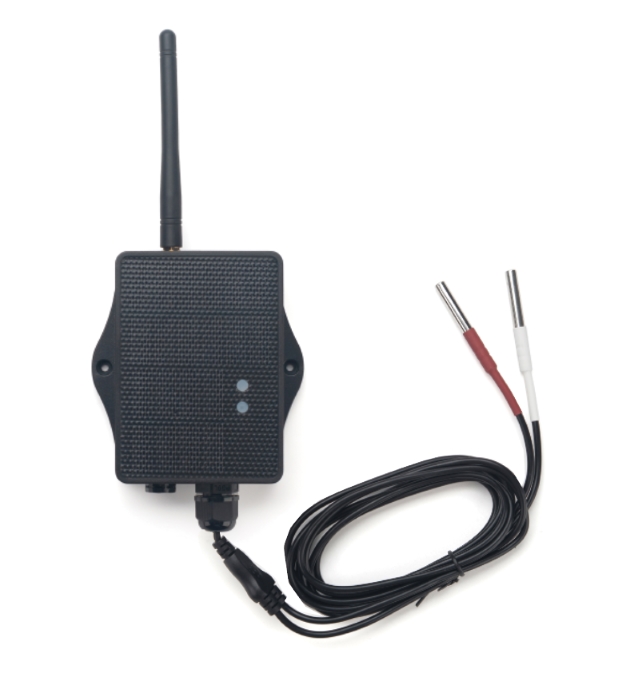
The Dragino D22-NS measures in two places at once: two DS18B20 probes in stainless steel, each on 1.5 m of cable, on one device with one battery and one radio link. That is more than half the saving against two separate devices — on a flow and return, top and bottom of a cylinder, inside and outside the same wall, the difference is the real measured quantity, and it is only clean if both values come from the same message. This version transmits without a gateway over NB-IoT onto the cellular network while being solar powered — the most demanding of the energy budgets, because cellular consumes more than LoRaWAN and the cell holds only 3000 mAh.
- 2 channelstwo DS18B20 probes
- −55 … 125 °Crange per probe
- ±0.5 °Ctypical, max. ±2.0 °C
- IP66enclosure, probes IP65
- 3000 mAhLi-ion, solar charged
What defines the D22-NS
- Both values from the same message: the two channels are sampled together and sent together. Anyone evaluating a temperature difference therefore gets it with no time offset — with two separate devices on their own reporting intervals, that is exactly the error nobody sees in the chart.
- Two measuring points, one battery, one device: one device profile instead of two, one maintenance visit instead of two, one place in the network server’s inventory instead of two. Across a fleet that is the item that adds up over the years.
- The probes can be told apart: Dragino marks them with a red and a white ring and carries them as separate channels in the payload. At installation it is therefore clear which value belongs to which measuring point — not a given with two identical-looking sensors.
- A measuring range that covers most applications: −55 to +125 °C is not a marketing figure but the DS18B20’s range. The same device therefore measures in a deep-freeze store and on a heating flow.
- Stainless steel, not plastic: both sensing elements sit in stainless sleeves rated IP65. They slide into thermowells, strap to pipes or push into bulk material — and they survive the cleaning that open sensors fail.
- An alarm flag per channel: thresholds can be set for both probes together or for each individually; the message carries the alarm flag with it. The minimum time between two alarm messages is also set by downlink, so a sensor sitting on a limit does not flood the network.
- Recording when the network drops: if coverage fails, the device writes timestamped readings to its own memory and sends them on once the network is back.
- Device status travels along: cell voltage, device model, IMEI and serial number sit in the same message as the readings. For a fleet that means the inventory can be kept from the running data stream without querying the device — and the cell voltage doubles as the early warning before a battery change.
- No battery change planned in: the solar panel charges a rechargeable 3000 mAh Li-ion cell. With sufficient light the replacement cycle disappears — at hard-to-reach measuring points the larger item over the service life. It still supplies the cellular module’s short, high currents.
- Configuration without a network server: reporting interval and thresholds are set on the device or sent back through your own server. There is no LoRaWAN network server managing downlinks here — that responsibility sits with your platform.
- No gateway, no network server: the device transmits straight onto the cellular network and sends its data to your endpoint. No device profile, no join, no key management — but a SIM that wants managing.
- One series, four probe fit-outs: one probe on the D20, a buriable one on the D20S, three on the D23. Payload layout, decoder and integration are the same for all of them — the channel a model does not fit reads a fixed value.
Where the D22-NS is used
- Flow and return on heating or a heat pump: the spread is the figure that matters, not the single temperature. Two clamp-on probes, one device, no time offset.
- Cylinder stratification: top and bottom of the hot water cylinder — from which the usable reserve can be estimated, which a single reading cannot give.
- Solar thermal and heat recovery: collector circuit and store, supply air and exhaust air — wherever the plant is controlled on a difference.
- Two cold rooms on one device: where two rooms adjoin, one transmitter outside and two cables through the seals are enough.
- Inside and outside the same envelope: cold room wall, greenhouse, livestock housing — the difference shows the heat ingress that is otherwise only estimated.
- Soil at two depths: surface and root horizon at the same spot, for frost warning and irrigation decisions.
- Process monitoring with inlet and outlet: heat exchanger, dryer, cooling line — the temperature difference across the run is what describes the process.
- Large rollouts: one article, one decoder, one spare — and through the D22-LS, D22-NB and D22-CB variants the same measuring technology with a different form of power or radio.
That covers the purchase decision. What follows is the depth needed for mounting, integration and operation.
Why a difference has to be handled differently from two values
The commonest reason for two channels on one device is a temperature difference — spread, heat ingress, gradient. The measurement error behaves differently there than on a single reading, and that is regularly overlooked in planning.
Consequence for planning: with two sensors at ±0.5 °C each, the uncertainty of the difference reaches a whole degree in the unfavourable case. If the spread to be measured is five degrees, that is tolerable; at a spread of two degrees — as occurs on a heat pump at part load — it is not. The remedy is simple and costs nothing: hold both probes side by side in the same medium before installation, note the deviation and carry it as a fixed correction in the evaluation. After that the difference is considerably more accurate than the absolute value — the systematic error cancels out.
Assessment from field practice, not a manufacturer statement: with clamp-on probes the installation error almost always exceeds the sensor error. Two probes, one insulated and one not, deliver a spread that says more about the insulation than about the plant. For a differential measurement the rule is therefore: build both measuring points the same way — same material, same heat transfer compound, same insulation, same position around the pipe.
Payload and integration
Without LoRaWAN the whole apparatus of ports, device profiles and decoders falls away: there is no FPort, no network server and no payload function for anyone to maintain. The device opens a connection to the cellular network and delivers the same values — cell voltage, measured quantities, alarm flag, device identity — straight to your endpoint.
Consequence for the integration: what was the decoder in the network server under LoRaWAN is here the receiver on your side. That is less infrastructure but the same work — the raw format has to be interpreted once. The exact field order is in the manufacturer’s cellular manual, linked under “Documents”; it differs from the LoRaWAN version and belongs held against a real message once at commissioning.
One point regularly overlooked on cellular devices: the device identity comes from the IMEI and serial number, not from a DevEUI. Anyone running a fleet of LoRaWAN and cellular devices together needs a key field that can take both.
No gateway — what that costs and what it saves
NB-IoT uses the cellular network that is there anyway. So there is no gateway infrastructure to build, no coverage to plan and no network server to run. In return every device needs a SIM card and a server that accepts the data — the costs do not disappear, they move from the initial investment into running expenses.
The arithmetic that comes first: a single sensor somewhere remote is a clear case for cellular — a gateway for one device never pays. Thirty sensors on one site are an equally clear case for LoRaWAN. The boundary lies, depending on tariffs, somewhere between five and ten devices per site, and it shifts with the question of whether anyone is there to look after a gateway.
Assessment from field practice, not a manufacturer statement: what is regularly underestimated is not the radio technology but the SIM. Many standard data cards are not enabled for NB-IoT at all, and that only shows when the device fails to get onto the network at the site. On top comes administration: a hundred LoRaWAN devices hang on one network server, a hundred NB-IoT devices on a hundred SIM contracts with terms and invoices. That is not a technical but an organisational argument — and on larger fleets it decides more often than range does.
Connecting to your own server
The device speaks MQTT, MQTT over TLS, TCP and UDP. MQTT with TLS is the right choice for most applications: widespread, economical and encrypted. UDP is more economical still and therefore kinder to the battery, but offers no delivery guarantee — usable where individual lost messages are tolerable.
Server, port, credentials and topic are set on the device. There is no network server decoding the payload; the device sends straight to your endpoint. Decoder maintenance falls away, and responsibility for reachability and certificates rests with you.
Solar and cellular — the tightest energy budget
Solar and cellular are each manageable on their own; together they are the most demanding combination. A cellular module draws short, high currents when establishing a connection and, over the day, needs considerably more than a LoRaWAN transmitter, and the solar cell has only 3000 mAh, a good third of the lithium primary cell’s capacity. What works effortlessly in summer can tip over in December.
Consequence for planning: the reporting interval is not a comfort parameter here but the decisive lever — and radio quality at the site shifts the balance again, because a device at the edge of coverage transmits with more power and stays awake longer. Anyone combining solar and cellular plans the interval around winter.
Assessment from field practice, not a manufacturer statement: for this version Dragino gives neither a battery life nor a minimum irradiation — consistent, with three independent variables. What is usable instead is the cell voltage that comes with every message: anyone watching it through the first winter knows afterwards whether the site carries.
Data at a glance
| Sensing elements | 2 × Dallas DS18B20 in stainless steel sleeves, IP65, 1.5 m cable each, marked with a red and a white ring |
| Temperature | −55 … +125 °C per channel · ±0.5 °C typical, up to ±2.0 °C maximum · resolution 0.1 °C |
| Operating temperature | −40 … 85 °C (device) |
| Radio | NB-IoT via Quectel BC660K-GL · B1/B2/B3/B4/B5/B8/B12/B13/B17/B18/B19/B20/B25/B28/B66/B70/B85 in H-FDD |
| Protocols | MQTT · MQTT over TLS · TCP · UDP |
| SIM | GE version: without SIM · nano-SIM slot · 1T version: 1NCE SIM, 500 MB over 10 years |
| Payload | raw format straight to your own endpoint · no FPort, no network-server decoder · field order in the manufacturer’s cellular manual |
| Configuration | on the device or through your own server’s return channel · Bluetooth 5.1 on site · firmware update over the air |
| Power | solar panel with rechargeable 3000 mAh Li-ion cell · no battery-life figure from the manufacturer |
| Enclosure | IP66 · 200 × 120 × 55 mm · 372 g |
| Versions | D22-LB LoRaWAN battery · D22-LS LoRaWAN solar · D22-NB NB-IoT · D22-NS NB-IoT solar · D22-CB LTE-M and NB-IoT · D22-CS LTE-M and NB-IoT solar |
What the manufacturer does not state: the product photographs show a circular connector between the enclosure and the probe cable, so the probe pair is apparently detachable. Dragino does not say whether the probes are individually replaceable and available as spares — for an application where one sensor is mechanically exposed, that would be the decisive information. Also left open are the diameter and length of the stainless sleeves and a dimensioned drawing. We are asking the manufacturer about both.
Reviews
There are no reviews yet.