
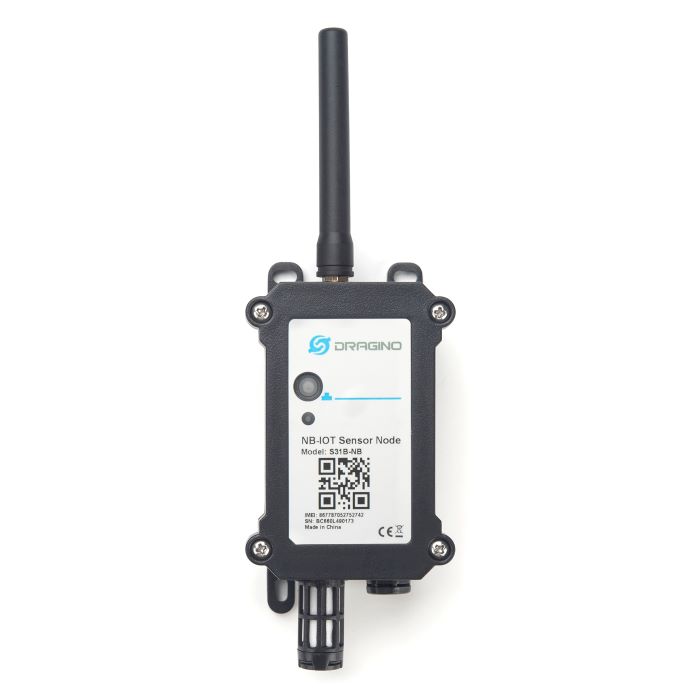
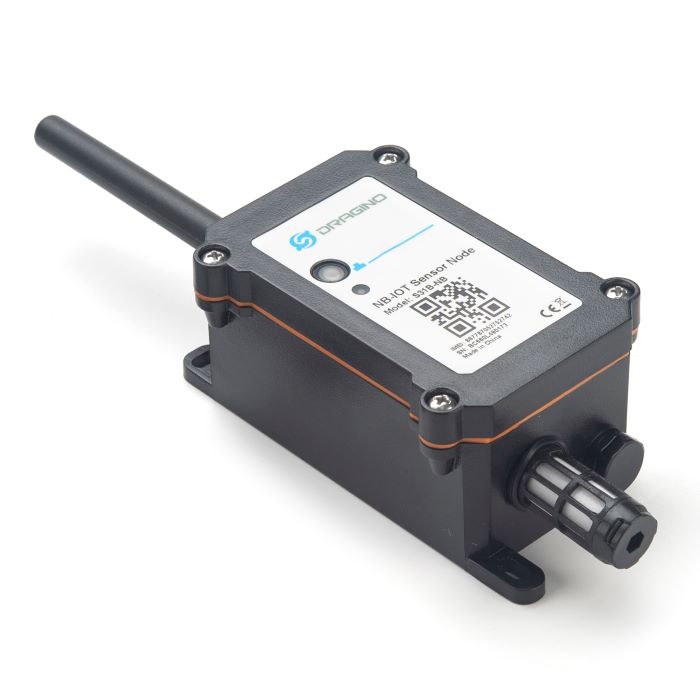


The Dragino S31B-NB measures temperature and humidity where it hangs — sensor and radio are one piece. The Sensirion SHT31 sits in a condensation-proof sleeve directly on the enclosure: no cable to route, no second mounting point. At ±0.2 °C and ±2 %RH it is markedly tighter than the usual room sensors, and the 8500 mAh cell carries it for years. The IP66 enclosure is built for outdoors, not merely tolerated there — which makes it the outdoor climate sensor you screw to a wall and forget for five years. This version transmits without a gateway over NB-IoT straight onto the cellular network — in return it needs a SIM card and a server that accepts the data.
- ±0.2 °Caccuracy, 0 … 90 °C
- ±2 %RHhumidity, whole range
- IP66enclosure
- −40 … 85 °Coperating range
- 8500 mAhLi-SOCl₂ cell
What defines the S31B-NB
- One piece instead of two mounting points: the sensor sits in a sleeve attached directly to the enclosure. No cable to route, clamp or lead through a seal — mounting is one screwed fixing and done. Across a fleet of outdoor measuring points that is the difference between twenty minutes and five per device.
- A Sensirion SHT31, not a house brand: the sensor fitted has a public datasheet and behaviour documented over years. ±0.2 °C and ±2 %RH are not marketing but the component’s specification — and they sit a class above what simple room sensors deliver.
- The drift is stated, not glossed over: the manufacturer gives less than 0.03 °C and less than 0.25 %RH deviation per year. That is the figure which decides, over five years, whether a measurement series stays comparable — and the one that is simply missing from most cheap sensors.
- Condensation-proof, not merely splash-proof: the sleeve lets humidity through but not water. That is exactly where open sensors fail outdoors: after the first condensation cycle they read permanently wrong.
- The timestamp comes from the device: every message carries a Unix time from the sensor, not just the network server’s time of receipt. If delivery is delayed the series still stays chronologically correct — the precondition for it to serve as evidence.
- An alarm flag in every message: a dedicated bit shows whether the value has left a set threshold. The evaluation therefore does not have to check thresholds itself, and an alarm is not lost if processing falls behind.
- Recording when the network drops: if coverage fails, the device writes the readings to its own memory and sends them on once the network is back. For an evidential series that is the difference between a gap and continuity.
- Device status travels along: cell voltage, device model, IMEI and serial number sit in the same message as the readings. For a fleet that means the inventory can be kept from the running data stream without querying the device — and the cell voltage doubles as the early warning before a battery change.
- A large cell, soberly reckoned: 8500 mAh of Li-SOCl₂ is three times that of a common room sensor, and because no external probe has to be powered before each reading, the budget here works out slightly better still than on the sibling device with a cable. The manufacturer quotes up to five years.
- Configuration without a network server: reporting interval and thresholds are set on the device or sent back through your own server. There is no LoRaWAN network server managing downlinks here — that responsibility sits with your platform.
- No gateway, no network server: the device transmits straight onto the cellular network and sends its data to your endpoint. No device profile, no join, no key management — but a SIM that wants managing.
- Two forms of power, one article: where no battery change is wanted, the same device comes as the S31B-LS with a solar panel and a rechargeable cell. The measuring and radio sections are identical, the integration stays the same.
Where the S31B-NB is used
- Outdoor climate on buildings: IP66 and a condensation-proof sleeve allow façade mounting; the operating range runs from −40 to 85 °C. This device’s classic application.
- Unheated halls, barns, storage sheds: one device, one screw, no wiring — and reachable over radio even where no line runs.
- Stores with humidity limits: paper, timber, electronics, animal feed. ±2 %RH is accurate enough to prove a limit and not merely assert it.
- Greenhouse and polytunnel: the sensor hangs in the crop along with the device. Condensation-proof, so still able to measure after misting.
- Building sites and temporary measuring points: mounted in minutes, removed just as fast, nothing to route.
- Plant rooms and service risers: where the measuring point and the device location coincide, the compact form saves the second fixing.
- Evidence towards third parties: thanks to the device’s own timestamp and the replay from memory the series stays continuous and chronological.
- Large rollouts: one article, one decoder, one spare — and through the S31B-LS variant the solar-powered version as well, with no new integration.
That covers the purchase decision. What follows is the depth needed for mounting, integration and operation.
Why the mounting location becomes a measured quantity here
On a device with a remote probe, the question “where do I measure” is separate from the question “where does the transmitter hang”. On the S31B the two coincide, and so the mounting location becomes part of the measurement. That is not a fault but a property to account for in planning — and one regularly overlooked in practice.
Consequence for planning: a black plastic enclosure in direct sun becomes warmer than the air it is meant to measure; depending on irradiation and wind that is several degrees. For outdoor air temperature the device therefore belongs on the north side, under a roof overhang or inside a radiation shield. The same applies in reverse to heat sources indoors: a device above a radiator or beside a switch cabinet measures the cabinet as well.
Assessment from field practice, not a manufacturer statement: the S31B shares this limitation with every compact sensor, and it is the real reason the cabled version exists at all. Anyone needing absolute outdoor air temperatures — for evidence, not for a trend — should plan for a radiation shield; anyone following trends and threshold breaches in a sheltered mounting position does not need one. Dragino makes no statement about sensitivity to radiation; on a device that hangs in arbitrary places that is hard to quantify anyway.
Payload and integration
Without LoRaWAN the whole apparatus of ports, device profiles and decoders falls away: there is no FPort, no network server and no payload function for anyone to maintain. The device opens a connection to the cellular network and delivers the same values — cell voltage, measured quantities, alarm flag, device identity — straight to your endpoint.
Consequence for the integration: what was the decoder in the network server under LoRaWAN is here the receiver on your side. That is less infrastructure but the same work — the raw format has to be interpreted once. The exact field order is in the manufacturer’s cellular manual, linked under “Documents”; it differs from the LoRaWAN version and belongs held against a real message once at commissioning.
One point regularly overlooked on cellular devices: the device identity comes from the IMEI and serial number, not from a DevEUI. Anyone running a fleet of LoRaWAN and cellular devices together needs a key field that can take both.
No gateway — what that costs and what it saves
NB-IoT uses the cellular network that is there anyway. So there is no gateway infrastructure to build, no coverage to plan and no network server to run. In return every device needs a SIM card and a server that accepts the data — the costs do not disappear, they move from the initial investment into running expenses.
The arithmetic that comes first: a single sensor somewhere remote is a clear case for cellular — a gateway for one device never pays. Thirty sensors on one site are an equally clear case for LoRaWAN. The boundary lies, depending on tariffs, somewhere between five and ten devices per site, and it shifts with the question of whether anyone is there to look after a gateway.
Assessment from field practice, not a manufacturer statement: what is regularly underestimated is not the radio technology but the SIM. Many standard data cards are not enabled for NB-IoT at all, and that only shows when the device fails to get onto the network at the site. On top comes administration: a hundred LoRaWAN devices hang on one network server, a hundred NB-IoT devices on a hundred SIM contracts with terms and invoices. That is not a technical but an organisational argument — and on larger fleets it decides more often than range does.
Connecting to your own server
The device speaks MQTT, MQTT over TLS, TCP and UDP. MQTT with TLS is the right choice for most applications: widespread, economical and encrypted. UDP is more economical still and therefore kinder to the battery, but offers no delivery guarantee — usable where individual lost messages are tolerable.
Server, port, credentials and topic are set on the device. There is no network server decoding the payload; the device sends straight to your endpoint. Decoder maintenance falls away, and responsibility for reachability and certificates rests with you.
Data at a glance
| Sensor | Sensirion SHT31 in a watertight, condensation-proof sleeve, directly on the enclosure |
| Temperature | sensor −40 … +80 °C · ±0.2 °C in the range 0 … 90 °C · resolution 0.1 °C · long-term drift < 0.03 °C/yr |
| Humidity | 0 … 99.9 %RH · ±2 %RH across the whole range · resolution 0.01 %RH · long-term drift < 0.25 %RH/yr |
| Operating temperature | −40 … 85 °C |
| Radio | NB-IoT via Quectel BC660K-GL · B1/B2/B3/B4/B5/B8/B12/B13/B17/B18/B19/B20/B25/B28/B66/B70/B85 in H-FDD |
| Protocols | MQTT · MQTT over TLS · TCP · UDP |
| SIM | GE version: without SIM · nano-SIM slot · 1T version: 1NCE SIM, 500 MB over 10 years |
| Payload | raw format straight to your own endpoint · no FPort, no network-server decoder · field order in the manufacturer’s cellular manual |
| Configuration | on the device or through your own server’s return channel · Bluetooth 5.1 on site · firmware update over the air |
| Power | 8500 mAh Li-SOCl₂, not rechargeable · quiescent current 5 µA at 3.3 V · manufacturer: up to 5 years |
| Enclosure | IP66 · 200 × 120 × 55 mm |
| Versions | S31B-LB LoRaWAN battery · S31B-LS LoRaWAN solar · S31B-NB NB-IoT · S31B-NS NB-IoT solar · S31B-CB LTE-M and NB-IoT · S31B-CS LTE-M and NB-IoT solar |
On the measuring range: the manufacturer gives −40 to +80 °C for the sensor and an operating range of −40 to 85 °C for the device. The accuracy figure of ±0.2 °C refers to 0 to 90 °C and so reaches beyond the sensor’s range — that is the SHT31 component’s specification, not the finished device’s. Outside 0 to 80 °C the tolerance is larger; how much larger, Dragino does not say. For sub-zero temperatures one should therefore not count on two tenths of a degree, but hold the setup against a reference instrument once.
On the weight: the manufacturer states 370 g on the product page — the same figure as for the sibling device with three metres of probe cable, which is implausible for a device without one. The price list gives 230 g for the shipping unit. We therefore state no device weight and will add it after the first goods receipt.
Reviews
There are no reviews yet.