
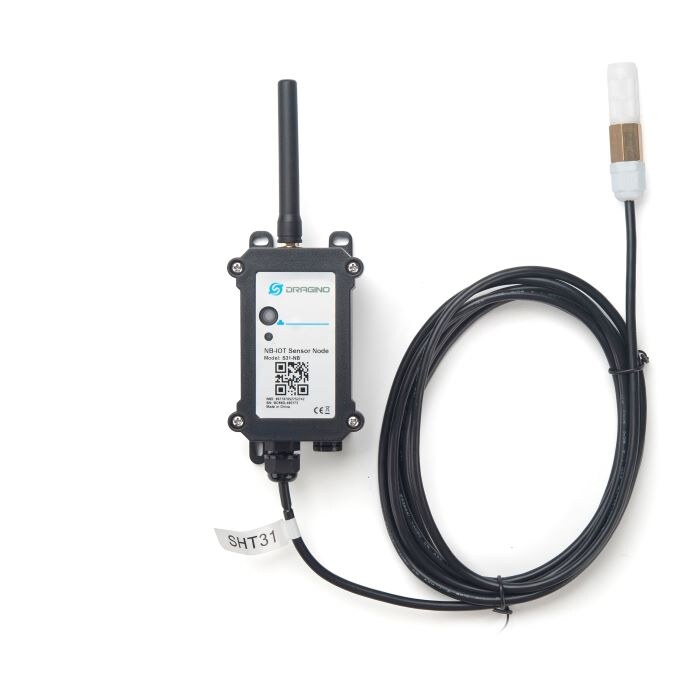
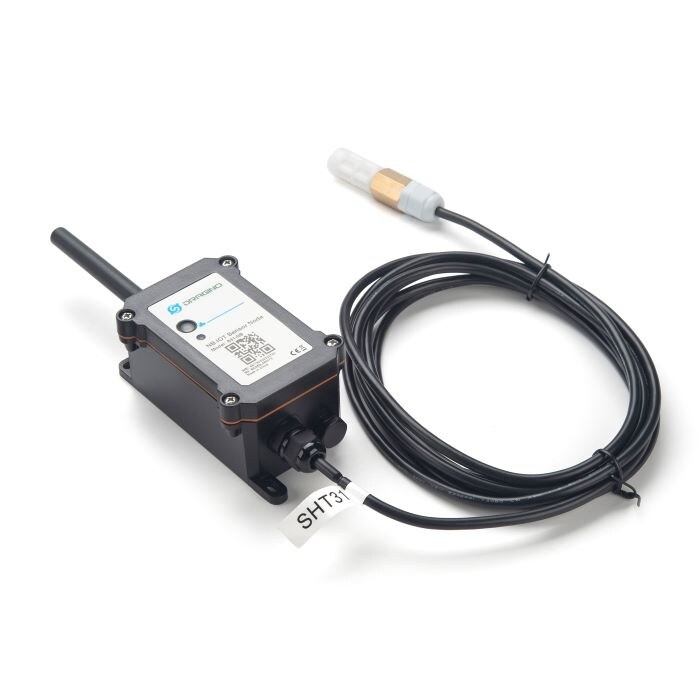


The Dragino S31-NB measures temperature and humidity with a remote probe on three metres of cable — and sends the readings without a gateway, straight over the cellular network. That is the decisive difference from the LoRaWAN family: there is no radio infrastructure to build, no coverage to plan and no network server to run. In return every device needs a SIM card and a server that accepts the data. For individual, widely scattered measuring points that is the better arithmetic; beyond a certain density it tips in favour of LoRaWAN. In measurement terms it is identical to the S31-LB: the same Sensirion SHT31, ±0.2 °C, ±2 %RH, the same IP66 enclosure.
- no gatewaystraight onto cellular
- ±0.2 °Caccuracy, 0 … 90 °C
- ±2 %RHhumidity, full range
- 17 bandsNB-IoT, H-FDD
- 8500 mAhLi-SOCl₂ cell
What defines the S31-NB
- A measuring point needs no infrastructure: where a single sensor has to stand somewhere remote, a LoRaWAN gateway costs more than the sensor — and wants running. The S31-NB uses the cellular network that is already there.
- It speaks protocols every server understands: MQTT, MQTT over TLS, TCP and UDP. It therefore connects to an existing platform without a LoRaWAN network server and a payload decoder standing in between.
- Seventeen NB-IoT bands: the BC660K-GL module covers B1 through B85 in H-FDD operation. One device thus fits practically every European network, and changing operator is a question of the SIM, not the hardware.
- Two ordering routes for the SIM: the GE version ships without a SIM — you fit your own, for instance from your Swiss operator. The 1T version includes a 1NCE SIM with 500 MB over ten years, preconfigured to the manufacturer’s server. This product is the version without a SIM.
- Measurement unchanged and good: Sensirion SHT31 in a condensation-protected sleeve, ±0.2 °C and ±2 %RH, long-term drift below 0.03 °C and 0.25 %RH per year. That is the same measuring chain as on the LoRaWAN sibling and a class above simple room sensors.
- Three metres between measuring point and device: the probe sits on the cable, the device at the accessible spot. In a cold store that means measurement inside, radio outside — just as important on cellular as on LoRaWAN, because an NB-IoT signal also gets out of a cold-store door poorly.
- A large cell for a hungrier radio method: 8500 mAh of Li-SOCl₂ with less than one per cent self-discharge per year. The cell supplies 130 mA continuously and up to 2 A briefly — the peaks a cellular module draws when establishing a connection.
- IP66 and −40 to 85 °C: the enclosure is the same as on the LoRaWAN version and built for outdoor mounting.
- No network-server administration: no device profile, no join, no key management. Instead SIM management — the effort does not vanish, it moves.
- Identical to the S31B-NB: anyone needing the transducer inside the enclosure rather than on the cable should take the S31B-NB. Electronics, radio and protocols are identical.
Where the S31-NB is used
- Single measuring points without a radio network of your own: a transformer station, a reservoir, a pumping station — wherever a gateway does not pay for one device.
- Widely scattered properties: several sites in different municipalities, each with one or two measuring points. Cellular saves an infrastructure per site.
- Construction sites and interim measurements: set up, activate the SIM, measure, dismantle. No gateway to plan in, mount and remove again.
- Cold stores and warehouses in other people’s buildings: where you may not or do not want to use the customer’s network infrastructure, your own cellular device is the simpler route.
- Evidence measurements at third parties: one device, one SIM, one endpoint — the measurement does not hang on the site’s IT and stays independently provable.
- Connection to an existing platform: anyone already processing MQTT streams integrates the sensor without a LoRaWAN layer in between.
- Greenhouses and outdoor installations: IP66 on the enclosure, protected probe, operating range down to −40 °C.
- Interim solution before a LoRaWAN rollout: measure while your own network is not yet in place — with the same measuring technology that later runs on as the LoRaWAN variant.
That covers the purchase decision. What follows is the depth needed for network planning, integration and operation.
NB-IoT or LoRaWAN — the arithmetic that comes first
Both methods solve the same task, but the costs sit in different places. LoRaWAN demands an initial investment in gateways and their operation; after that an additional device costs nothing but the device. NB-IoT demands no infrastructure but a data charge per device per year — and that runs for as long as the device runs.
Consequence for planning: the question is not “which radio method is better” but “how many measuring points lie within range of one gateway”. A single sensor at a remote reservoir is a clear NB-IoT case. Thirty sensors in one plant are an equally clear LoRaWAN case. In between the tariff decides — and the question of whether anyone is there to look after a gateway.
Assessment from field practice, not a manufacturer statement: the administrative effort of SIM cards is regularly underestimated. A hundred LoRaWAN devices are managed on one network server; a hundred NB-IoT devices mean a hundred SIM contracts with terms, notice periods and invoices. That is not a technical but an organisational argument — and on larger fleets it decides more often than the radio technology does.
Connecting to your own server
The device speaks MQTT, MQTT over TLS, TCP and UDP. For most applications MQTT with TLS is the right choice: widespread, economical in protocol overhead and encrypted. UDP is more economical still and therefore kinder to the battery, but offers no delivery guarantee — usable where individual lost messages are tolerable and battery life counts.
Server, port, credentials and topic are set on the device. Unlike LoRaWAN there is no network server decoding the payload — the device sends its data straight to your endpoint. That saves decoder maintenance and moves responsibility for availability and certificates to you.
Data at a glance
| Radio | NB-IoT via Quectel BC660K-GL · 17 bands B1/B2/B3/B4/B5/B8/B12/B13/B17/B18/B19/B20/B25/B28/B66/B70/B85 in H-FDD |
| Protocols | MQTT · MQTT over TLS · TCP · UDP |
| SIM | GE version: without SIM · 1T version: 1NCE SIM, 500 MB over 10 years, preconfigured to the manufacturer’s server |
| Transducer | Sensirion SHT31 in a waterproof, condensation-protected sleeve, 3 m cable |
| Temperature | −40 … +80 °C · ±0.2 °C across 0 … 90 °C · resolution 0.01 °C · drift < 0.03 °C/year |
| Humidity | 0 … 99.9 %RH · ±2 %RH · resolution 0.01 %RH · drift < 0.25 %RH/year |
| Operating temperature | −40 … 85 °C |
| Power | 8500 mAh Li-SOCl₂, not rechargeable · self-discharge < 1 %/year at 25 °C · 130 mA continuous, 2 A for 1 s |
| Enclosure | IP66 |
| Versions | S31-NB probe on cable · S31B-NB transducer inside the enclosure · S31-NS with solar · S31-CB for LTE-M and NB-IoT |
What the manufacturer does not state: dimensions and weight do not appear on this version’s page; the LoRaWAN version in the same enclosure measures 200 × 120 × 55 mm and weighs 370 g. Dragino does not name an antenna type either. Neither has been carried over, because figures for another model are not this device’s specification — to be added at the first goods receipt.
Reviews
There are no reviews yet.