
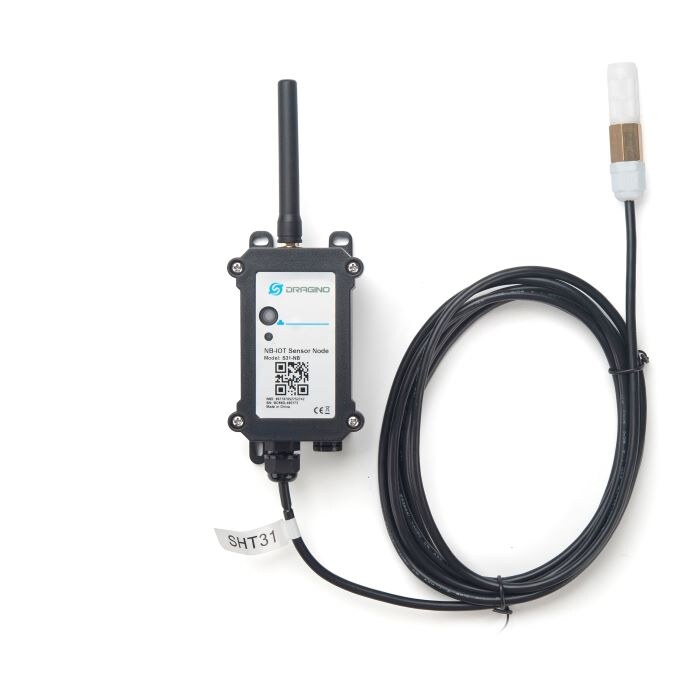
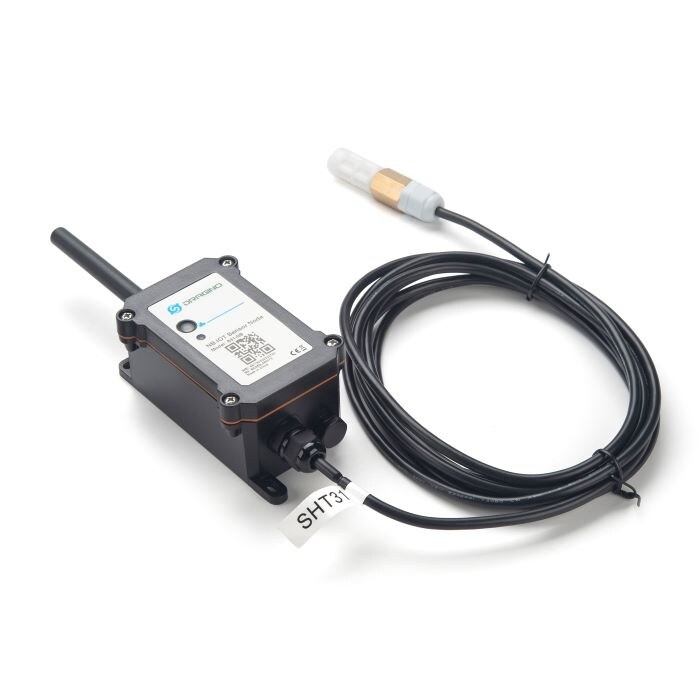


The Dragino S31-CB is the cellular version of the S31 that handles both narrowband methods: LTE-M and NB-IoT. That sounds like a detail, but it decides whether a device gets onto the network at all at somebody else’s site — because which of the two an operator offers, and how well it carries at a particular spot, is rarely known in advance. In measurement terms it is identical to the S31-LB: Sensirion SHT31 in a condensation-protected sleeve on three metres of cable, ±0.2 °C, ±2 %RH, IP66 enclosure. No gateway infrastructure is needed, but a SIM card is, and a server that accepts the data.
- LTE-M + NB-IoTboth methods
- ±0.2 °Caccuracy, 0 … 90 °C
- ±2 %RHhumidity, full range
- 5 protocolsMQTT, MQTTs, TCP, UDP, CoAP
- 8500 mAhLi-SOCl₂ cell
What defines the S31-CB
- Two radio methods in one device: LTE-M and NB-IoT are not the same thing and are not offered equally by every operator. A device that can do both does not become a bad purchase when the network changes — and over a service life of years that is a real risk, not a theoretical one.
- LTE-M where it has to be quick: LTE-M has shorter response times and tolerates a change of location during a connection. For readings that should arrive promptly, or for devices that are not stationary, that is the right branch.
- NB-IoT where it has to go deep: NB-IoT gets through concrete and metal better and draws less current at rest. For the cellar, the chamber and the long service life, that is the right branch.
- Five protocols instead of four: besides MQTT, MQTT over TLS, TCP and UDP this version also speaks CoAP — the protocol designed for exactly this class of device, which makes do with the smallest packets.
- A separate band list per method: in CAT-M1 operation the module covers B1, B2, B3, B4, B5, B8, B12, B13, B18, B19, B20, B25, B26, B27, B28, B66 and B85; in narrowband operation a list of its own with B71 instead of B70. For Europe the decisive bands B3, B8 and B20 are in both.
- Measurement unchanged: Sensirion SHT31, ±0.2 °C and ±2 %RH, resolution of 0.01 in both quantities. The same measuring chain as on the LoRaWAN and NB-IoT versions.
- Three metres between measuring point and device: probe on the cable, device at the accessible spot — in a cold store the precondition for the radio signal getting out at all.
- A cell sized for the peaks: 8500 mAh of Li-SOCl₂, 130 mA continuous, up to 2 A briefly. Cellular modules draw short, high currents when establishing a connection; a cell without that reserve collapses under them.
- Ordered without a SIM: this version carries the suffix GE and comes without a card — you fit your own. The 1T version would include a 1NCE SIM with 500 MB over ten years, preconfigured to the manufacturer’s server.
- IP66 and −40 to 85 °C: the same enclosure as on all S31 versions, built for outdoor mounting.
Where the S31-CB is used
- Sites with an unknown network situation: where nobody has measured beforehand which method carries, a device that can do both is the safe choice.
- International rollouts: which of the two methods an operator builds out differs from country to country. One device type for several countries saves managing variants.
- Measuring points with a time requirement: where a threshold has to be reported promptly, LTE-M plays out its shorter response time.
- Deep interiors and service shafts: that is where the NB-IoT branch takes over, without having to buy a different device.
- Individual, widely scattered sites: reservoir, transformer station, pumping station — one device per site, with no radio infrastructure of your own.
- Cold stores in other people’s buildings: no coordination with the site’s IT needed, the measurement stays independent.
- Connection to existing platforms: anyone already handling MQTT or CoAP integrates the sensor without an intermediate layer.
- Evidence measurements at third parties: one device, one SIM, one endpoint — provable independently of the infrastructure on site.
That covers the purchase decision. What follows is the depth needed for network planning, integration and operation.
LTE-M or NB-IoT — what the difference means in practice
Both are narrowband cellular methods for devices that need little data and long battery life. They differ, however, in three respects that matter in planning. Response time: LTE-M answers in seconds, NB-IoT can take considerably longer depending on the mode — for an alarm message that is the difference between usable and unusable. Building penetration: NB-IoT is narrower and therefore reaches deeper; it carries in a cellar shaft where LTE-M drops out. Mobility: LTE-M permits a cell change during a connection, NB-IoT does not — immaterial for stationary sensors, decisive for moving devices.
Consequence for planning: the choice is not made once for the whole fleet but per site. That is precisely why a device that can do both makes sense — the decision can then be taken at commissioning and corrected later, without swapping hardware.
Assessment from field practice, not a manufacturer statement: in Switzerland the situation is more comfortable than in many neighbouring countries, because the operators have built out both methods. The real stumbling block is therefore seldom the radio technology but the SIM: many standard data cards are not enabled for LTE-M and NB-IoT, and that only shows when the device fails to get onto the network at the site. That enablement belongs clarified before the rollout — with a test device, not with an assurance over the phone.
Connecting to your own server
The device speaks MQTT, MQTT over TLS, TCP, UDP and CoAP. MQTT with TLS is the right choice for most applications. CoAP is the most economical variant: it was designed for exactly this class of device, makes do with the smallest packets and thereby saves data volume and battery — worthwhile where the data allowance is tight, as on the widespread ten-year tariffs of a few hundred megabytes.
Server, port, credentials and topic are set on the device. There is no network server decoding the payload — the device sends straight to your endpoint. Decoder maintenance falls away, and responsibility for reachability and certificates rests with you.
Data at a glance
| Radio | Quectel BC660K-GL · LTE-M (CAT-M1) and NB-IoT |
| CAT-M1 bands | B1, B2, B3, B4, B5, B8, B12, B13, B18, B19, B20, B25, B26, B27, B28, B66, B85 |
| Narrowband bands | B1, B2, B3, B4, B5, B8, B12, B13, B18, B19, B20, B25, B28, B66, B71, B85 |
| Protocols | MQTT · MQTT over TLS · TCP · UDP · CoAP |
| SIM | GE version: without SIM · 1T version: 1NCE SIM, 500 MB over 10 years |
| Transducer | Sensirion SHT31 in a waterproof, condensation-protected sleeve, 3 m cable |
| Temperature | −40 … +80 °C · ±0.2 °C across 0 … 90 °C · resolution 0.01 °C |
| Humidity | 0 … 99.9 %RH · ±2 %RH · resolution 0.01 %RH |
| Operating temperature | −40 … 85 °C |
| Power | 8500 mAh Li-SOCl₂, not rechargeable · 130 mA continuous, 2 A for 1 s |
| Enclosure | IP66 |
| Versions | S31-CB probe on cable · S31B-CB transducer inside the enclosure · S31-CS with solar · S31-NB NB-IoT only · S31-LB as LoRaWAN |
What the manufacturer does not state: dimensions, weight and antenna type do not appear on this version’s page. The enclosure is the same as on the LoRaWAN version, which is quoted at 200 × 120 × 55 mm and 370 g — we have not carried that over, because figures for another model are not this device’s specification. To be added at the first goods receipt.
About the images: Dragino uses the same product photographs for the NB-IoT and the LTE-M version — the views shown here come from the manufacturer’s site and are filed for both versions. Enclosure, probe and connectors are identical; the difference lies in the firmware and the radio module’s band support, and it cannot be seen on the device.
Reviews
There are no reviews yet.