
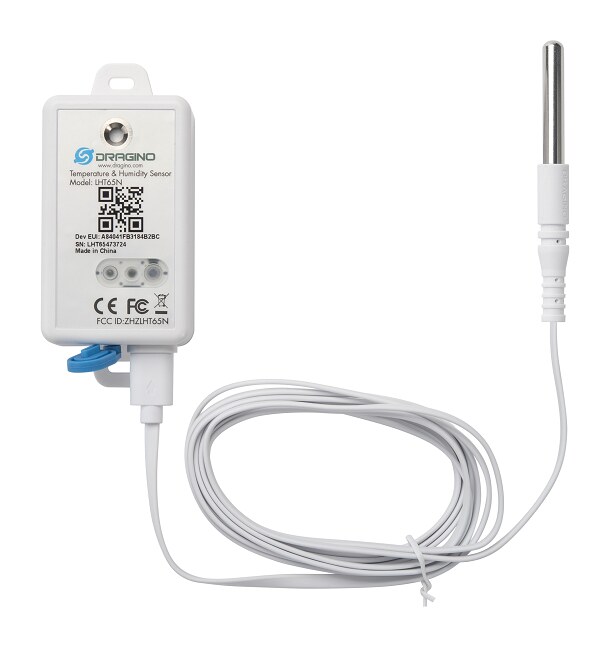
The Dragino LHT65N hangs on more walls in Europe than any other LoRaWAN room sensor, and for a sober reason: it measures temperature and humidity accurately enough for building automation and compliance records, runs up to ten years on its built-in cell, and costs less than an hour of installation work. What sets it apart from the many similar devices is the socket on its underside. Plug in an external probe and the room sensor becomes a flow-temperature sensor, a cold-store sensor or a counting input — same device, same integration, same spare-parts logistics. Anyone building a fleet therefore often buys this one model and fits it differently at each site.
- ±0.3 °Caccuracy, typical
- ±3 %RHhumidity, typical
- 2400 mAhbuilt-in cell
- up to 10 yearsbattery life
- 11 bytespayload per message
What defines the LHT65N
- One device, many measuring jobs: through the probe socket the sensor detects what is connected and writes the identifier into every message. So you do not stock six part numbers but one — and decide at the installation site whether it becomes a room sensor, an immersion probe or a pulse counter.
- The transducer barely drifts: the manufacturer specifies less than 0.02 °C deviation per year for temperature and less than 0.25 %RH for humidity. Over five years the added error therefore stays below a tenth of a degree — the right order of magnitude for a device whose life is counted in years anyway.
- Resolution far below the accuracy: readings are reported in 0.01 °C steps while ±0.3 °C is guaranteed. That sounds contradictory but is exactly right: for absolute statements the tolerance applies, for changes at the same device the resolution does. A 0.05 °C drift over one night is therefore detectable even though the absolute value may be three tenths off.
- A payload that fits any integration: eleven bytes on FPort 2, fixed field order, battery state in the top two bits of the first field. No padding, no variant logic — the decoder is twenty lines long and does not break when a different probe is plugged in.
- Battery state as a state, not as a voltage: the device reports both — the voltage in millivolts and a two-level assessment. In practice the latter is the more useful one: a Li-SOCl₂ cell holds its voltage almost constant until shortly before the end, so millivolts alone are a poor guide to what is left.
- Twenty minutes as the default: out of the box the sensor reports three times an hour. For room climate that is the right choice — air changes slowly and every message costs battery. For faster processes the interval can be shortened by radio command; the ten-year figure then no longer applies.
- Configuration over the air: reporting interval, probe type and thresholds are set by downlink from the network server. A device already stuck to the ceiling does not have to come down to be changed.
- Joins via OTAA, as it should: the sensor announces itself to the network server with DevEUI, AppEUI and AppKey. The keys ship with the device; for a rollout they can be requested from the manufacturer as a list and imported in advance.
- Spring antenna inside the housing: no stub antenna to snap off, no connector to corrode. The manufacturer explicitly names indoor spaces with stable coverage as the application area — that is a limitation, and it appears in the selection guidance below.
- Large quantities without per-unit work: adhesive pad or two screws, press the button, done. The effort per site is in the minutes range, and across a hundred rooms that is the difference between two days and two weeks.
Where the LHT65N is used
- Room climate in offices, schools and public administration: the classic application — temperature and humidity per room, as the basis for heating curves, ventilation control and complaint handling.
- Record-keeping duties in warehouses and archives: paper, timber, electronics and foodstuffs all have humidity limits. An unbroken series per storage location is the proof that they were observed.
- Cold stores and chilled cabinets with an external probe: the device sits outside, the probe inside. The radio path therefore does not run through the metal door — the mistake that usually defeats cold-store monitoring.
- Flow and return in building services: with the clamp-on probe on the pipe, the room sensor becomes a heating measurement point without pulling a cable into the plant room.
- Server rooms and technical cabinets: close monitoring at several points, because temperature varies by several degrees over the height of a cabinet.
- Greenhouses and indoor growing: humidity is the governing variable there for fungal pressure and irrigation, and it calls for measuring points spread across the area rather than one central one.
- Pulse counting through the probe socket: with the counting cable the same device records meter pulses or contacts — useful where a water or electricity meter offers nothing but a reed contact.
- Large rollouts: one part number, one spare, one decoder, interchangeable across all sites. That is the commercial reason why this model is so widespread.
That covers the purchase decision. What follows is the depth needed for radio planning, integration and operation.
What the probe socket really does — and what it costs
The socket on the underside is why this device is a platform rather than a single product. It accepts a cabled temperature probe (range −55 to 125 °C, resolution 0.0625 °C, tolerance ±0.5 °C between −10 and +85 °C and ±2 °C at the extremes), a second temperature and humidity probe, an analogue input for 0.1 to 1.1 V, or a counting and interrupt input. The connected type is carried in the payload’s “Ext #” field, so the integration does not need configuring — it recognises what is being reported.
The price for this is battery. An external probe is powered before every measurement, and the analogue input adds the reference voltage on top. The manufacturer’s ten-year figure applies to the built-in transducer at a twenty-minute interval. With an external probe and a shortened interval you end up well below that depending on the setup — not a weakness of the device but physics, and it belongs in the planning of replacement cycles.
Assessment from field practice, not a manufacturer statement: the “device outside, probe inside” arrangement is the decisive advantage for cold stores and is regularly underestimated. A cold-store door is a Faraday cage; a sensor inside often reaches the gateway only when the door opens, and the measurement series develops gaps precisely when nobody is looking. With the cable run through the door seal or an existing gland the radio path stays outside — and the series stays complete.
Radio operation and network server
The sensor works to LoRaWAN 1.0.3 in Class A and joins via OTAA. Class A means the device sleeps, transmits, opens two short receive windows and goes back to sleep. Downlinks — that is, configuration commands — therefore do not take effect immediately but with the next message. At a twenty-minute interval a change can take twenty minutes in the worst case; anyone reconfiguring a fleet plans it as a queue on the network server rather than as an interactive session.
The device is not tied to any platform and runs on every LoRaWAN network server. For The Things Stack and ChirpStack a ready-made device profile is held in the LoRa Alliance Device Repository; on the Swisscom LPN it is onboarded through the same profile. The payload decoder is the same JavaScript module in all three systems.
Measuring ranges and tolerances
| Built-in temperature | resolution 0.01 °C · typical ±0.3 °C · drift < 0.02 °C/year |
| Built-in humidity | 0 … 96 %RH · resolution 0.04 %RH · typical ±3 %RH · drift < 0.25 %RH/year |
| External temperature probe | −55 … 125 °C · resolution 0.0625 °C · ±0.5 °C from −10 to +85 °C, ±2 °C beyond |
| External analogue input | 0.1 … 1.1 V |
| Radio | LoRaWAN 1.0.3, Class A, OTAA · EU868 (other bands under a separate order code) |
| Payload | 11 bytes on FPort 2 · battery (2) · temperature (2) · humidity (2) · probe identifier (1) · probe value (4) |
| Power | built-in Li-SOCl₂ cell 2400 mAh, not rechargeable · up to 10 years at a twenty-minute interval |
| Device | 95 × 40 × 28 mm · 105 g · spring antenna inside the housing |
One contradiction in the sources that has to be named: for the measuring range of the built-in temperature the manufacturer’s product page states −40 to 80 °C, while the same manufacturer’s wiki states −40 to 85 °C. In practice this is immaterial because the sensor is operated as an indoor device. We have therefore not carried either figure into the attributes as the device’s operating temperature — a measuring range is not the same as the permissible operating range, and we do not guess here.
What matters during rollout
Request the join keys in advance. For more than a handful of devices the manufacturer’s key list pays for itself: it is imported on the network server and the devices announce themselves when switched on. Without the list someone types DevEUI and AppKey device by device — for fifty sensors that is half a day and a source of errors.
Choose the mounting position by reception, not by symmetry. The spring antenna is undemanding but not insensitive: metal cabinets, concrete cores and lift shafts all cost signal level. One test device at the least favourable planned position and an hour watching the data rate on the network server beats any calculation.
Fix a measuring height and keep to it. Room temperature depends on height; readings at 1.1 m and at 2.4 m are not comparable. For series spanning several rooms the uniform height matters more than the absolute accuracy of the individual device.
Reviews
There are no reviews yet.