
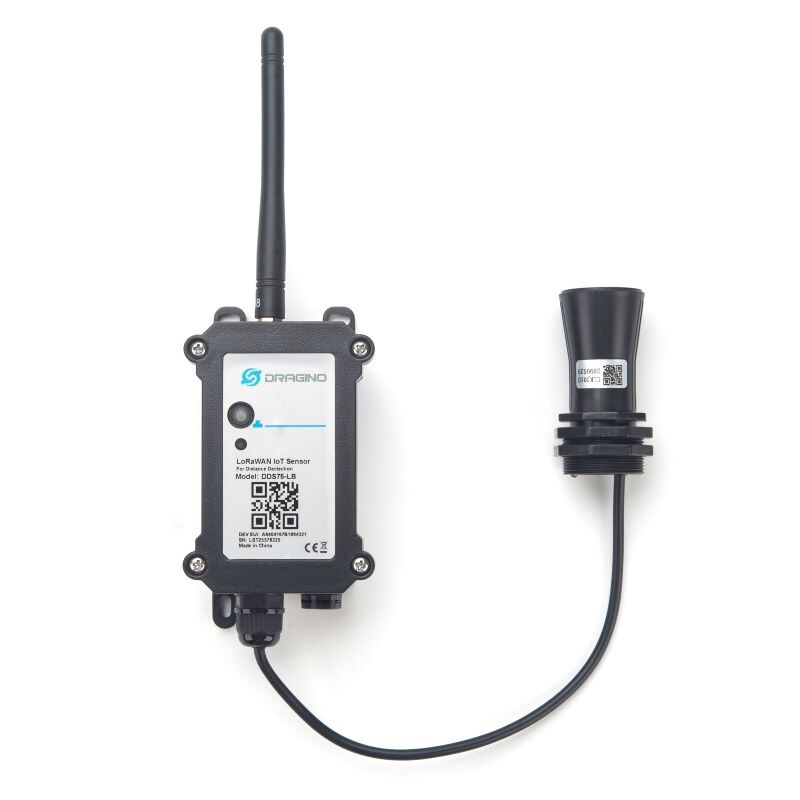
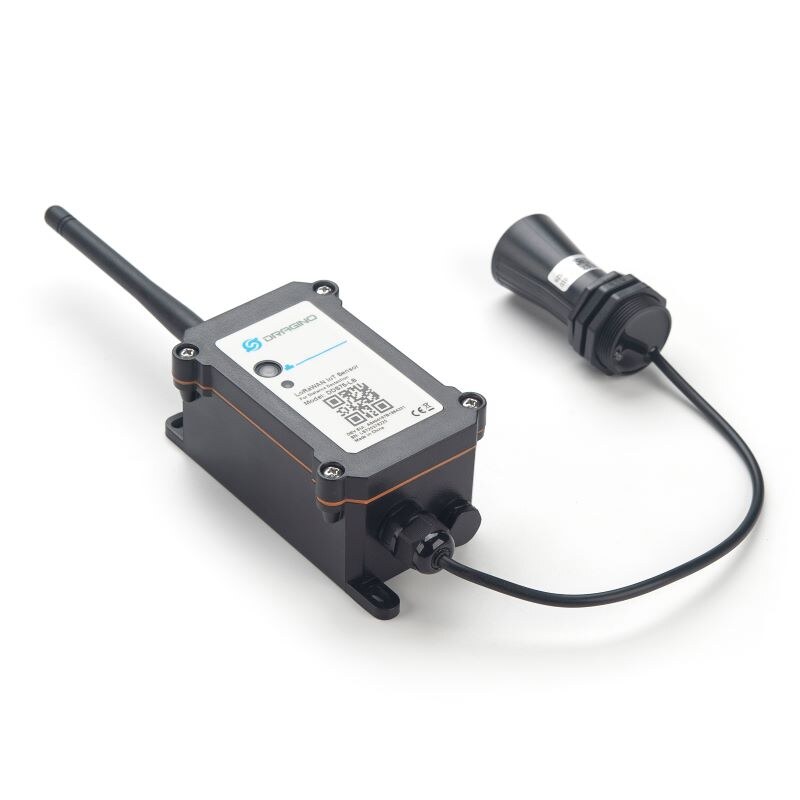

The Dragino DDS75-LB measures distance and level without contact using ultrasound — from 280 millimetres to 7.5 metres, with temperature compensation and without touching the medium at all. That is precisely its argument: it works above sewage, sludge, bulk solids and aggressive liquids where an immersed probe corrodes or fouls. The measuring head sits on 25 centimetres of cable and screws into the cover or the shaft pipe, while the electronics stay beside it in the IP66 enclosure. What you need to know before buying is the 40-degree beam angle — it decides whether the measurement works in the shaft or fails on the wall.
- 0.28 … 7.5 mmeasuring range
- ±1 cm + 0.3 %accuracy
- 40°beam angle
- IP66enclosure
- 8500 mAhLi-SOCl₂ cell
What defines the DDS75-LB
- No contact with the medium: the sound travels through air. Nothing sits in the liquid, fouls, corrodes or has to be cleaned — the reason ultrasound is the first choice in sewage, slurry and grit traps.
- Temperature compensation built in: the speed of sound in air depends on temperature, and noticeably so: roughly five per cent between 0 and 30 °C. Without compensation a level reading would not be the same in summer and winter. The device takes it out.
- Accuracy that grows with distance: ±1 cm plus 0.3 per cent of the measured distance. At one metre that is about 1.3 cm, at seven metres about 3.1 cm. This form of statement is more honest than a fixed number of centimetres, because it reflects how the method behaves.
- Remote measuring head: 25 centimetres of cable between electronics and transducer. The head screws in, the enclosure stays accessible — nobody has to climb into the shaft to change the battery.
- IP66 and −40 to 85 °C: the device is built for outdoor mounting and unheated shafts, not merely permitted for them.
- A large cell for a long service life: 8500 mAh of Li-SOCl₂, quoted by the manufacturer at up to five years. At a measuring point that requires lifting a manhole cover, that is the real cost factor.
- Configuration over the air: reporting interval and thresholds arrive by downlink from the network server. An installed device stays installed.
- Not tied to a platform: LoRaWAN 1.0.3, Class A, OTAA. Runs on TTN, ChirpStack and Swisscom LPN with the same profile.
- The same form in four power versions: battery, solar, NB-IoT and LTE-M — measuring section and mounting stay identical, the decision follows the site and the infrastructure.
- Explicitly named for sewage by the manufacturer: sewer, grit trap and bottom water level appear in its own application list. For a device in this price class that is not a given.
Where the DDS75-LB is used
- Level in cisterns and rainwater tanks: the classic application — non-contact, low-maintenance, and the reading is directly the distance to the surface.
- Sewage, sewers and grit traps: media in which every immersed sensor becomes a maintenance item.
- Retention basins and flood monitoring: level over time, even with foam and floating debris on the surface — with the limitations set out below in the technical section.
- Bulk solids in silos and hoppers: wood chips, pellets, granulate. Cone formation has to be allowed for, because the sensor sees the highest point of the cone.
- Waste containers and collection points: named by the manufacturer itself — fill level as the basis for emptying on demand rather than on fixed rounds.
- Parking and occupancy: distance measurement as presence detection above a bay.
- Slurry and manure pits: aggressive atmosphere, no contact with the medium, mounting in the cover.
- Large rollouts: one device type for water, sludge and bulk solids, one mounting method, one decoder — the difference between a range and a single part number.
That covers the purchase decision. What follows is the depth needed for mounting, radio planning and operation.
Planning the measuring cone properly
Ultrasound spreads as a cone, not as a beam. The 40 degrees of beam angle give the diameter of the insonified area directly: it is about 0.73 times the distance. That is the figure to plan the installation with — not the measuring range.
| 1 m distance | about 0.73 m cone diameter |
| 2 m distance | about 1.5 m |
| 3 m distance | about 2.2 m |
| 5 m distance | about 3.6 m |
| 7.5 m distance | about 5.5 m |
Consequence for mounting: in a standard shaft one metre across, the cone is wider than the shaft from about 1.4 metres depth. Mounted centrally the measurement still remains usable, because the strongest echo comes from the cone axis — but every ladder, every pipe mouth and every ledge on the wall produces a spurious echo. The rule of thumb: central, plumb, and everything with an edge kept out of the cone.
Assessment from field practice, not a manufacturer statement: the commonest mounting error on ultrasonic level measurements is not a tilted installation but proximity to the wall. A sensor sitting ten centimetres from the shaft edge delivers plausible values for months and then jumps to a fixed value as the level falls — that is the moment it receives the wall echo more strongly than the water echo. Anyone who watches the measuring point over one complete fill-and-empty cycle spots it immediately; anyone checking only snapshots never finds it.
What the accuracy figure means in practice
±(1 cm + 0.3 % of the measured distance) is a composite figure: a fixed part from the time measurement and a proportional part from the uncertainty in the speed of sound. In practice the absolute deviation grows with distance while the relative one shrinks — at 30 cm, 1.1 cm is almost four per cent; at 7 m, 3.1 cm is less than half a per cent.
For a volume calculation the geometry of the vessel therefore matters more than the last centimetre: in a flat, wide cistern one centimetre of level deviation amounts to many litres; in a slender shaft, to few. Anyone wanting to report volume in litres should calibrate the conversion against two known levels rather than relying on the vessel’s nominal dimensions.
Data at a glance
| Method | ultrasound with temperature compensation, non-contact |
| Measuring range | 280 … 7500 mm (manufacturer’s figure for flat objects) |
| Accuracy | ±(1 cm + distance × 0.3 %) |
| Beam angle | 40° |
| Measuring head | remote on 25 cm of cable, screw-in |
| Radio | LoRaWAN 1.0.3, Class A, OTAA · EU868 |
| Power | 8500 mAh Li-SOCl₂, not rechargeable · manufacturer: up to 5 years |
| Enclosure | IP66 · operating temperature −40 … 85 °C |
| Shipping unit | 150 × 120 × 55 mm, 220 g |
| Versions | DDS75-LB battery · DDS75-LS solar · DDS75-NB NB-IoT · DDS75-CB LTE-M and NB-IoT |
What the manufacturer does not state: the dead zone is not named explicitly; in practice it follows from the lower range limit of 280 mm. Resolution, enclosure dimensions without packaging and a mounting method do not appear on the product page either. To be added at the first goods receipt.
Reviews
There are no reviews yet.