
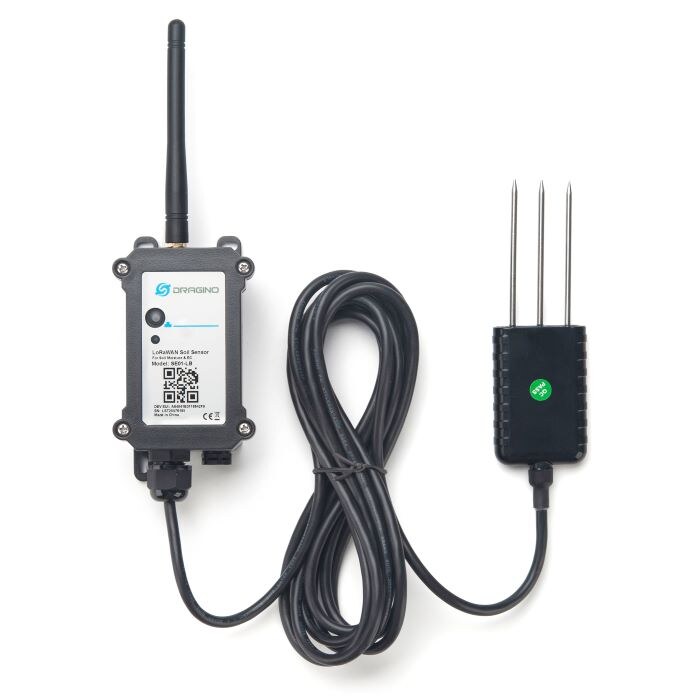
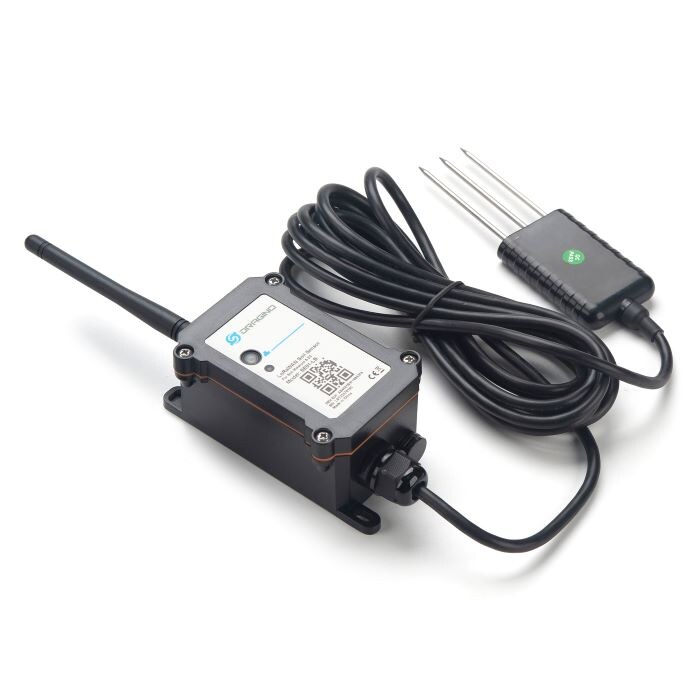

The Dragino SE01-LB measures three quantities in the soil at once: water content, temperature and electrical conductivity. The third is the reason to choose this device over a plain moisture probe — it shows the salt and nutrient content of the soil solution and therefore whether a plant can take up the water that is there. High water content together with high conductivity means drought stress despite damp earth, and a moisture probe alone does not show that. The probe is buried, the IP66 enclosure stays above ground, and the 8500 mAh cell carries the device for years.
- 3 quantitiesmoisture, temperature, conductivity
- ±3 %water content up to 53 % V/V
- 0 … 20,000 µS/cmconductivity
- ±0.3 °Csoil temperature, −10 … 50 °C
- IP66enclosure
What defines the SE01-LB
- Conductivity is what makes the moisture reading meaningful: water alone does not say whether the plant can take it up. When conductivity rises — through fertilising, salt ingress or evaporation — water is drawn osmotically away from the root zone. Only both values together show the real state.
- The moisture measurement is temperature- and conductivity-compensated: the FDR method responds to both disturbances. Dragino takes them out, and that is exactly what distinguishes a soil sensor from a cheap resistive probe whose reading wanders with salinity.
- Temperature via an RTD element: better than 0.3 °C between −10 and 50 °C, which is precisely where soil biology and germination happen. Beyond that it stays under 0.6 °C.
- Resolution far below the tolerance: 0.01 V/V % for water content, 0.01 °C for temperature, 1 µS/cm for conductivity. For absolute statements the tolerance applies — for changes at the same site the resolution does, and that is the more relevant figure for irrigation control.
- The conductivity range reaches into saline soil: 20,000 µS/cm also covers substrate culture and salt-affected sites, where horticultural probes have long since run out of scale.
- Device above, probe below: the electronics stay accessible, only the probe goes into the ground. A battery change therefore means no digging.
- IP66 and −40 to 85 °C: built for year-round outdoor service, not merely permitted for it.
- A large cell, soberly calculated: 8500 mAh of Li-SOCl₂, quoted by the manufacturer at up to five years — for three quantities that each cost current per reading, a more honest figure than the ten-year promises of simple probes.
- Not tied to a platform: LoRaWAN 1.0.3, Class A, OTAA. Runs on TTN, ChirpStack and Swisscom LPN with the same profile.
- Configuration over the air: reporting interval and thresholds arrive by downlink from the network server. A buried sensor stays where it is.
Where the SE01-LB is used
- Irrigation control in field crops: watering follows the water content of the root zone rather than the calendar — the application that pays for itself fastest.
- Greenhouse and substrate culture: here conductivity is the governing variable: it shows the substrate salting up long before the plant shows symptoms.
- Orchards and viticulture: controlled drought stress is a quality tool — it can only be managed if the water content of the rooting horizon is known.
- Sports turf and golf courses: even moisture across the area, with conductivity as an indication of fertiliser movement.
- Urban trees: street trees suffer from de-icing salt; conductivity in the root zone makes that measurable rather than suspected.
- Slope monitoring and soil mechanics: water content as an input for assessing the risk of slippage.
- Trials and evidence keeping: three quantities with a time series at a defined depth, traceable over years.
- Large rollouts: one device type, one mounting method, one decoder — and through the solar, NB-IoT and LTE-M versions also for sites without radio infrastructure of their own.
That covers the purchase decision. What follows is the depth needed for installation, analysis and operation.
What FDR measures — and what follows from it
The method is called Frequency Domain Reflectometry. What is measured is not water but the dielectric constant of the soil. Water has about 80 of it, air 1, mineral soil constituents between 3 and 7 — water content therefore dominates the signal to such a degree that it can be inferred reliably. That is the method’s strength and at the same time the reason for its quirks.
First, the relationship depends on the soil type. The same dielectric constant means a different water content in peat than in sand, because the solid matrix differs. Hence the factory calibration to one soil type and the formula for deviating soils. Second, salt interferes. Dissolved ions raise the apparent permittivity; without compensation a fertilised soil would appear wetter than it is. That is exactly why this device measures conductivity anyway and takes it out. Third, the probe only measures its immediate surroundings — a few centimetres around the rods. A cavity beside it therefore weighs heavily.
Assessment from field practice, not a manufacturer statement: the commonest installation error is drilling too large a hole and backfilling it loosely. The probe then sits in loosened soil that holds water differently from the undisturbed ground right next to it — the series is consistent with itself, but it describes the hole and not the field. Better is a slit into which the probe’s three tines are pressed, followed by firm hand compaction of the soil. The probe sits at the end of a cable several metres long, so the device can be mounted well away from it — Dragino does not state the exact cable length, however. Anyone comparing across several sites should also record the installation depth; ten centimetres of difference shifts the curve more than any device tolerance.
Reading conductivity correctly
What is measured is the conductivity of the soil as a whole — solids, water and air together. That is not the same as the conductivity of the soil solution, which is what matters agronomically, and the two are linked through water content: the same salinity in the water gives a lower overall figure in dry soil, because there is less conducting liquid.
Consequence for analysis: conductivity rising while water content falls is the normal case during drying out and not an alarm. It becomes interesting when conductivity rises while water content stays level or increases — then salt is being added, from fertiliser, de-icing salt or saline irrigation water. The rule is therefore never to look at the two curves separately, but overlaid.
Data at a glance
| Water content | 0 … 100.00 V/V % · resolution 0.01 · ±3 % up to 53 %, ±5 % above · FDR with temperature and conductivity compensation |
| Soil temperature | −40.00 … 85.00 °C · resolution 0.01 °C · better than 0.3 °C from −10 to 50 °C, otherwise better than 0.6 °C · RTD |
| Conductivity | 0 … 20,000 µS/cm at 25 °C · resolution 1 µS/cm · 2 % of full scale · temperature compensated |
| Radio | LoRaWAN 1.0.3, Class A, OTAA · EU868 |
| Power | 8500 mAh Li-SOCl₂, not rechargeable · manufacturer: up to 5 years |
| Enclosure | IP66 · 195 × 125 × 55 mm · 420 g · operating temperature −40 … 85 °C |
| Versions | SE01-LB battery · SE01-LS solar · SE01-NB NB-IoT · SE01-CB LTE-M and NB-IoT |
What the manufacturer does not state: probe material, probe length and cable length do not appear on the product page. For planning the installation those are exactly the figures needed — to be added at the first goods receipt or asked of the manufacturer.
About the predecessor: we have carried the Dragino LSE01 since 2026, which measures the same three quantities. It no longer appears in Dragino’s current reseller price list; the SE01 is its successor and measures moisture and conductivity more tightly. Existing LSE01 installations are unaffected — the payload is not the same, so swapping one in the field requires a change in the decoder.
Reviews
There are no reviews yet.